In transformer manufacturing, the choice of winding material and cross-sectional shape directly affects the electrical performance, mechanical strength, and manufacturing cost of the transformer. Copper strip windings (foil windings) and round wire windings each have their own distinct advantages, disadvantages, and suitable applications.
The following is a core comparison of the two:
1. Structure and Short-Circuit Withstand Capability (Core Difference)
-
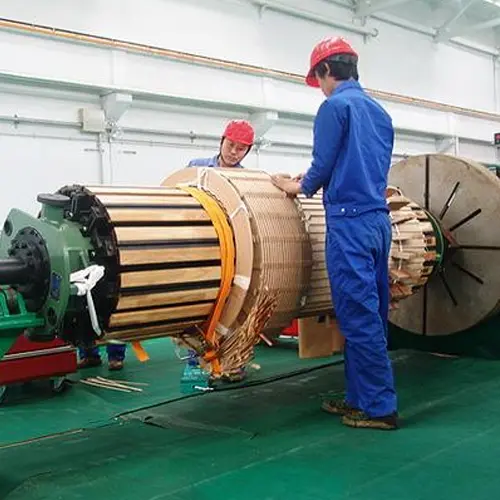
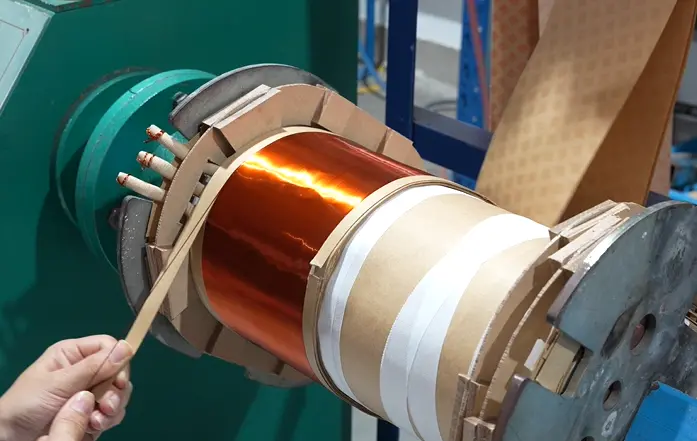
Copper Strip Winding: Uses full-width copper foil or strip wound layer by layer like a roll of paper (typically one turn per layer). This structure eliminates the axial spiral angle. During an external short circuit, virtually no axial electromagnetic force is generated, resulting in uniform stress distribution on the winding and exceptionally high short-circuit mechanical strength.
-
Round Wire Winding: The wire is wound in a spiral configuration. During a short circuit, significant radial and axial electromagnetic forces are generated, which can easily cause inter-turn sliding, insulation damage, or winding deformation. The short-circuit withstand capability is relatively weaker and relies on insulation blocking and curing processes to enhance strength.
2. Space Utilization (Fill Factor)
-
Copper Strip Winding: The strip structure fits completely with no gaps between layers, offering an extremely high fill factor. This allows for a more compact transformer volume for the same cross-sectional area.
-
Round Wire Winding: The circular cross-section inevitably creates geometric gaps when stacked, resulting in a lower fill factor. To achieve the same conductive cross-sectional area, a larger apparent space is typically required.
3. Electrical Performance and Losses
-
Copper Strip Winding:
-
Advantage (Impulse Withstand): The large inter-layer capacitance ensures a very uniform initial voltage distribution when subjected to transient overvoltages such as lightning impulses, providing strong impulse voltage withstand capability.
-
Disadvantage (Eddy Current): Due to the wide copper strip, the upper and lower ends of the winding are susceptible to leakage magnetic flux (transverse flux), which generates localized eddy current losses at the ends (end effect).
-
Round Wire Winding:
-
Advantage (Loss Control): The additional eddy current losses caused by leakage flux within the smaller cross-section of the round wire are relatively low.
-
Disadvantage (Capacitance): The inter-turn and inter-layer capacitance is small, resulting in uneven impulse voltage distribution at the beginning of the winding, which can easily produce extremely high inter-turn voltage stress. When high current capacity is required, a single round wire becomes too thick and suffers from skin effect, typically necessitating the use of multiple parallel fine strands.
4. Heat Dissipation and Temperature Rise
-
Copper Strip Winding: Excellent axial thermal conductivity allows heat to be conducted along the copper strip to the winding ends for dissipation. However, in the radial direction (thickness), the layers of insulation paper or resin create significant thermal resistance, hindering internal heat transfer outward.
-
Round Wire Winding: The gaps between wires naturally form fine cooling channels, allowing insulating oil or air to penetrate more easily into the winding interior, making radial convective heat dissipation relatively more efficient.
5. Manufacturing Process
-
Copper Strip Winding: Requires specialized foil winding machines with a high degree of automation and extremely fast production efficiency, but the initial equipment investment is substantial.
-
Round Wire Winding: Offers flexible winding processes and can be completed with standard winding machines or even manually, with low equipment costs. However, when handling high currents that require "multiple parallel strands," process issues such as wire crossing, difficult transposition, and high labor intensity often arise.
Summary of Applicable Scenarios
Engineering Conclusion
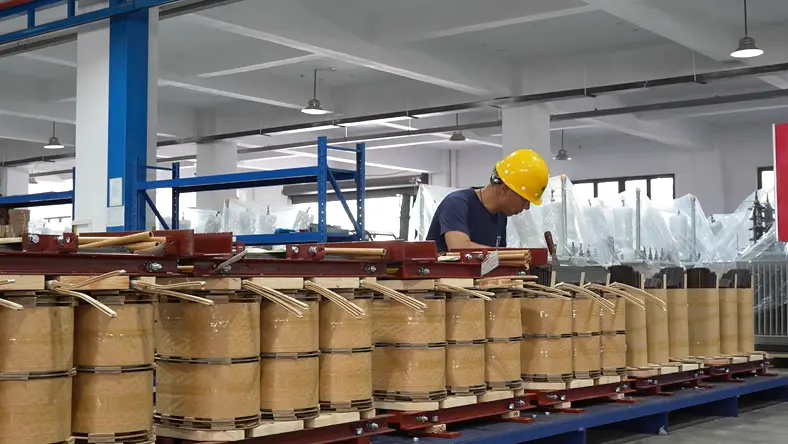
The most classic structural combination for modern small and medium-sized distribution transformers, particularly dry-type transformers, is: copper strip (foil structure) for the low-voltage winding to handle high currents and significantly enhance overall short-circuit withstand capability, and round wire (or rectangular wire) for the high-voltage winding to meet the high number of turns required at elevated voltages. This combination achieves the optimal balance between electrical performance and manufacturing cost.
Rockwill strictly adheres to this classic structural combination of low-voltage copper foil winding and high-voltage round wire winding. Building upon this foundation, we employ precision CNC winding processes and vacuum pressure impregnation (VPI) curing technology to ensure that winding tightness, mechanical strength, and short-circuit withstand capability significantly exceed industry standards, guaranteeing long-term stable operation of transformers in harsh environments.
Edited From:Echo

 Login
Login