Must-Read Technical Insights for Distribution Network O&M and Electrical Engineers!
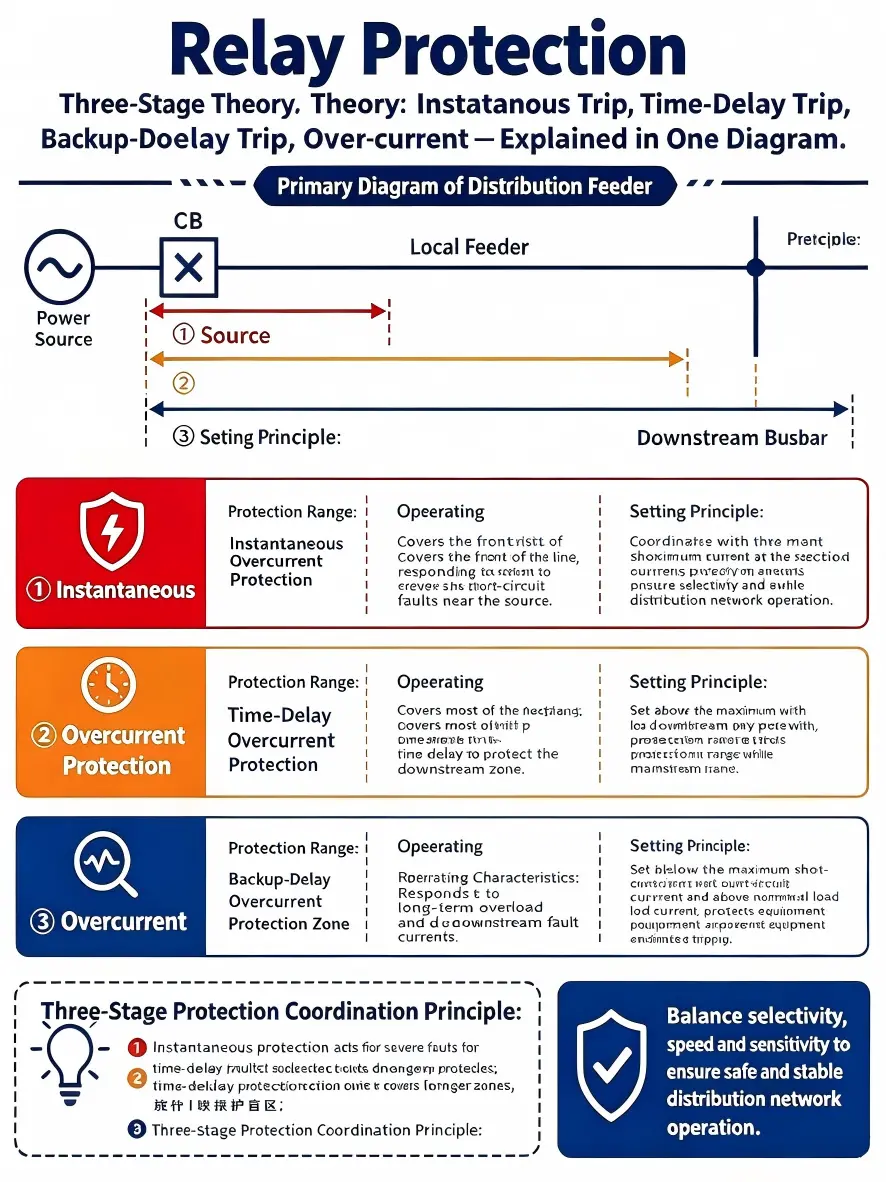
① Instantaneous Overcurrent Protection (Stage I)
Protection Zone: Partial section at the beginning of the protected line.
Characteristics: Instantaneous tripping upon fault detection; no intentional time delay.
Setting Criteria: Must exceed the maximum short-circuit current at the remote end of the line.
② Time-Delayed Instantaneous Overcurrent Protection (Stage II)
Protection Zone: Full length of the protected line, extending slightly into the adjacent downstream line.
Characteristics: Incorporates a short time delay to cover the blind spot of Stage I protection.
Setting Criteria: Must exceed the short-circuit current at the remote end of the downstream instantaneous protection zone; time delay coordinated with downstream protection.
③ Definite-Time Overcurrent Protection (Stage III)
Protection Zone: Full length of the protected line + full length of downstream lines; serves as backup protection.
Characteristics: Long time delay; acts as the final line of defense for the entire protection scheme.
Setting Criteria: Must exceed the maximum load current of the line; time-graded coordination with downstream protections.
Coordination Logic of Three-Stage Protection
Instantaneous (Stage I) Rapid clearance of severe faults near the source.
Time-Delayed Instantaneous (Stage II) Full line coverage, eliminating protection blind spots.
Definite-Time Overcurrent (Stage III) Backup safeguard, balancing sensitivity and selectivity.
The combination of these three stages balances selectivity, speed, and sensitivity, ensuring the stable operation of the distribution network.

 Login
Login