Synchronous reactance (Xₛ) is an imaginary reactance used to represent voltage effects in the armature circuit, arising from both the actual armature leakage reactance and air gap flux variations due to armature reaction. Similarly, synchronous impedance (Zₛ) is a fictitious impedance that accounts for voltage effects from the armature resistance, leakage reactance, and air gap flux changes caused by armature reaction.
The actual generated voltage comprises two components: the excitation voltage (Eₑₓₑc), which would be induced by field excitation alone in the absence of armature reaction, and the armature reaction voltage (Eₐₚ), which reflects the impact of armature reaction. These voltages are combined to quantify the effect of armature reaction on the generated voltage, expressed as:Ea = Eexc + EAR.

The voltage induced in the circuit due to flux changes from armature current is an inductive reactance effect. Thus, the armature reaction voltage (Eₐₚ) is equivalent to an inductive reactance voltage, expressed by the following equation:

The inductive reactance (Xₐₚ) is a fictitious reactance that generates a voltage in the armature circuit. Consequently, the armature reaction voltage can be modeled as an inductor connected in series with the internally generated voltage.
In addition to armature reaction effects, the stator winding exhibits self-inductance and resistance. Let:
La = self-inductance of the stator winding
Xa = self-inductive reactance of the stator winding
Ra = armature stator resistance
The terminal voltage V is expressed by the following equation:

Where:
Ra Ia = armature resistance voltage drop
Xa Ia = armature leakage reactance voltage drop
XAR Ia = armature reaction voltage
Both armature reaction and leakage flux effects manifest as inductive reactances in the machine. These combine to form a single equivalent reactance known as the machine's synchronous reactance XS.
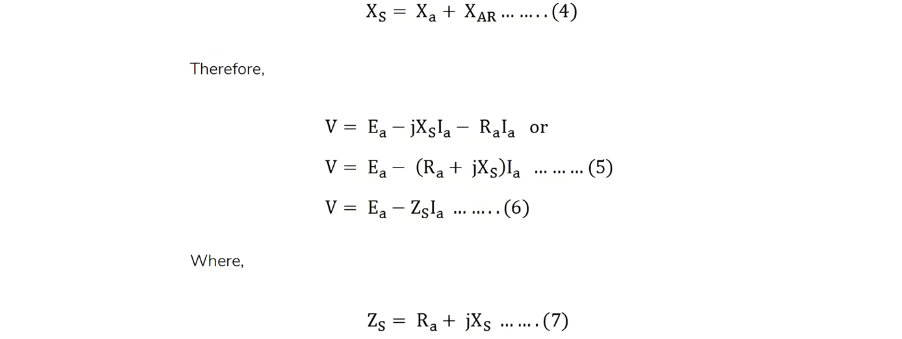
The impedance ZS in Equation (7) is the synchronous impedance, where XS denotes the synchronous reactance.

 Login