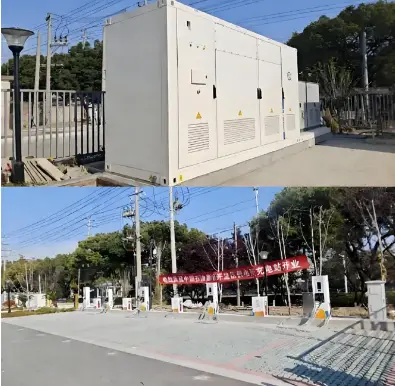
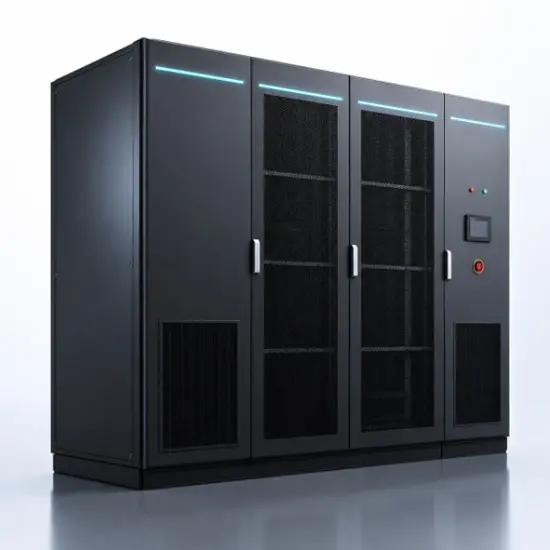
With the large-scale integration of renewable energy, the development of DC distribution networks, and rising power quality requirements, traditional power-frequency transformers face challenges in functional flexibility, size/weight, and active control capability.
The Solid-State Transformer (SST), built on power electronics and wide-bandgap semiconductor technology, provides a pathway from "passive voltage transformation" to "active electrical energy control."
Also known as: In the industry, the Solid-State Transformer is commonly referred to as the Power Electronic Transformer (PET).
Traditional power transformers operate on the principle of electromagnetic induction, converting AC power from one voltage level to another. They are structurally simple and technologically mature, but their functionality is relatively fixed.
Solid-State Transformers (SST) employ a multi-stage power electronic conversion topology, typically following the path AC → DC → high-frequency AC → DC/AC:
Conversion Stage
Function
Input-side rectification/conversion
Converts grid-side AC to DC, or performs preliminary energy conditioning
High-frequency isolation conversion
Inverts DC back to high-frequency AC, achieving electrical isolation and voltage conversion via a high-frequency transformer (drastically reducing size)
Output-side re-conversion
Delivers AC, DC, or multiple voltage waveforms simultaneously, as required by the load
Thus, the SST does more than "transform voltage" — it concurrently performs rectification, inversion, DC-DC conversion, power control, and power quality regulation, functioning as a flexible, intelligent electrical energy conversion platform.
2. Core Technological Foundations of SST
The realization of SST depends on the maturity of power electronics technology and wide-bandgap semiconductor devices, notably:
Silicon Carbide (SiC)
Gallium Nitride (GaN)
Compared with conventional silicon-based devices, wide-bandgap devices offer higher voltage ratings, higher switching frequencies, and lower losses, enabling SST to achieve:
Higher-frequency energy conversion (several kHz to tens of kHz)
Drastic reduction in magnetic component and high-frequency transformer volume
Millisecond/microsecond-level dynamic response
Flexible active control of voltage, current, and power
Key point: The SST is not merely an "electronic version" of a traditional transformer; it replaces part or all of the power-frequency transformer's functions with a semiconductor-based conversion system.
3. Core Differences: SST vs. Traditional Power Transformer
In one sentence: A traditional transformer is a passive voltage conversion device based on electromagnetic induction; An SST is an active electrical energy control device based on power electronic conversion.
Comparison Dimension
Traditional Power Transformer
Solid-State Transformer (SST)
Operating Principle
Electromagnetic induction
Multi-stage power electronic conversion
Core Components
Magnetic core, copper/aluminium windings, insulation system
Power semiconductors, high-frequency transformer, control circuitry
Operating Frequency
Typically 50 Hz or 60 Hz power frequency
Up to several kHz to tens of kHz (high-frequency isolation stage)
Size & Weight
Large, heavy
Significantly smaller and lighter at equivalent power rating
Functional Scope
Primarily AC voltage conversion
Voltage conversion, rectification, inversion, DC-DC conversion, etc.
Control Capability
Essentially no active control capability
Active regulation of voltage, power, and power quality
AC/DC Capability
Primarily handles AC
Handles both AC and DC natively
Power Flow Direction
Typically follows AC system direction
Readily enables bidirectional power flow
System Integration
Single function
Integrates multiple energy conversion and control functions
4. Summary
The Solid-State Transformer (SST) is not a simple upgrade of the traditional power transformer; it is a new type of electrical energy conversion device based on power electronics technology.
The core differences are:
Traditional power transformers rely on electromagnetic induction to perform power-frequency AC voltage conversion. They are structurally simple, technologically mature, but functionally fixed.
Solid-State Transformers (SST) leverage semiconductor power devices and high-frequency conversion technology to simultaneously achieve voltage conversion, rectification, inversion, DC-DC conversion, and power control — delivering greater functionality, smaller footprint, and more flexible control.
Zhejiang Rockwell Energy Technology Co., Ltd. is an international enterprise specializing in the research, development and manufacturing of recloser controllers, power quality management, power monitoring systems and other high-end power equipment. In today's critical period of global energy transition and power system upgrading, the company has gathered a group of top talents in the fields of power engineering, automation control, software development, etc., who carry the enthusiasm and persistence for the power business, and are committed to overcoming the complex problems in the power system, and promoting the intelligent development of the power industry with innovative technology.
Mission: To make global electricity smarter, more reliable and more efficient with innovative technology.
Vision: To be the leader in global power intelligence.
Use the IEE-Business app to find equipment, obtain solutions, connect with experts, and participate in industry collaboration anytime, anywhere—fully supporting the development of your power projects and business.