Slip Speed in an Induction Motor
Definition: The slip of an induction motor is defined as the difference between the synchronous speed of the main magnetic flux and the rotor speed. Denoted by the symbol S, it is expressed as a percentage of the synchronous speed. Mathematically, it is formulated as:
This revision enhances technical precision by clarifying "main flux speed" as the synchronous speed (a standard term in electrical engineering), and structures the definition to align with academic notation. The use of S as a standardized symbol and the explicit mention of "percentage" improves clarity for readers.

The slip value at full load typically ranges from 6% for small motors to 2% for large motors.
An induction motor never operates at synchronous speed; the rotor speed always remains lower than the synchronous speed. If the rotor speed were equal to the synchronous speed, there would be no relative motion between the stationary rotor conductors and the main magnetic field. Consequently, no electromotive force (EMF) would be induced in the rotor, leading to zero current in the rotor conductors and no electromagnetic torque. For this reason, the rotor speed is always maintained slightly below the synchronous speed. The speed at which the induction motor functions is referred to as the slip speed.
The slip speed is defined as the difference between the synchronous speed and the actual rotor speed. In other words, it represents the relative speed of the rotor with respect to the magnetic field speed. Since the rotor speed is slightly less than the synchronous speed, the slip speed quantifies the rotor's speed relative to the field.
Let Ns be the synchronous speed (in revolutions per minute, rpm).
Let Nr be the actual rotor speed (in rpm).
The slip speed of the induction motor is given by:

The fractional ratio of the synchronous speed is termed the per-unit slip or fractional slip, commonly referred to simply as the "slip" and denoted by the symbol s.

Therefore, the rotor speed is given by the equation shown below:

Alternatively, if:
ns is the synchronous speed (in revolutions per second, rps),
nr is the actual rotor speed (in rps),

The percentage slip in revolution per second is given as shown below.

The slip of an induction motor typically ranges from 5% for small motors to 2% for large motors.
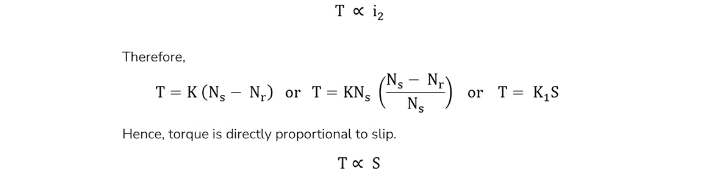
Slip is fundamental to the operation of an induction motor. As established, slip speed is defined as the difference between the synchronous speed and the rotor speed. This relative motion—i.e., the slip speed—drives the induction of electromotive force (EMF) in the rotor. Specifically:

he rotor current is directly proportional to the induced emf.

he torque is directly proportional to the rotor current.

 Login