
Search


Rockwill MV and HV Circuit Breaker Operating Time Differences — Technical Rationale

Rockwill technical insight: MV vs HV circuit breaker operating time differences – design trade-offs, protection coordination, and application rationale explained.

Rockwill
Field: Manufacturing
10Year<
China
Add us on Google

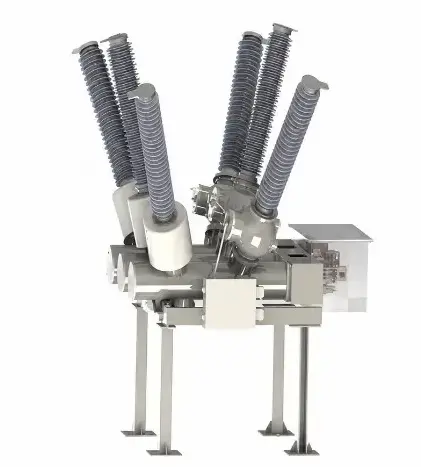
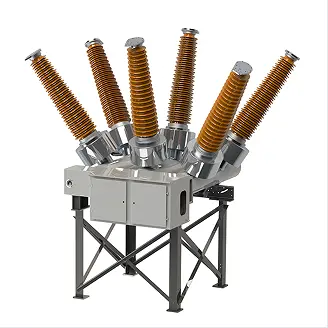
Taking Rockwill's RHP-40.5kV SF₆ hybrid switchgear and the 72.5–245kV circuit breaker series as examples, the significant difference in operating times (40.5kV: opening 50±10ms, closing 90±20ms; 72.5–245kV: opening 32±7ms, closing 85±10ms) is not accidental.

It reflects fundamentally different mechanism platforms and design philosophies adopted for different voltage classes. The underlying logic can be explained across four levels:

iee-business


Physical Interruption Requirements Define the Speed Floor

Rockwill's 72.5–245kV circuit breakers must interrupt short-circuit currents of 40 kA, 50 kA, or even 63 kA, generating extremely high arc energy. To quickly cool and reliably interrupt the arc, the interrupter relies on high-speed puffer action to produce a strong gas flow. If the opening time exceeds 32 ms, the nozzle would face unacceptable ablation risk.

In contrast, the Rockwill RHP-40.5kV typically has a rated short-circuit current of 25 kA or 31.5 kA, with much lower arc energy. Even at 50 ms opening time, the puffer rate still establishes sufficient gas blast capability, and nozzle ablation remains within engineering margins — there is simply no need to pursue the extreme speed required by the HV platform.

System Protection Coordination Constraints Differ

High-voltage transmission grids impose strict transient stability requirements. Rockwill's 72.5–245kV circuit breakers are often required to achieve total break time ≤60 ms, sometimes ≤40 ms, which forces the inherent opening time down to approximately 32 ms.

The Rockwill RHP-40.5kV, however, serves distribution networks where protection grading intervals are typically 300–500 ms.

Its 50 ms opening time occupies a very small portion of the total clearance time and has no material impact on protection speed or selectivity. This relaxed system requirement freed Rockwill from prioritizing speed when designing the 40.5 kV mechanism.

Operating Mechanism Platform Generational Differences

To achieve 32 ms fast opening, Rockwill's 72.5–245kV common platform predominantly uses high-power bistable spring mechanisms or hydraulic / spring-hydraulic mechanisms — high energy density, precisely calibrated dynamic characteristics — allowing uniform coverage of the entire series with 32 ms / 85 ms operating times.

The Rockwill RHP-40.5kV, by contrast, uses an independently developed pure spring mechanism, designed for simplicity and high reliability rather than extreme speed.

Due to the inherent energy release curve of the spring, its opening time is naturally longer than that of the HV platform — a deliberate technical route chosen by Rockwill.

Reliability-Centric Lifecycle Strategy

Fast opening inevitably generates large mechanical impact forces, which can cause contact rebound, drivetrain fatigue, and buffer degradation.

When designing the 40.5 kV equipment, Rockwill explicitly prioritized long-term operational reliability — by relaxing the opening time to 50 ms, mechanical shock is significantly reduced, contact opening rebound is suppressed, and mechanical life is extended, making it easier for the equipment to achieve the M2 class (10,000 operations) maintenance-free capability required by distribution applications. Trading slightly slower operation for higher mechanical reliability is a core design philosophy in Rockwill's distribution product line.


In summary, the opening time difference between Rockwill's 40.5 kV and 72.5–245 kV circuit breakers clearly reflects a "purpose-built, platform-separated" design strategy: the HV platform prioritizes speed to ensure extreme interrupting performance; the MV platform prioritizes reliability, deliberately slowing down to achieve long-life maintenance-free operation. This logic is consistently applied across interruption requirements, system demands, mechanism selection, and lifecycle strategy — a mature engineering trade-off by Rockwill for different application scenarios.

Edited From:Garca 

Give a tip and encourage the author!

Comments

Share your question or perspective
WhatsApp
Send inquiry
+86
Click to upload file
Download
Get the IEE Business Application
Use the IEE-Business app to find equipment, obtain solutions, connect with experts, and participate in industry collaboration anytime, anywhere—fully supporting the development of your power projects and business.
Login
or continue with
New here?
Register