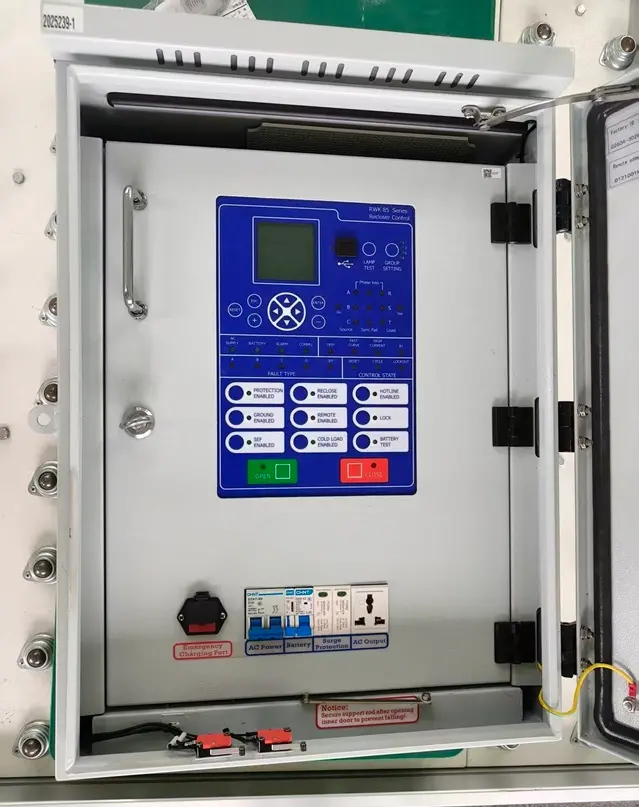
1. The Industry Challenge: Why Does Power "Trip-on-Close" During Restoration?
Utility engineers often face a frustrating cycle: the line fault is repaired, but the moment the close button is pressed, the recloser trips again instantly. This phenomenon is known as the "Cold Load Pickup (CLP)" challenge.
- The Physical Cause: After a prolonged outage, transformer cores become non-magnetized. The moment power is restored, an Excitation Inrush Current occurs, which can be 8 to 10 times higher than the rated current.
- The Consequence: Traditional protection switches cannot distinguish between this "harmless inrush" and a "lethal short circuit." This triggers nuisance trips, trapping crews in a loop of repeated outages and drastically lowering grid reliability (SAIDI).
2. The RW-energy-Architecture Solution: Intelligent "Fingerprint" Recognition
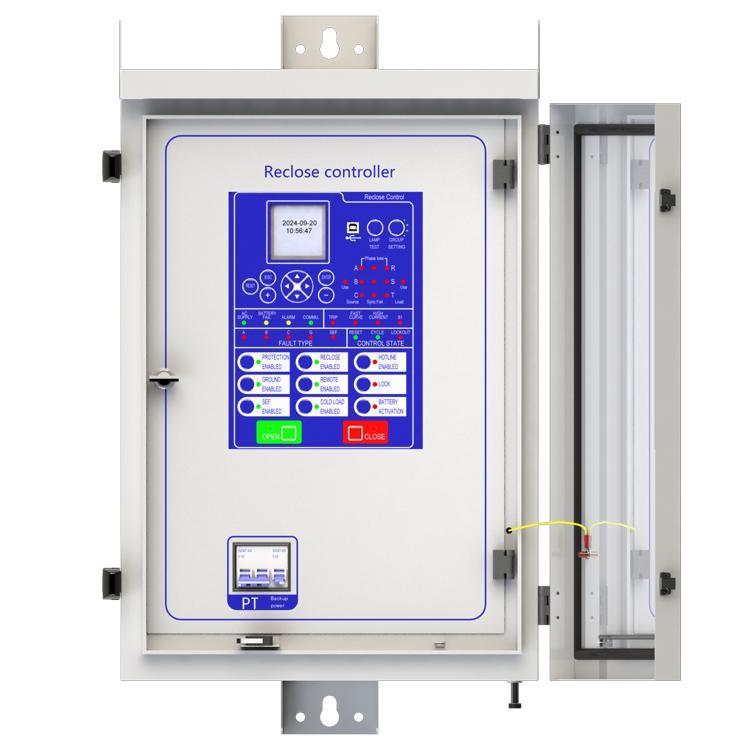
Our smart recloser controllers utilize Second Harmonic Restraint Technology to physically identify the identity of the current.
- Technical Solution: The controller features high-frequency sampling chips that perform real-time FFT (Fast Fourier Transform) spectral analysis on the current waveform.
- Physical Causal Proof:
- Real Faults: Contain almost zero second-order harmonics.
- Excitation Inrush: Is physically rich in Second Harmonic Components (its unique "fingerprint").
- Logical Action: When the controller detects high current accompanied by a high percentage of second harmonics, it automatically "blocks" the trip signal, allowing the inrush to pass safely until the system stabilizes.
3. Operational Benefits: From Constant Restarts to Instant Recovery
Implementing harmonic restraint logic delivers direct operational value:
- Improved SAIDI Metrics: Reduces average restoration time by over 40%, eliminating the need for repeated manual trials.
- Asset Longevity: Precise inrush recognition physically blocks unnecessary electrodynamic stress on expensive transformer windings.
- Renewable Readiness: In modern grids saturated with Solar PV and BESS (Battery Storage), this technology acts as a "physical safety valve" to ensure seamless interconnection.

 Login