• Product
  • Suppliers
  • Manufacturers
  • Solutions
  • Free tools
  • Knowledges
  • Experts
  • Communities
Search


Advanced Online Monitoring System for Zinc Oxide Surge Arresters: Key Technologies and Fault Diagnosis
Oliver Watts
Oliver Watts
Field: Inspection and testing
China

1 Architecture of the Online Monitoring System for Zinc Oxide Surge Arresters

The online monitoring system for zinc oxide surge arresters comprises three layers: the station control layer, bay layer, and process layer.
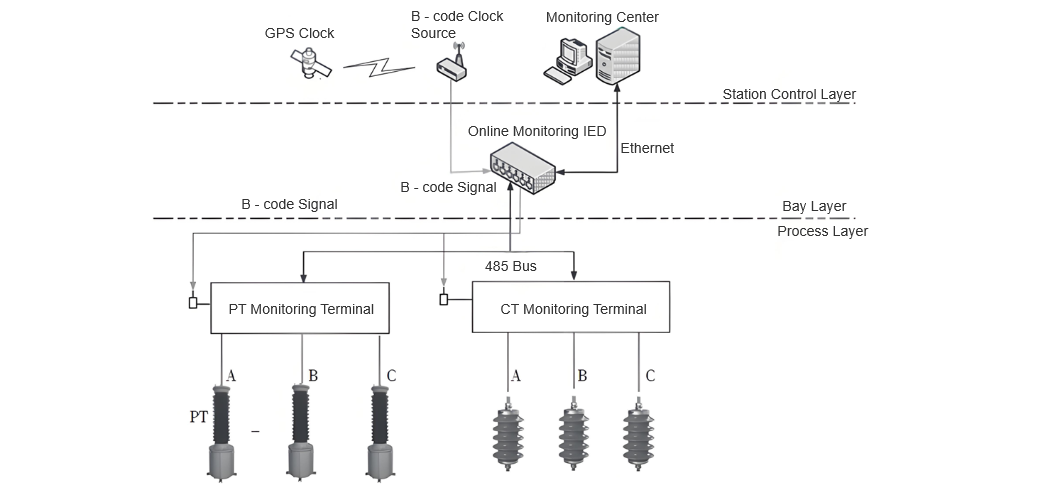
  • Station Control Layer: Includes a monitoring center, a Global Positioning System (GPS) clock, and a B - code clock source.

  • Bay Layer: Consists of online monitoring Intelligent Electronic Devices (IEDs).

  • Process Layer: Features monitoring terminals for Potential Transformers (PTs) and Current Transformers (CTs), as illustrated in Figure 1.

Within this system, each device serves a distinct function:

  • Monitoring Center: Classifies and aggregates status data of zinc oxide surge arresters, analyzing the operating condition of each unit. Operators access real - time arrester performance via the system backend. Information is visualized on displays through reports, statistical charts, and curves, ensuring user - friendly interaction. In case of faults, the system triggers immediate alarms to prompt timely troubleshooting, safeguarding arrester operation.

  • Online Monitoring IEDs: Act as communication intermediaries between monitoring terminals (unable to directly connect to the center) and the monitoring center. They parse and transmit data, enabling seamless information flow.

  • Monitoring Terminals: Function as front - end data collectors, tracking environmental parameters (temperature, humidity), resistive leakage current, and arrester pollution levels. They also record lightning strike counts with high precision. Collected data is transmitted to the monitoring center via the bay layer, empowering managers to make data - driven decisions.

2 Key Points of Online Monitoring Technology for Zinc Oxide Surge Arresters
2.1 Time Synchronization of Online Monitoring Systems

Research on the fundamental resistive current method and harmonic analysis for zinc oxide surge arresters reveals that the synchronization of sampling operations significantly impacts monitoring results. Despite the extremely small leakage current values monitored, minor errors can cause large deviations. Thus, online monitoring systems demand high sampling synchronization, requiring technicians to calibrate system time. Two methods are available:

  • GPS - based Synchronization: Achieves synchronization within 2ns, minimizing time errors;

  • IRIG - B Code Clock Synchronization: Features strong anti - interference capabilities, ensuring stable signal transmission and high - precision signal reception. However, excessive precision increases costs—technicians should select precision (1μs, 1ms, 10ms, 1s) based on system minimum resolution requirements .

IRIG - B code clock synchronization is cost - effective. Although less precise than GPS, it meets system needs. Thus, technicians can use IRIG - B for synchronization to ensure sampling consistency.

2.2 Noise Reduction in Online Monitoring Signals

Zinc oxide surge arrester data collection faces multiple interferences. Given the extremely small leakage current, unprocessed noise causes monitoring deviations, failing to reflect actual device status. Technicians must select appropriate denoising algorithms—wavelet denoising is widely used: it decomposes signals, retains valid content, sets useless coefficients to 0, and extracts usable information after repeated decomposition.

2.3 Fault Diagnosis in Online Monitoring
2.3.1 Significance of Fault Diagnosis

As power equipment scales up, power system safety becomes critical. Faults disrupt power supply and risk personnel safety—making online monitoring and fault diagnosis of zinc oxide surge arresters essential. The system monitors insulation conditions, predicts risks, and supports maintenance. However, online data is vast, complex, and redundant, interfering with monitoring accuracy.

To ensure diagnostic precision, technicians preprocess data: remove redundancies, correct errors, and provide reliable inputs. Additionally, zinc oxide arrester resistive current is affected by weather, temperature, magnetic fields, and signal interference—increasing diagnosis difficulty. Effective data processing via technical means is crucial for diagnosis .

2.3.2 Multi - Sensor Information Fusion Algorithm

Information fusion algorithms, fundamental to online monitoring data processing, integrate multi - level information for comprehensive analysis. Multi - sensor fusion algorithms use data from multiple sensors, avoid harmonic interference via calculations, and accurately reflect real - time arrester status. Common algorithms include:

  • Embedded Constraint Method: Constrains sensor - collected parameters (original and intrinsic phases) to ensure unique solutions. The system acquires real - time arrester data via sensors and extracts key information based on device characteristics;

  • Evidence Combination Method: Extracts operational data, calculates based on arrester states, and provides fault - judgment basis;

  • Artificial Neural Network (ANN) Method: Uses machine learning for diagnosis. First, design sensor - tailored topologies; second, map data patterns via network - environment interaction; finally, train models to automatically detect faults .

2.3.3 Grey Relational Analysis Method

As a common fault diagnosis approach for zinc oxide surge arresters, the grey relational analysis method focuses on statistically analyzing multiple fault - influencing factors. It quantifies the impact of different factors on arrester faults by plotting fitting curves. In practice, compare curve shape changes: higher curve fitting degrees indicate stronger correlations between real - time fault factors and the actual fault states of arresters.

For diagnosis, the dielectric loss angle of the arrester is typically set as the reference sequence X1, while parameters like temperature, humidity, and leakage current serve as comparison sequences Xi. Using the grey relational analysis model to calculate the correlation between each factor and the dielectric loss angle enables precise identification of key fault causes, providing data support for diagnostic decisions.

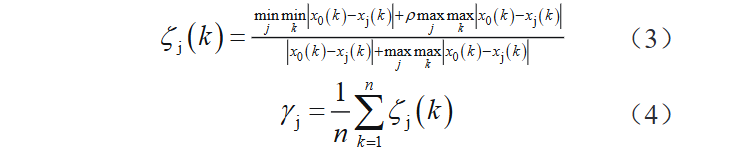
The obtained data is normalized, and the correlation coefficient ζj(k)) and the correlation degree γj between each data are calculated.
2.4 Online Monitoring Expert Software

The online monitoring expert software for zinc oxide surge arresters, as a sub - software of the online monitoring system, boasts diverse functions. It can not only monitor transformers, detecting partial discharges and gas conditions in oil, but also monitor circuit breakers and capacitive equipment. It supports setting pre - alarm parameters for the system and conducting substation equipment management.

In addition, the online monitoring expert software enables user - defined preset management, facilitating users to view historical and current data, and check the real - time status of equipment. After logging into the system, users can query data as needed, providing a reference for their decision - making.

3 Conclusion

Faults of zinc oxide surge arresters can severely impact the safe operation of power grid systems. Thus, real - time detection via an online monitoring system is essential to accurately grasp fault information and carry out timely disposal.

The online monitoring system for zinc oxide surge arresters achieves real - time monitoring through the coordinated operation of the monitoring center, online monitoring IED devices, and monitoring terminals, completing the acquisition, transmission, and processing of data information. Meanwhile, by optimizing key technologies such as system time synchronization, monitoring signal denoising, and fault diagnosis, it supplies accurate data to the system, ensuring the stable operation of zinc oxide surge arresters and fortifying the power grid's safety.
Give a tip and encourage the author!
Recommended
World’s First 500kV/90kA Cost-Effective AC Current Limiter: R&D Success & Grid Trial
Recently, the world’s first 500kV/90kA cost-effective high-voltage AC current limiter, jointly led by Guangzhou Power Supply Bureau of Guangdong Power Grid and developed by China High-Voltage AC Current Limiter Manufacturer, successfully completed artificial short-circuit tests and has been officially connected to the grid for trial operation on the Shunguang Jia Line at the 500kV Guangnan Substation. As a key project under China’s National Key R&D Program, the successful completion of the “
Baker
11/27/2025
How to Test Vacuum in Vacuum Circuit Breakers
Vacuum Integrity Testing of Circuit Breakers: A Critical Measure for Performance EvaluationVacuum integrity testing is a key method for assessing the vacuum performance of circuit breakers. This test effectively evaluates the insulation and arc-quenching capabilities of the breaker.Before testing, ensure the circuit breaker is properly installed and correctly connected. Common vacuum measurement methods include the high-frequency method and the magnetic control discharge method. The high-frequen
Oliver Watts
10/16/2025
Ensure Hybrid System Reliability with Full Production Testing
Production Testing Procedures and Methods for Wind-Solar Hybrid SystemsTo ensure the reliability and quality of wind-solar hybrid systems, several critical tests must be conducted during production. Wind turbine testing primarily includes output characteristic testing, electrical safety testing, and environmental adaptability testing. Output characteristic testing requires measuring voltage, current, and power under varying wind speeds, plotting wind-power curves, and calculating power generatio
Oliver Watts
10/15/2025
Electrical Meter Accuracy Issues? Solutions Revealed
Analysis of Measurement Errors in Electrical Instruments and Elimination Strategies1.Electrical Instruments and Common Testing MethodsElectrical instruments play a vital role in the generation, transmission, and utilization of electricity. As a special form of energy, electricity requires strict safety standards in production and use. Safe electricity usage is crucial to daily life, production, and socio-economic development. Power system monitoring relies on electrical instruments, which are of
Oliver Watts
10/07/2025
Related Products
Send inquiry
Download
Get the IEE Business Application
Use the IEE-Business app to find equipment, obtain solutions, connect with experts, and participate in industry collaboration anytime, anywhere—fully supporting the development of your power projects and business.