Sa sistema nga elektrisidad sa China, ang 6 kV, 10 kV, ug 35 kV grids kasagaran nagpadayon sa usa ka operasyon nga walay gipang-ground ang neutral point. Ang distribusyon nga side sa mga main transformers sa grid kasagaran gigamit ang delta configuration, nga walay neutral point aron miconnect ang mga grounding resistors. Kapag may single-phase ground fault sa usa ka sistema nga walay gipang-ground ang neutral point, ang line-to-line voltage triangle adunay sama nga symmetrical, nagresulta sa gamay nga disruption sa operasyon sa user. Masobra, kapag ang capacitive current gamay ra (mas baba sa 10 A), ang pipila ka transient ground faults mahimong mag-self-extinguish, nga maayo nga effective sa pag-improve sa reliability sa supply ug pagbawas sa outage incidents.
Pero, tungod sa patuloy nga expansion ug development sa industriya sa elektrisidad, kini nga simple nga paagi wala na nakaabot sa kasamtangan nga pangutana. Sa moderno nga urban power grids, ang pag-increase sa paggamit sa cable circuits nagresulta sa mas taas nga capacitive currents (mas taas sa 10 A). Sa matang sa kondisyon, ang ground arc dili na reliably mapatay, nagresulta sa sumala nga mga consequence:
Ang intermittent extinction ug reignition sa single-phase ground arc mahimong mogenerate og arc-ground overvoltages nga ang amplitudes makakita sa 4U (diin ang U ang peak phase voltage) o mas taas pa, naglast long duration. Kini naghatag og severe nga threats sa insulation sa electrical equipment, mahimong mag-result sa breakdowns sa weak insulation points ug nagresulta sa significant nga losses.
Ang sustained arcing ionizes ang surrounding air, nagdeteriorate sa iyang insulating properties ug nag-increase sa likelihood sa phase-to-phase short circuits.
Ang ferroresonant overvoltages mahimong mogenerate, madaling mag-damage sa voltage transformers ug surge arresters—potentially even causing arrester explosions. Kini nga consequences severely endanger ang insulation integrity sa grid equipment ug threaten ang safe operation sa entire power system.
Arigaton sa pag-prevent sa mga incident ug pag-provide og sufficient zero-sequence current ug voltage aron sigurado ang operasyon sa ground-fault protection, kinahanglan buhaton ang artificial neutral point aron miconnect ang grounding resistor. Kini nga pangutana naglead sa pag-develop sa grounding transformers (commonly referred to as "grounding transformers" or "grounding units"). Ang grounding transformer artificially creates a neutral point with a grounding resistor, typically featuring very low resistance (usually less than 5 ohms).
Bisan pa, tungod sa iyang electromagnetic characteristics, ang grounding transformer nagpresent og high impedance sa positive- ug negative-sequence currents, allowing only a small excitation current to flow through its windings. Sa each core limb, two winding sections wound in opposite directions. Kapag equal zero-sequence currents flow through these windings, they exhibit low impedance, resulting in minimal voltage drop across the windings under zero-sequence conditions.
Specifically, during a ground fault, the winding carries positive-, negative-, and zero-sequence currents. It presents high impedance to positive- and negative-sequence currents but low impedance to zero-sequence current. This is because, within the same phase, the two windings are connected in series with opposite polarity; their induced electromotive forces are equal in magnitude but opposite in direction, effectively canceling each other out, thus presenting low impedance to zero-sequence current.
In many applications, grounding transformers are used solely to provide a neutral point with a small grounding resistor and do not supply any secondary load. Therefore, many grounding transformers are designed without a secondary winding. During normal grid operation, the grounding transformer operates essentially in a no-load state. However, during a fault, it carries fault current only for a short duration. In a low-resistance grounded system, when a single-phase ground fault occurs on the 10 kV side, highly sensitive zero-sequence protection quickly identifies and temporarily isolates the faulty feeder.
The grounding transformer is active only during the brief interval between fault occurrence and the operation of the feeder’s zero-sequence protection. During this time, zero-sequence current flows through the neutral grounding resistor and the grounding transformer, following the formula: I_R = U / (R₁ + R₂), where U is the system phase voltage, R₁ is the neutral grounding resistor, and R₂ is the additional resistance in the ground fault loop.
Based on the above analysis, the operational characteristics of a grounding transformer are: long-term no-load operation and short-term overload during faults.
In summary, a grounding transformer artificially creates a neutral point to connect a grounding resistor. During a ground fault, it exhibits high impedance to positive- and negative-sequence currents but low impedance to zero-sequence current, thereby ensuring reliable operation of ground-fault protection.
Currently, grounding transformers installed in substations serve two primary purposes:
Supplying low-voltage AC power for substation auxiliary use;
Creating an artificial neutral point on the 10 kV side, which, when combined with an arc suppression coil (Petersen coil), compensates for capacitive ground-fault current during 10 kV single-phase ground faults, thereby extinguishing the arc at the fault point. The principle is as follows:
Along the entire length of conductors in a three-phase power grid, capacitance exists both between phases and between each phase and ground. When the grid neutral is not solidly grounded, the capacitance to ground of the faulted phase becomes zero during a single-phase ground fault, while the voltages of the other two phases rise to √3 times the normal phase voltage. Although this increased voltage remains within the insulation design limits, it increases their capacitance to ground. The capacitive ground-fault current during a single-phase fault is approximately three times the normal per-phase capacitive current. When this current becomes large, it easily sustains intermittent arcs, exciting resonant oscillations in the grid’s inductive-capacitive circuit and generating overvoltages up to 2.5–3 times the phase voltage. The higher the grid voltage, the greater the risk from such overvoltages. Therefore, only systems below 60 kV may operate with an ungrounded neutral, as their single-phase capacitive ground-fault currents remain small. For higher-voltage systems, a grounding transformer must be used to connect the neutral point through impedance.
Kung ang usa ka bahin sa main transformer sa substation (e.g., ang 10 kV bahin) gitukod sa delta o wye nga walay neutral nga gibulag, ug ang single-phase capacitive ground current dako, wala'y available neutral point alang sa grounding. Sa mga kasagaran niini, gigamit ang grounding transformer aron makahimo og artificial neutral point, nag-enable sa koneksyon sa arc suppression coil. Kini nga artificial neutral naka-allow sa sistema nga kompensar ang capacitive current ug patayon ang ground arcs—kini ang fundamental role sa grounding transformer.
Sa normal nga operasyon, ang grounding transformer adunay balanced three-phase voltage ug nakapuyo lamang ang gamay nga excitation current, nag-operate essentially unloaded. Ang neutral-to-ground potential difference zero (neglecting minor neutral displacement voltage gikan sa arc suppression coil), ug walay current mogalop sa coil. Kon halimbawa, ang phase C naa'y ground fault, ang resulta nga zero-sequence voltage (gikan sa asymmetry) mogalop sa arc suppression coil hangtod sa ground. Ang coil mohimo og inductive current nga kompensar ang capacitive ground-fault current, pinaagi niini napapatay ang arc—functionally identical sa standalone arc suppression coil.
Sa katugbang nga tuig, daghan na nga misoperations sa grounding transformer protection nahitabo sa 110 kV substations sa usa ka rehiyon, nag-grabe nga epekto sa grid stability. Aron mas identipikar ang root causes, gisagol ang mga analisis, implementado ang corrective measures, ug gipasabot ang mga leksyon aron maprevent ang recurrence ug guide sa uban pang rehiyon.
Tungod sa pagdako sa paggamit sa cable feeders sa 110 kV substation 10 kV networks, ang single-phase capacitive ground currents gi-increase substantially. Aron mahatagan og low-resistance grounding ug makabalaka sa overvoltage magnitudes sa panahon sa ground faults, daghan na ang 110 kV substations nga ig-install og grounding transformers aron mag-establish og zero-sequence current path. Kini nag-enable sa selective zero-sequence protection nga ma-isolate ang ground faults basehan sa location, nag-prevent sa arc reignition ug nag-sure sa safe power supply.
Tungod pa sa 2008, retrofitted ang usa ka rehiyon sa iyang 110 kV substation 10 kV systems sa low-resistance grounding pinaagi sa pag-install sa grounding transformers ug associated protection devices. Kini nag-allow sa rapid isolation sa bisan unsang 10 kV feeder ground fault, minimizing ang impact sa grid. Pero sa katugbang nga panahon, lima ka 110 kV substations sa rehiyon naa'y repeated misoperations sa grounding transformer protection, nag-cause sa outages ug nag-threaten sa grid stability. Busa, importante nga mas identify ang causes ug implementar ang solutions.
1. Analisis sa Causes para sa Grounding Transformer Protection Misoperation
Kon ang 10 kV feeder naa'y ground fault, ang feeder’s zero-sequence protection sa 110 kV substation dapat mogalop unang-unahan aron mailisan ang fault. Kon magfail, ang grounding transformer’s backup zero-sequence protection mogalop sa bus tie ug main transformer breakers aron mailisan ang fault. Busa, importante nga correct operation sa 10 kV feeder protection ug breakers. Statistical analysis sa misoperations sa lima ka substations nagpakita nga ang feeder protection failure ang primary cause.
Ang 10 kV feeder zero-sequence protection mogalop as follows: zero-sequence CT samples → protection initiates → breaker trips. Key components mao ang zero-sequence CT, protection relay, ug breaker. Ang analisis focus sa mga mosunod:
1.1 Zero-sequence CT errors causing misoperation
Kon may ground fault, ang faulty feeder’s zero-sequence CT detect ang fault current, triggering ang iyang protection. Sa samang panahon, ang grounding transformer’s zero-sequence CT usab mosense sa current. Aron mas ensure ang selectivity, ang feeder protection settings (e.g., 60 A, 1.0 s) mas baba kay sa grounding transformer settings (e.g., 75 A, 1.5 s to trip bus tie, 2.5 s to trip main transformer). Pero, ang CT errors (e.g., -10% for grounding transformer CT, +10% for feeder CT) makapanglantaw sa actual pickup currents naa lang malapit (67.5 A vs. 66 A), relying only on time delay. Kini nag-increase sa risk sa grounding transformer overreach.
1.2 Incorrect cable shield grounding causing misoperation
Ang 10 kV feeders gamit ang shielded cables nga shields grounded sa duha ka end—a common EMI mitigation practice. Ang zero-sequence CTs typical toroidal, installed around the cable at the switchgear outlet. Kon may ground fault, ang unbalanced current induces a signal sa CT. Pero, kon ang shield grounded sa duha ka end, circulating shield currents usab mogalop sa CT, distorting measurement. Without proper installation (e.g., shield ground wire passing correctly through the CT), ang feeder protection may fail, causing grounding transformer overreach.
1.3 Feeder protection failure causing misoperation
Kahibalo ang microprocessor-based relays offer high performance, product quality varies. Common failures involve power, sampling, CPU, or trip output modules. Kon undetected, kini makapanglantaw sa protection refusal, leading to grounding transformer misoperation.
1.4 Feeder breaker failure causing misoperation
Aging, frequent operations, o poor-quality breakers (especially older GG-1A types sa rural areas) nag-increase sa failure rates. Control circuit faults—particularly burnt trip coils—prevent breaker operation even when protection commands a trip, forcing grounding transformer backup to act.
1.5 High-impedance ground faults sa usa o duha ka feeders causing misoperation
Kon duha ka feeders naa'y simultaneous high-impedance ground faults sa same phase, individual zero-sequence currents (e.g., 40 A ug 50 A) may stay below the feeder pickup (60 A), pero ilang sum (90 A) exceeds the grounding transformer setting (75 A), causing overreach. Bisag ang usa ka severe high-impedance fault (e.g., 58 A) combined with normal capacitive current (e.g., 12–15 A) can approach 75 A. System disturbances may then trigger misoperation.
2. Countermeasures to Prevent Misoperation
2.1 Address CT errors
Use high-quality zero-sequence CTs; reject units with >5% error during commissioning; set protection thresholds based on primary values; verify settings via primary injection testing.
2.2 Correct cable shield grounding
Padala ang mga ground wire sa paingon pana nga adunay zero-sequence CT ug insulate gikan sa cable trays; iwasan ang pag-contact sa wala pa maabot sa CT.
Iwan ang mga exposed conductor ends para sa testing; insulate ang uban.
Kon ang shield ground point adunay posisyon sa wala pa maabot sa CT, dili padalhon kini sa CT. Iwasan ang pag-place sa ground point sa CT window.
Pagtutok sa mga tawo sa protection ug cable sa proper installation.
Pag-enforce sa joint acceptance inspections sa relay, operations, ug cable teams.
2.3 Iwasan ang pag-refusal sa protection
Gamiton ang proven, reliable relays; palitan ang aging o faulty units; enhance ang maintenance; install cooling/ventilation aron maprevent ang overheating.
2.4 Iwasan ang pag-refusal sa breaker
Gamiton ang reliable, modern breakers (e.g., spring- o motor-charged sealed types); phase out ang old GG-1A cabinets; maintain ang control circuits; gamiton ang high-quality trip coils.
2.5 Mitigate ang high-impedance fault risks
Promptly investigate ug clear feeders kon may ground alarms; reduce ang feeder lengths; balance ang phase loads aron mapahimulos ang normal capacitive current.
3. Conclusion
Wa't sa grounding transformers improve grid structure ug stability, recurring misoperations highlight hidden risks. This paper analyzes key causes ug proposes practical solutions aron mapaguide ang regions nga naka-install o plan to install grounding transformers.
Zigzag (Z-Type) Grounding Transformers
Sa 35 kV ug 66 kV distribution networks, ang mga transformer windings kasagaran wye-connected ug adunay available neutral point, eliminating ang need for grounding transformers. Pero sa 6 kV ug 10 kV networks, ang mga delta-connected transformers walay neutral point, necessitating ang grounding transformer aron magprovide og usa—primarily for connecting arc suppression coils.
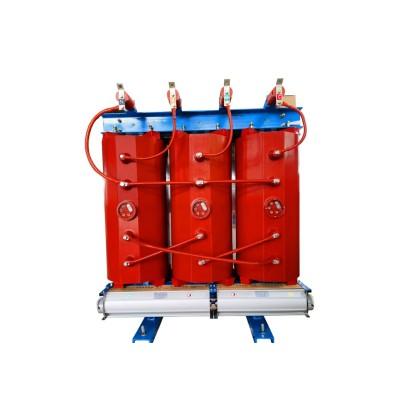
Ang mga grounding transformers gamiton ang zigzag (Z-type) winding connections: ang bawg phase winding split across two core limbs. Ang zero-sequence magnetic fluxes gikan sa duha ka windings cancel each other, resulting sa very low zero-sequence impedance (typically <10 Ω), low no-load losses, ug utilization of over 90% of rated capacity. Sa contrast, ang conventional transformers adunay mas taas na zero-sequence impedance, limiting ang arc suppression coil capacity to ≤20% of transformer rating. Thus, Z-type transformers optimal for grounding applications.
Kon ang system unbalance voltage adunay dako, balanced Z-type windings sufficient for measurement. Sa low-unbalance systems (e.g., all-cable networks), ang neutral designed aron produce 30–70 V unbalance voltage for measurement needs.
Ang grounding transformers makapadala usab og secondary loads, serving as station service transformers. Sa such cases, ang primary rating equals the sum of arc suppression coil capacity ug secondary load capacity.
Ang primary function sa grounding transformer mao ang deliver ground-fault compensation current.
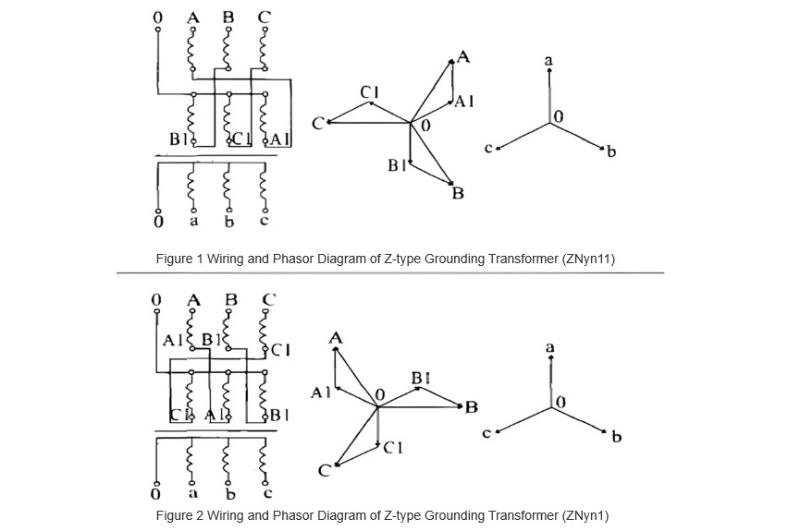
Ang Figure 1 ug Figure 2 show duha ka common Z-type grounding transformer connections: ZNyn11 ug ZNyn1. Ang principle behind low zero-sequence impedance mao ang: ang bawg core limb adunay duha ka identical windings connected sa different phase voltages. Sa positive- o negative-sequence voltage, ang magnetomotive force (MMF) sa bawg limb mao ang vector sum sa duha ka phase MMFs. Ang three limb MMFs balanced ug 120° apart, forming a closed magnetic path sa low reluctance, high flux, high induced voltage, ug thus high magnetizing impedance.
Sa zero-sequence voltage, ang duha ka windings sa bawg limb produce equal but opposite MMFs, resulting sa zero net MMF per limb. Walay zero-sequence flux flows sa core; instead, circulating through the tank ug surrounding medium, encountering high reluctance. Consequently, zero-sequence flux ug impedance very low.