Loss of Excitation Definition
Loss of excitation in a generator occurs when the excitation system fails, causing the generator to run above synchronous speed.
Induction Generator Mode
Without excitation, the generator becomes an induction generator, which can lead to overheating and overloading issues.
Undercurrent Relay Protection
An undercurrent relay can protect against loss of field by operating when the excitation current falls below a certain value.
This relay operates if the excitation current falls below a set value, typically 8% of the rated full load current. If the field circuit remains intact but the exciter fails, an induced current at slip frequency can cause the relay to pick up and drop off. This can be managed by adjusting the relay settings.
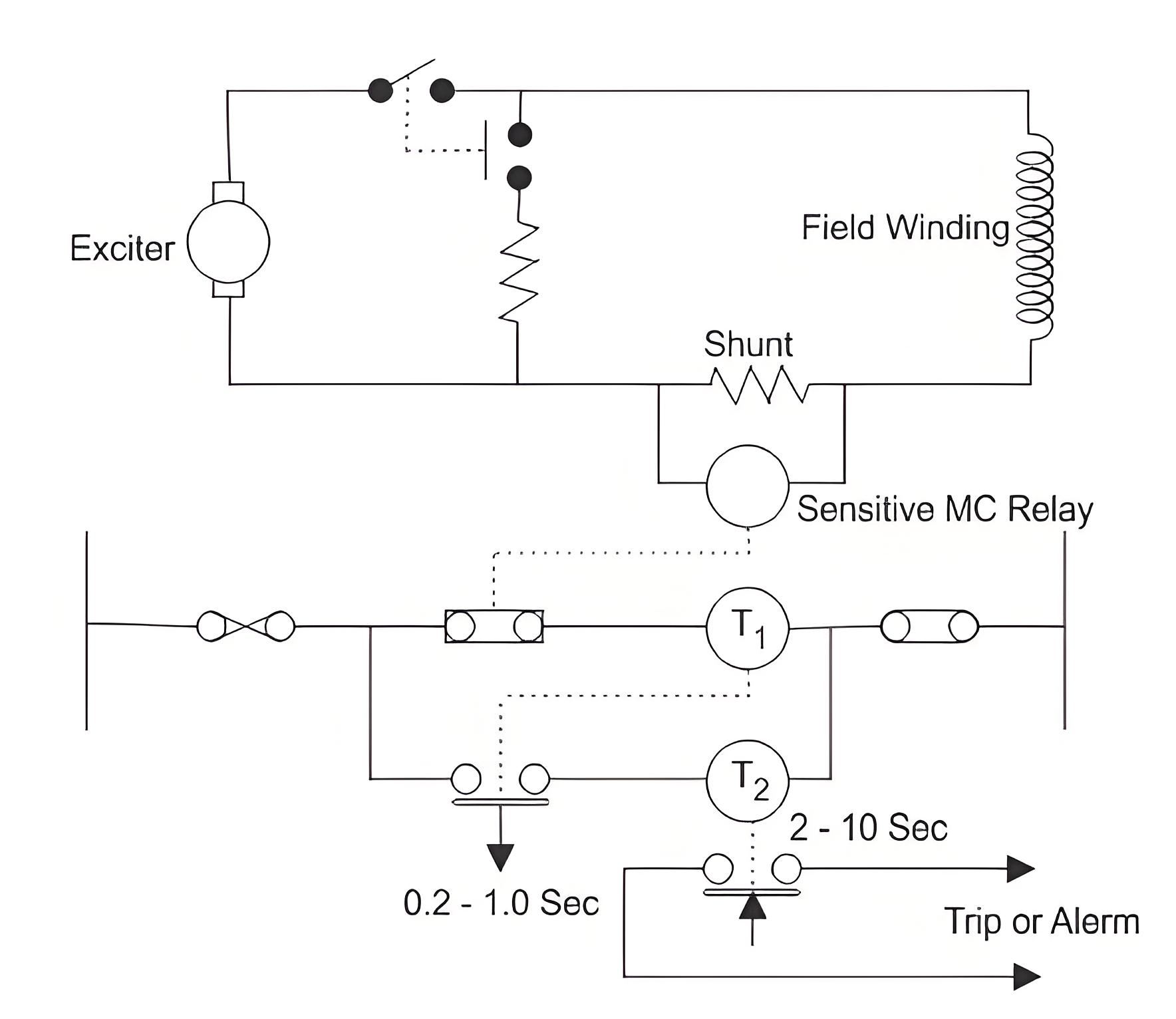
A setting of 5% of the normal full load current is recommended. The undercurrent relay has a normally closed contact that stays open while the relay coil is energised by the shunted excitation current. When the excitation system fails, the relay coil de-energises, closing the contact and supplying power to timing relay T1.
As the relay coil is energized, the normally open contact of this relay T1 is closed. This contact closes the supply across another timing relay T2 with an adjustable pickup time delay of 2 to 10 seconds. Relay T1 is time delayed on drop off to stabilize scheme again slip frequency effect. Relay T2 closes its contacts after the prescribed time delay to either shut down the set or initiate an alarm. It is time delayed on pickup to prevent spurious operation of the scheme during an external fault.
Timing Relays for Stability
Using timing relays helps stablise the protection scheme against slip frequency effects and prevent false operations.
We know that system voltage is the main indication of system stability. Therefore the offset mho relay is arranged to shut the machine down instantaneously when operation of generator is accompanied by a system voltage collapse. The drop in system voltage is detected by an under voltage relay which is set to approximately 70 % of normal rated system voltage. The offset mho relay is arranged to initiate load shedding to the system up to a safe value and then to initiate a master tripping relay after a predetermined time.
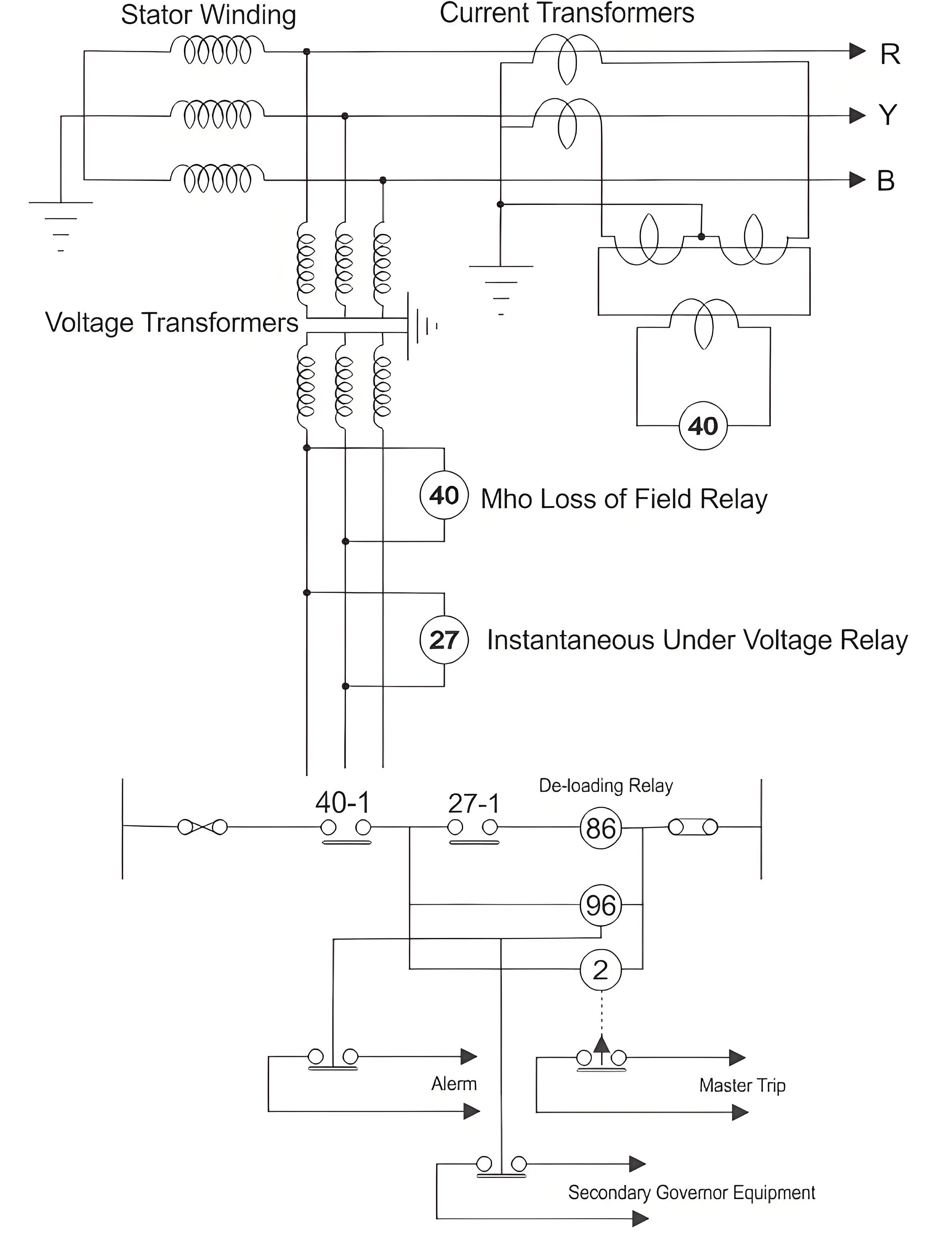
Advanced Protection for Large Generators
For larger generators, advanced schemes with offset mho relays and under voltage relays are used to maintain system stability through load shedding and master tripping relays.

 Login