Epoxy Resin Casting Technology: The Core Determinant of Dry-Type Transformer Lifespan and Maintenance-Free Performance

Discover how epoxy resin casting technology extends dry-type transformer lifespan, ensuring maintenance-free performance for critical power systems.

Vziman
Field: Manufacturing
10Year<
China
Add us on Google
 
Dry-type transformers have become the standard configuration for urban complexes, rail transit, data centers, and other critical scenarios due to their oil-free, flame-retardant, and environmentally friendly characteristics. Despite all being classified as "dry-type," transformers from different manufacturers exhibit significant differences in partial discharge levels, crack resistance, and operational lifespan.
The root cause of this quality gap lies in the technical level of the epoxy resin casting process. Casting is far from a simple material filling operation — it is a systematic engineering discipline involving materials science, thermodynamics, and mechanics, and it directly determines the transformer's full life-cycle performance.
iee-business

1. Partial Discharge Control: The "Invisible Defense Line" of Insulation Life

Partial discharge is the primary cause of insulation aging and eventual breakdown in dry-type transformers. If micro-voids, cracks, or filler-resin interface separation defects exist inside the resin casting body, these defects will become PD sources under operating voltage. Continuous PD generates high-energy particle bombardment that erodes the insulation. If PD levels exceed acceptable limits, the transformer may suffer inter-turn short circuits or even complete failure in a short period.

High-quality transformers employ advanced vacuum casting technology: windings are preheated and dried in a vacuum environment, and resin is injected under continuous vacuum conditions to ensure full penetration between every turn of the winding, completely eliminating internal bubbles. This process control keeps factory PD levels extremely low, cutting off the insulation degradation pathway at the source and significantly extending the electrical service life of the equipment.

2. Crack Resistance and Stress Management: The "Mechanical Toughness" for Thermal Cycling

Transformers experience heat generation during operation, cooling during shutdown, and mechanical vibration during handling. Repeated thermal expansion and contraction, combined with mechanical stress, continuously act on the cured epoxy resin insulation layer. If the resin system lacks sufficient toughness or if improper curing control introduces excessive internal stress, micro-cracks may develop on or within the coil surface after a certain number of thermal cycles, which can eventually propagate into through-cracks.

Modern high-quality processes commonly adopt a "thin insulation" structure (reinforced with glass fiber), giving the resin layer sufficient elasticity to expand and contract with the winding without cracking. Toughening agents are added to the formulation, and a programmed temperature-controlled curing curve is used to allow slow, uniform solidification, minimizing residual internal stress. This synergistic optimization of "material + process" endows the transformer with exceptional resistance to thermal cycling cracking.

3. Ultimate Sealing and Moisture Protection: The Physical Foundation of "Maintenance-Free" Operation

One of the key advantages of dry-type transformers over oil-immersed transformers is maintenance-free operation, which relies heavily on the solid insulation barrier formed by resin casting. Full-vacuum epoxy resin casting fully encapsulates the high and low-voltage coils in a dense resin body, creating a high-strength fiberglass-reinforced structure.

This fully encapsulated construction provides a near-perfect barrier against moisture, dust, and chemical corrosion. Open-impregnated (VPI) transformers have relatively limited sealing performance and are susceptible to moisture absorption during shutdown or in high-humidity environments, typically requiring preheating for moisture removal before restart. In contrast, high-quality epoxy cast transformers can be directly loaded without preheating even after prolonged shutdown in harsh, high-humidity environments. This completely eliminates tedious moisture protection procedures and insulation testing, delivering true maintenance-free operation.

Aspect Epoxy Cast Transformer VPI (Open-Impregnated) Transformer
Encapsulation Full vacuum-cast resin encapsulation Impregnated varnish, open structure
Moisture barrier Near-perfect seal Limited; absorbs moisture in high humidity
Preheating before restart Not required Typically required
Dust / chemical protection Complete enclosure Partial
Maintenance Truly maintenance-free Periodic insulation checks needed
 

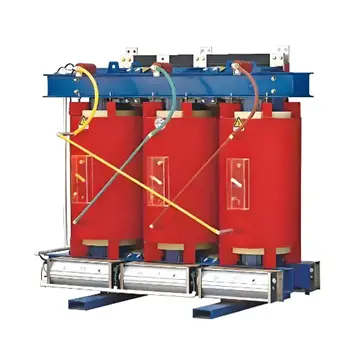
Three-Phase Insulation Epoxy Resin Cast Dry Type Distribution Transformers 13.8kV 15.5kV 27kV 34.5kV

Three red resin cast coils dry-type transformer with blue frame, connecting wires and bottom cooling fans

4. Intrinsic Material Property Matching: The Foundation for High-Frequency Operation and Thermal Management

Beyond the process itself, the intrinsic properties of the resin material form the underlying logic of quality. Parameters such as resin viscosity, toughness, dielectric loss factor (tan δ), and glass transition temperature (Tg) directly influence casting quality and long-term reliability:

Property Benefit
Low viscosity Better flowability, reducing casting voids
High toughness Enhanced resistance to thermal cycling cracking
High glass transition temperature (Tg) Stable modulus and expansion at elevated temperatures, stronger thermal fatigue resistance
Low dielectric loss (tan δ) Reduced high-frequency self-heating, preventing the "temperature rise → increased loss → further temperature rise" cycle
 

In the high-frequency, high-voltage scenarios of emerging solid-state transformers (SST), low dielectric loss is particularly critical, suppressing temperature rise caused by high-frequency losses at the source.

Conclusion

Epoxy resin casting technology represents the core technical barrier in dry-type transformer manufacturing. The quality of the casting process directly determines whether internal PD defects exist, whether the transformer can resist thermal stress cracking, and whether it achieves ultimate environmental protection. The paradigm shift from "reactive repair" to "predictive maintenance" depends not only on intelligent operation and maintenance tools but also on the inherent quality built into the equipment at the factory. Choosing a cast resin transformer with rigorous process control and superior intrinsic material properties means fewer outages, more stable operation, and lower total life-cycle cost.

Edited From:Leon

Give a tip and encourage the author!

Comments

Share your question or perspective
WhatsApp
Send inquiry
+86
Click to upload file
Download
Get the IEE Business Application
Use the IEE-Business app to find equipment, obtain solutions, connect with experts, and participate in industry collaboration anytime, anywhere—fully supporting the development of your power projects and business.
Login
or continue with
New here?
Register