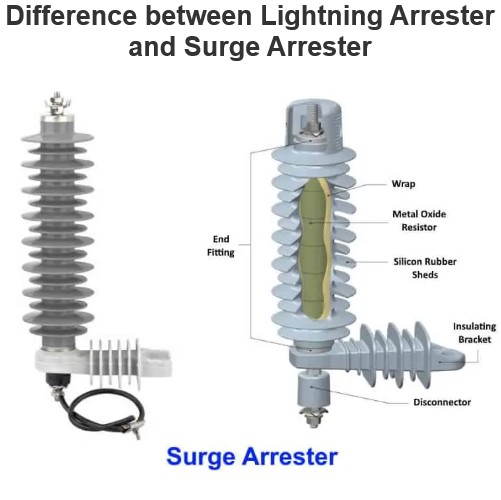
In high-voltage engineering, the "Sheds" (or skirts) of a surge arrester serve as the primary external insulation barrier. Their geometry is mathematically optimized to handle the harsh intersection of high electric fields and environmental stress.
1. Optimization of Creepage Distance
The primary function of sheds is to extend the creepage distance—the shortest path along the surface of the insulation between two conductive parts.
- Physics: By creating a convoluted surface, we increase the resistance to leakage currents. In polluted environments (salt, dust, humidity), a flat surface would quickly form a conductive path, leading to a "flashover." The shed design allows a high creepage-to-height ratio, keeping the device compact while maintaining high dielectric strength.
2. Management of Surface Hydrophobicity and Water Film
During heavy rain or fog, water can form a continuous film on the insulator, effectively short-circuiting the device.
- The "Break" Effect: The downward tilt of the sheds forces water to bead and drip off at the edges rather than forming a continuous vertical stream.
- Dry Zones: In "Alternating Shed" designs (Large/Small configurations), the area under the large shed remains dry even during vertical rainfall, preserving a high-impedance path that prevents rain-induced flashovers.
3. Electric Field Grading and Stress Relief
High-voltage terminals create intense electric field concentrations.
- Mechanism: The profile of the sheds acts as a capacitive grading system. By physically spacing the surface away from the internal ZnO core in specific patterns, the design helps to homogenize the electric field distribution, reducing the risk of corona discharge and premature material aging.
Enhanced Visual Documentation
To further illustrate these concepts and the internal excellence of ROCKWILL products, I have prepared the following technical widgets.
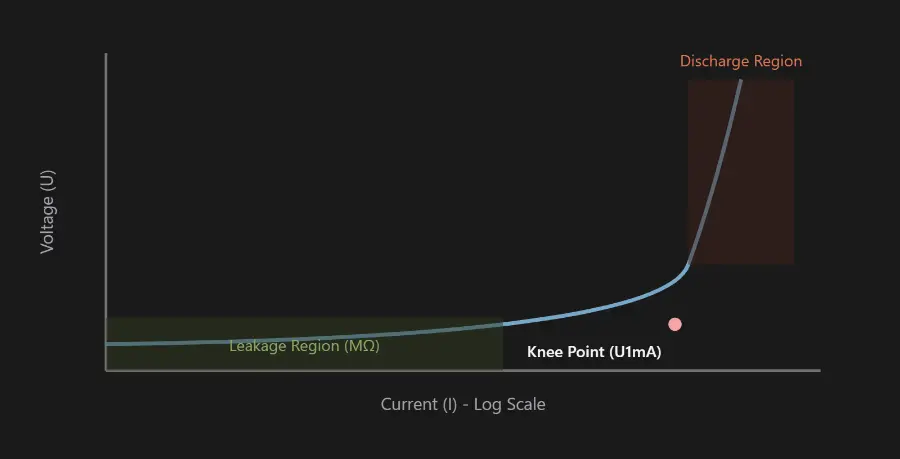
Visualization 1: ZnO Varistor V-I Characteristic Curve
The "Soul" of a surge arrester is its non-linear resistance. This chart illustrates how ROCKWILL ZnO varistors transition from high insulation to high conduction in nanoseconds.
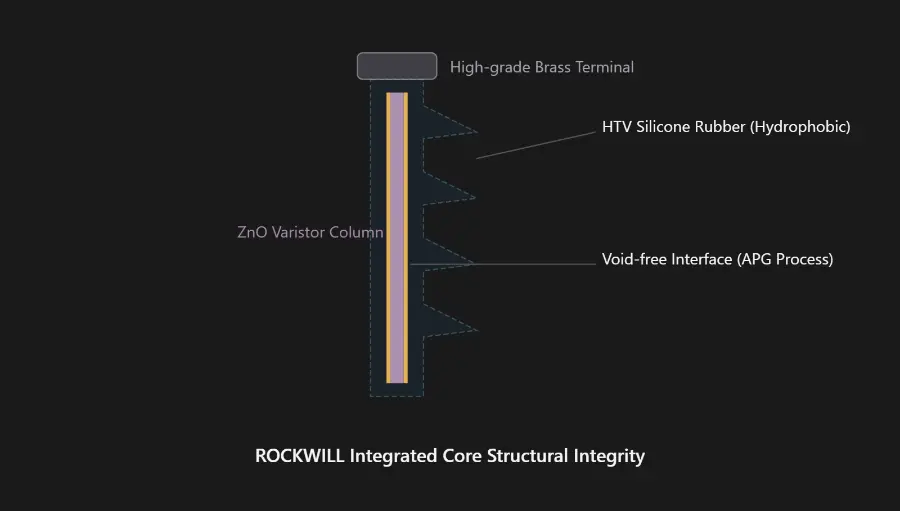
Visualization 2: Internal Anatomy of ROCKWILL Composite Arrester
Understanding the internal integration explains why ROCKWILL products excel in reliability.
Product Recommendation: ROCKWILL Premium Surge Protection Series
For international projects requiring strict adherence to IEC 60099-4 or IEEE C62.11, I recommend the following ROCKWILL solutions:
RCW-SA Series: Composite Housed Metal-Oxide Surge Arrester
- Material Science: Utilizes high-performance HTV (High Temperature Vulcanized) silicone rubber. Its unique molecular structure allows for "hydrophobicity transfer"—meaning even if the surface is covered in dust, the silicone oils migrate to the surface to maintain water-beading properties.
- Manufacturing Excellence: Unlike traditional assembly, ROCKWILL uses an Integrated Injection Molding process. The silicone is molded directly onto the ZnO stack and FRP (Fiberglass Reinforced Plastic) rods. This eliminates the air gap, preventing internal moisture ingress and partial discharge.
- Operating Range: Available from 3kV to 220kV, with nominal discharge currents of 5kA and 10kA.
- Safety Feature: Designed with a high Short-Circuit Withstand Capacity. In the rare event of an overload, the composite housing prevents explosive fragmentation, ensuring the safety of nearby personnel and transformers.
Strategic Advantage: By choosing ROCKWILL, you are not just buying a component; you are investing in a system designed for a 30-year lifecycle with zero maintenance in high-pollution zones.
Technical Keywords: Dielectric Strength, Hydrophobicity, Creepage Ratio, Non-linear Coefficient, Thermal Stability, APG Technology.
BY:Dyson

 Login