What Are the Basic Requirements for Outdoor Installation of Distribution Transformers?
1. General Requirements for Pole-Mounted Transformer Platforms
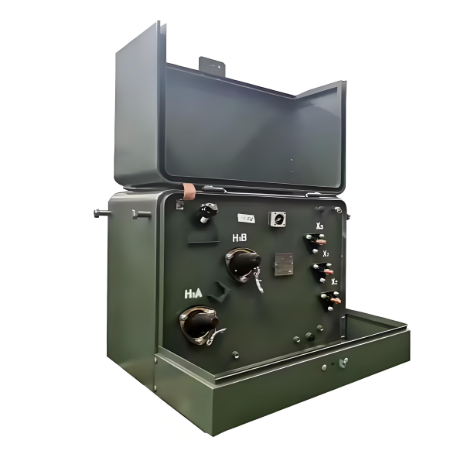
Location Selection:Pole-mounted transformers should be installed near the load center to minimize power losses and voltage drop in low-voltage distribution lines. Typically, they are placed close to facilities with high electricity demand, while ensuring that the voltage drop at the farthest connected equipment remains within allowable limits. The installation site should allow easy access for maintenance and avoid complex pole structures such as corner poles or branch poles.
Clearance from Buildings:The transformer’s outer contour must be at least 5 meters away from combustible buildings and no less than 3 meters from fire-resistant buildings.
Mounting Height:The bottom of the transformer platform shall be no less than 2.5 meters above ground level. The lower edge of the low-voltage distribution box must be at least 1 meter above the ground.
Height of Exposed Live Parts:All exposed live components on the transformer platform must be installed at a height of at least 3.5 meters above ground level.
Co-located High- and Low-Voltage Lines:When high- and low-voltage lines are mounted on the same pole, the low-voltage lines must be positioned below the high-voltage lines. The vertical distance between the high- and low-voltage crossarms shall be no less than 1.20 meters.
Warning Signage:A clearly visible warning sign (e.g., “Danger: High Voltage”) must be installed at a height of 2.5 to 3.0 meters above ground level.
Hazardous Environments:Pole-mounted transformer platforms should not be installed in areas where the air contains flammable/explosive gases or conductive/damaging dust that could degrade insulation. In such environments, an indoor substation is recommended.
2. General Requirements for Pad-Mounted (Ground-Level) Transformer Platforms
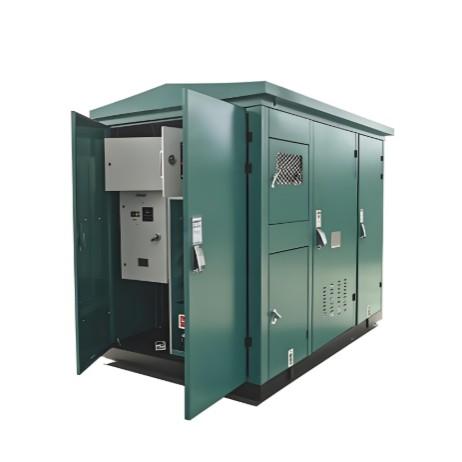
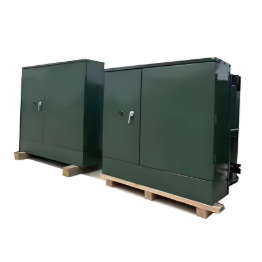
Capacity-Based Installation Method:For outdoor transformers with a capacity of 320 kVA or less, a pole-mounted platform may be used. For capacities exceeding 320 kVA, a ground-level (pad-mounted) platform is recommended.
Foundation and Enclosure:The pad-mounted platform must rest on a solid foundation, with the foundation surface elevated at least 0.3 meters (typically 0.3–0.5 m) above ground level.
For safety, the platform must be surrounded by a fence or barrier at least 1.8 meters high. The minimum clearance between the transformer enclosure and the fence/barrier shall be 0.8 meters, and the distance to the gate/door must be no less than 2 meters.Safety and Access Control:The downlead pole must be located inside the fenced area. After opening the isolator or fuse, all live parts must remain at least 4 meters above ground; if protected by a barrier, this height may be reduced to 3.5 meters.
The gate must be locked, and a warning sign reading “Stop! High Voltage Danger!” must be prominently displayed. Entry into the fenced area is permitted only after the power supply is fully disconnected.Drop-Out Fuse Mounting Height:The crossarm for installing drop-out fuses must be at least 4.5 meters above ground level.
Transformer Mounting Stability:Pole-mounted transformers must be installed securely and stably. The waist band (support strap) should be made of 4 mm diameter cold-drawn galvanized steel wire (commonly known as "iron wire"), wrapped at least four turns without any joints, and tightly secured. The waist band must maintain a minimum clearance of 0.2 meters from any live parts.
High-Voltage Drop-Out Fuse Installation:The high-voltage drop-out fuses should be installed at an inclination angle of 25° to 30°, with a minimum phase-to-phase distance of 0.7 meters.
Low-Voltage Fuse Installation:
If a low-voltage isolator switch is present, the fuse must be installed between the isolator and the low-voltage insulator.
If no isolator is provided, the fuse should be mounted on the outer side of the low-voltage insulator, and an insulated jumper wire must connect the two ends of the fuse base across the insulator.