Key Differences Between Glass and Porcelain Insulators
Both porcelain and glass insulators are widely applied in power transmission and distribution to insulate overhead line conductors from supporting towers and poles. With extended service lives and suitability for high voltage ratings, their unique characteristics and properties define their distinct application scenarios.
Porcelain Insulators
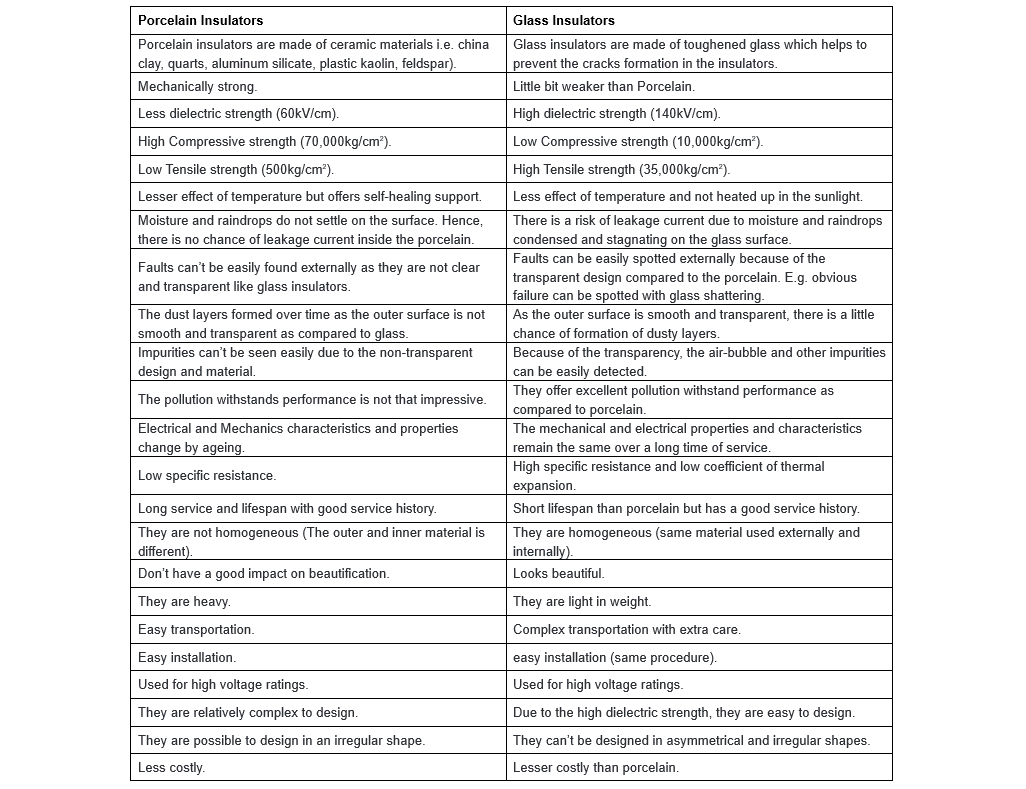
Porcelain, a ceramic material, is valued for its absence of internal defects such as voids, cracks, or thermal expansion when of premium quality. It is manufactured from china clay (naturally occurring aluminum silicate), mixed with plastic kaolin, feldspar (a crystalline silica stone), and quartz (silicon dioxide, SiO₂). This mixture is fired in a kiln at controlled temperatures to form a smooth, durable, and glossy insulator free of porosity.
A high-performance porcelain insulator features a dielectric strength of 60 kV/cm, a compressive strength of 70,000 kg/cm², and a tensile strength of approximately 500 kg/cm². Cement serves as the bonding material, rendering porcelain insulators one of the most prevalently used types in global power transmission and distribution networks.
Glass Insulators
Toughened glass is the core material for these insulators. The glass undergoes heating, melting, and a controlled cooling process (tempering), achieving a dielectric strength of up to 140 kV/cm.
Toughened glass suspension insulators are widely adopted in high-voltage transmission systems (≥ 500 kV) worldwide. With high resistivity, their transparent design offers a key advantage: faulty or arced insulators can be easily identified through visual inspection. Glass insulators exhibit a compressive strength of 10,000 kg/cm² and a tensile strength of 35,000 kg/cm².
Core Contrasts
Porcelain insulators, crafted from ceramic materials, excel in compressive strength (70,000 kg/cm²) but have lower tensile strength (500 kg/cm²), suitable for medium to high-voltage applications (<500 kV). Glass insulators, made of toughened glass, feature superior dielectric strength (140 kV/cm) and balanced mechanical properties (compressive strength 10,000 kg/cm², tensile strength 35,000 kg/cm²), ideal for extra-high voltage systems (≥ 500 kV). The transparency of glass enables straightforward fault detection, while porcelain’s non-transparent nature requires physical inspection. Despite higher initial costs, glass insulators demand less maintenance and offer longer lifespans, making them preferable for high-voltage networks where reliability is critical.

 Login