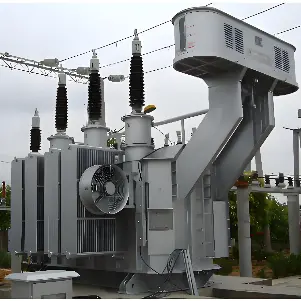
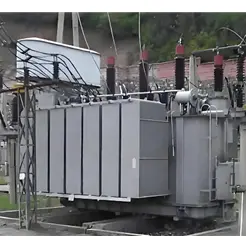
From the perspective of Pure Electromagnetic Theory, the answer is Yes. However, from the perspective of Engineering Pragmatism, the answer is almost always No.
Here is the deep-dive explanation of why "Reciprocity" does not equal "Interchangeability" in the field.
1. The Theoretical Perspective: Electrical Reciprocity
In the vacuum of physical laws, transformers are Passive Bidirectional Devices.
- Bidirectional Flux: The alternating magnetic flux in the laminated steel core is agnostic to which winding produces it. If you energize the Primary, the Secondary induces a voltage; if you energize the Secondary, the Primary does the same.
- Constant Ratio: The physical turns ratio (N1:N2N1:N2) is fixed. Electromagnetically, a 220V/110V220V/110V transformer should, in theory, output 220V220V if 110V110V is applied to the low-voltage side.
Verdict: In a laboratory or low-power electronics setting, they are interchangeable.
2. The Engineering Barrier: "Turns Compensation"
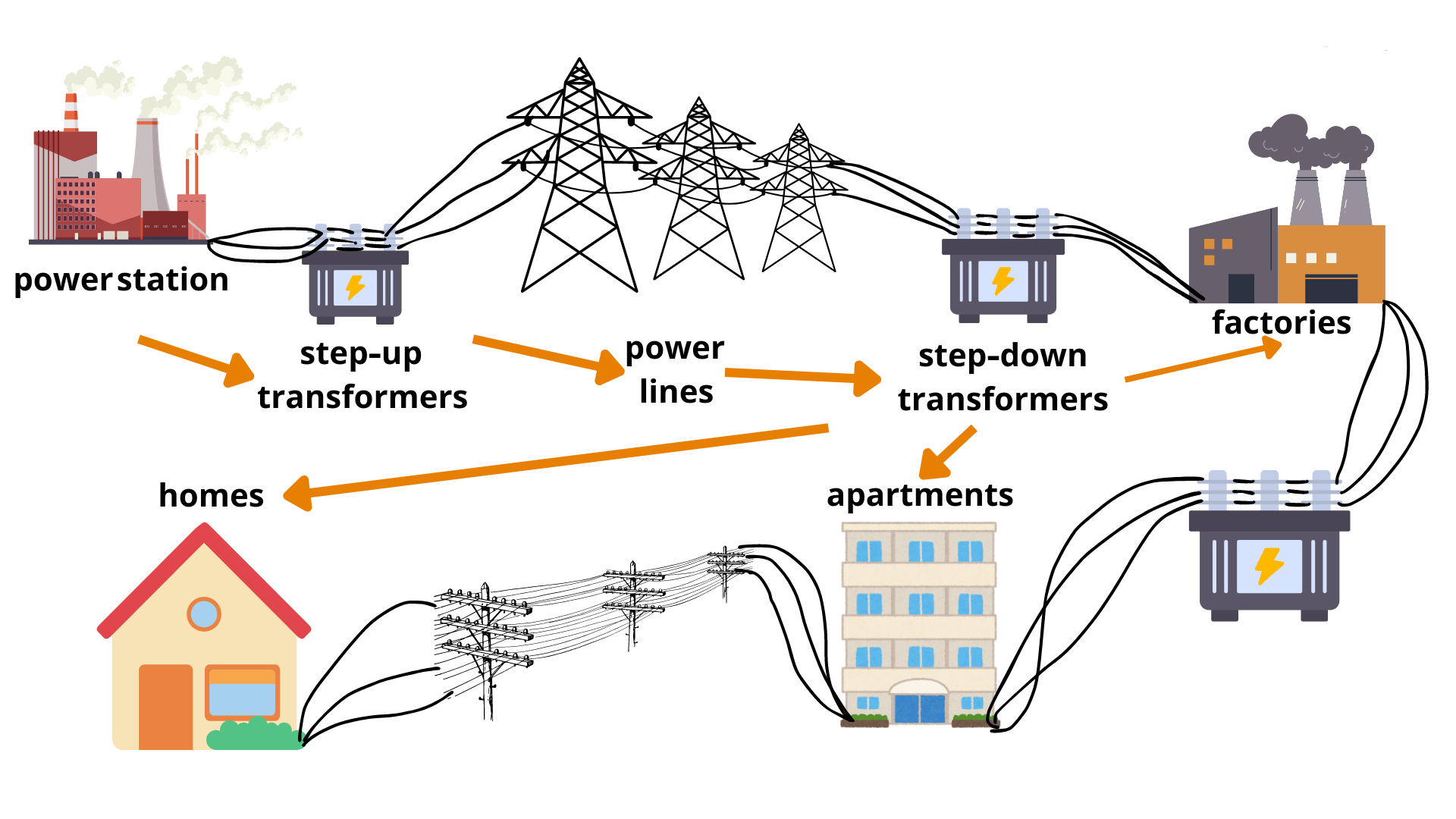
This is the primary reason why a reversed Step-Down transformer fails to provide the rated voltage.
The Logic of Compensation
In real-world operation, transformers experience Voltage Drop due to the internal resistance (RR) and leakage reactance (X) of the windings.
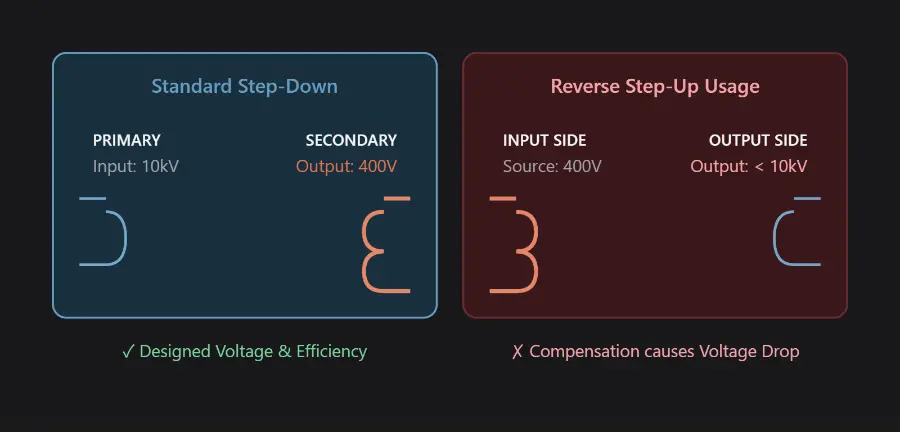
- Step-Down Design: To ensure the transformer outputs exactly 400V400V under full load, manufacturers add 3% to 5%3% to 5% extra turns to the secondary winding to compensate for the internal voltage drop.
- The Reversal Penalty: When you use a Step-Down transformer to "Step-Up," this compensation works against you.
- Example: A 10kV/400V10kV/400V unit actually has a secondary designed for ≈420V≈420V. If you input 400V400V into that secondary, the "Step-Up" output will be mathematically lower than 10kV10kV. Combined with the further voltage drop of the reverse current, you will suffer from significant Under-Voltage at the output.
3. Critical Engineering Constraints
In large-scale high-voltage engineering, reversal is practically impossible due to these factors:
A. Insulation Hierarchy & BIL
Transformers use Graded Insulation. The HV winding is designed with specialized end-shields and insulation layers to handle high dielectric stress. Reversing the energy flow changes the electric field distribution, potentially causing a Flashover in sections that were originally at low potential.
B. Bushing Design
High-voltage Bushings are massive and engineered to prevent corona discharge. Low-voltage terminals are usually simple copper busbars. The LV side is physically and dielectrically incapable of serving as the HV interface for the grid.
C. Inrush Current & Protection
Transformers are typically energized from the HV side because the higher impedance limits the Excitation Inrush Current. Energizing from the LV side (where impedance is much lower) can produce a massive current surge (10−20×10−20× rated current), which can trip protection relays or mechanically stress the windings.
D. Tap Changer Placement
In Step-Down units, the Tap Changer is located on the HV side to minimize the current flowing through the switch contacts. If reversed, the voltage regulation logic becomes inverted and ineffective.
4. Expert Conclusion: The Decision Matrix
| Capacity |
Interchangeable? |
Risk Level |
| Electronic (<100VA) |
Yes |
Low. Slight efficiency loss. |
| Small Dry-Type (1-10kVA) |
With Caution |
Output voltage will be lower than expected. |
| Distribution (100kVA-2.5MVA) |
No |
High. Issues with insulation, surge, and BIL. |
| Power Grid (>10MVA) |
Strictly Forbidden |
Catastrophic failure risk; zero mechanical/dielectric compatibility. |
Summary: While a transformer is a "bidirectional street" in theory, it is built as a "one-way road" in practice. Unless it is an emergency and you have calculated the exact insulation and compensation offsets, never use a Step-Down transformer as a Step-Up unit. Doing so will operate the device in a non-standard state, resulting in poor power quality and accelerated insulation aging.
5.ROCKWILL Transformer Key Advantages
ROCKWILL supplies both step-up and step-down transformers, covering the entire chain from power generation to end-user consumption:
| Application |
ROCKWILL Product |
| Solar / Wind step-up |
Skid-mounted step-up transformer (American/European style compact substation), 35kV step-up substation |
| Grid step-down |
110kV/35kV power transformer |
| Distribution step-down |
S22-M oil-immersed distribution transformer (10–33kV) |
| High-rise / Industrial |
Dry-type transformer (SCB series) |
| Extreme cold / Special environments |
-45°C extreme-cold type, salt-spray corrosion-resistant type |
| Voltage quality |
Line Automatic Voltage Regulator (AVR, 11/33kV) |
1. High Efficiency & Energy Saving
- No-load loss 30% lower than IEC standard
- Optimized load-loss design for lower operating costs
2. International Certification
- KEMA type-tested certification (S22-M oil-immersed transformer)
- Compliant with IEC and IEEE standards — no certification barriers for global export
3. Proven Quality
- Partial discharge below 80pC at 1.5× rated voltage
- Noise below 58dB for 63MVA and below
- Zero damage record for all in-service products
4. Globally Validated
- From a 20MW solar step-up project in Africa to -45°C extreme-cold distribution in Russia
- Delivery experience across 100+ countries
Whether you need renewable energy step-up grid connection or distribution network step-down supply, ROCKWILL provides a complete transformer solution from 10kV to 110kV, with capacities from 50kVA to 100MVA.
Contact us:
Edited From:Dyson

 Login
Login