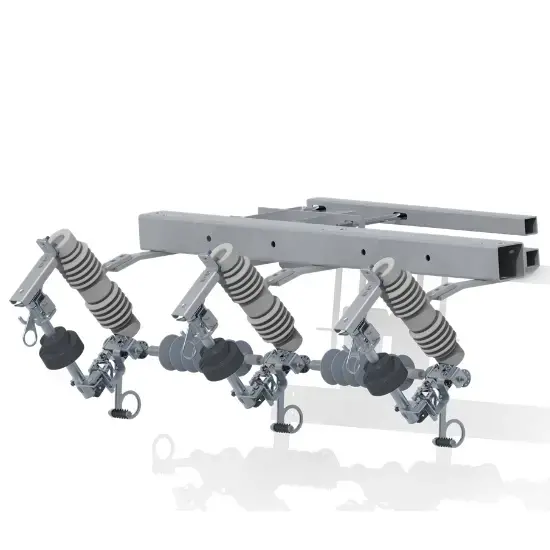
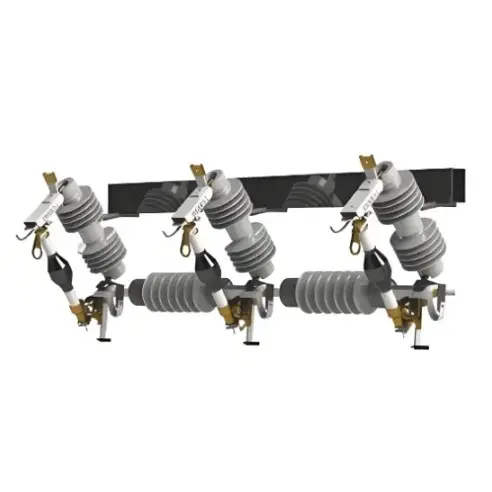
In the application of air-insulated pole-mounted electronic sectionalizers, self-powered designs (typically CT energy harvesting + supercapacitor/lithium battery) and external PT (voltage transformer) power supply represent two fundamentally different power supply approaches.
The core logic of an electronic sectionalizer is to "count fault current occurrences and perform open isolation during the dead zone after the upstream breaker/recloser trips." Since this type of switch does not need to interrupt short-circuit currents, its operating mechanism is typically lightweight (e.g., permanent magnetic actuator or low-power spring mechanism), making self-powered designs technically highly feasible.
Below is a comprehensive multi-dimensional comparison of the two approaches:
1. Operating Principle Comparison
-
Self-Powered Design: Utilizes an integrated CT (current transformer) within the switch body to harvest energy from line load current, or employs capacitive voltage division for power extraction. During normal operation, it charges internal supercapacitors or backup lithium batteries; when the line is de-energized, the stored energy maintains controller operation and executes the opening command.
-
External PT Power Supply: Involves suspending one or two electromagnetic voltage transformers (PTs) on the pole, stepping down 10kV/35kV high voltage to 110V/220V AC to power the controller, communication module, and motor, while also float-charging backup batteries. An alternative is the capacitive PT (electronic voltage transformer), which uses non-electromagnetic principles and eliminates ferroresonance risks, though at a higher cost.
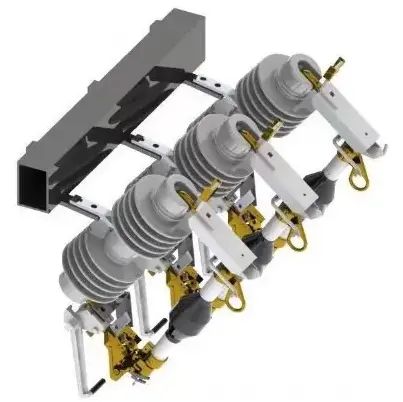
Rockwill RDK Series Three-Phase Pole Mounted SF6 Electronic Sectionalizer
2. Multi-Dimensional In-Depth Comparison
Power Supply Stability and Operating Condition Adaptability
-
External PT (Winner): As long as the line is energized (voltage present), it can continuously deliver hundreds of watts of power, completely unaffected by line load current magnitude. The ample power supply supports frequent motorized closing operations, heavy-duty FTU terminals, and high-power 5G/4G real-time communication.
-
Self-Powered (Limited): Suffers from "energy harvesting dead zones." With CT harvesting, when the line is at very low load (e.g., load current below 5A–10A), the harvested energy may be insufficient to sustain system power consumption, potentially depleting internal batteries over time. If zero-sequence/phase micro-energy harvesting is used, output is often only a few watts. In case of prolonged outages, devices may "go offline" due to battery depletion. However, power consumption optimization varies significantly across products—some low-power designs can operate reliably at even lower currents.
Size, Weight, and Installation
-
Self-Powered (Clear Winner): Highly integrated—true "primary-secondary fusion." The switch body is clean and compact, requiring no additional mounting of heavy PTs (a single oil-immersed or epoxy-resin PT typically weighs 30–50kg). Installation is plug-and-play, significantly reducing pole load and saving mounting space.
-
External PT (Cumbersome): Requires separate PT and bracket installation, with high-voltage side wiring; the secondary side requires aviation connectors and lengthy control cables to connect to the controller. This results in crowded pole tops, doubled construction difficulty, and extended overhead work time.
Safety and Insulation Fault Risks
-
Self-Powered (Winner): Air-insulated switches are inherently designed for environmental friendliness and maintenance-free operation. Eliminating the external PT removes a potential point of high-voltage insulation breakdown.
-
External PT (Higher Risk): In neutral-ungrounded systems (common in distribution networks), electromagnetic PTs are prone to ferroresonance, leading to PT burnout or frequent primary-side fuse blowing. Additionally, PT external insulation can age and leak current under prolonged outdoor exposure to sun and rain. Capacitive PTs eliminate resonance risks but are more expensive, and their electronic components are less tolerant of harsh environments compared to electromagnetic designs.
Procurement and Maintenance Costs
-
Self-Powered (Lower upfront, potentially higher later): Eliminates expensive high-voltage PT equipment and installation consumables, resulting in lower initial procurement and construction costs. However, lithium batteries may have shorter lifespans under extreme outdoor temperature variations (typically 5–8 years), potentially incurring replacement costs later. This issue is increasingly addressed by using supercapacitors with lifespans exceeding 10 years.
-
External PT (Higher upfront, lower later): Higher initial hardware costs, but PTs themselves have very long service lives (15–20 years), and batteries remain under good utility float-charge conditions, resulting in better long-term maintenance-free performance of the overall power architecture.
Special Considerations for "Sectionalizing" Logic
As noted earlier, the sectionalizer's core action (fault isolation) occurs during the dead period after the upstream recloser trips.
-
This means that at the very moment it needs to operate, the line is de-energized—and the PT has no power either.
-
Therefore, whether external PT or self-powered, the opening operation ultimately relies on internal capacitors or batteries to discharge. The external PT cannot provide power at this critical moment—it merely ensures the battery remains fully charged during normal operation.
3. Selection Recommendations: Which to Choose?
| Scenario Characteristics |
Recommended Solution |
Justification |
| Light-load branch lines, rural networks |
Self-powered |
Low loads create CT harvesting dead-zone risks; capacitive harvesting is unaffected by load current |
| Main feeders, FA core nodes |
External PT |
Requires frequent measurement/control/communication; high criticality demands 100% online rate—cannot tolerate battery depletion |
| Suburban areas with high aesthetic requirements |
Self-powered |
Clean pole-top appearance, no external attachments (often paired with compact pole-mounted switch cabinets) |
| Near renewable energy integration points |
External PT |
Bidirectional or highly variable power flow makes CT harvesting unstable; requires independent PT voltage supply |
Conclusion
For air-insulated electronic sectionalizers, the "self-powered design (CT harvesting + supercapacitor)" has become the mainstream trend, fully leveraging the advantages of lightweight construction and maintenance-free operation. However, at core network nodes with highly unstable loads or demanding communication requirements, external PT power supply remains the most reliable fallback choice for utility operators, thanks to its "power as long as the line is live" stability.
The Rockwill Air-Insulated Pole-Mounted Electronic Sectionalizer RDK Series exemplifies this philosophy. The product coordinates with upstream reclosers, counting fault current occurrences during line faults and precisely counting during the dead zone after the upstream switch trips. Upon reaching the preset count (1–4 times), it opens within 180ms to isolate the faulty section. No external power supply is required—the built-in CT simultaneously powers the controller and charges the supercapacitor energy storage, ensuring reliable opening even at the moment of outage. For temporary faults where the count does not reach the preset value, the RDK automatically resets without manual intervention.
At nodes with unstable loads or demanding communication requirements, external PT remains the reliable fallback choice. However, for new distribution network projects and FA retrofitting, the Rockwill RDK Series—with its primary-secondary integration, plug-and-play installation, and maintenance-free operation—is becoming the preferred choice for an increasing number of users.
Edited From:Garca

 Login