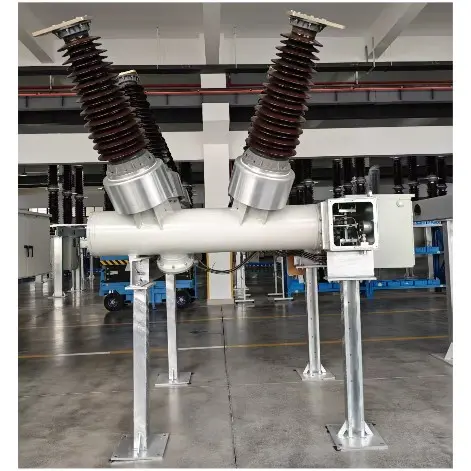
In the domain of Extra High Voltage (EHV) grids, the 400kV Dead Tank Circuit Breaker (DTCB) is regarded as the "Anchor" of the substation. Unlike the common Live Tank (porcelain column) breakers where the enclosure is at line potential, the DTCB features a metallic tank kept at ground potential. This design philosophy grants it superior seismic resilience and high system integration.
As a power systems expert, I will deconstruct this complex piece of heavy equipment for you, starting with its internal architecture.
I. Internal Anatomy of a 400kV Dead Tank Circuit Breaker
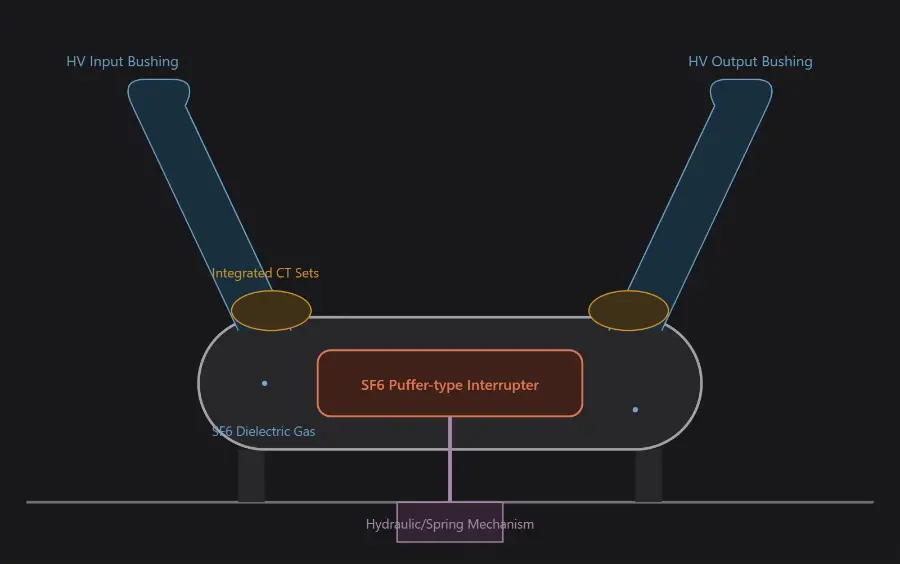
The 400kV DTCB typically utilizes SF6 (Sulfur Hexafluoride) gas for both insulation and arc quenching. All core components are hermetically sealed within the grounded metallic tank.
II. Key Characteristics of the 400kV DTCB
1. The "Dead Tank" Philosophy
In contrast to Live Tank designs where the enclosure is energized, the DTCB's tank is directly grounded. This results in:
- Low Center of Gravity: Making it exceptionally stable and the preferred choice for seismic zones.
- Ground-Level Mounting: Greatly simplifies the design of substation steel structures.
2. Integrated Current Transformers (Bushing CTs)
This is perhaps the greatest engineering advantage. CTs are installed directly around the base of the bushings inside the tank.
- Advantage: It eliminates the need for separate, free-standing CTs. This reduces the substation's footprint, shortens busbar lengths, and significantly lowers overall project costs.
3. Puffer-type Arc Extinction
At the 400kV level, the breaker typically utilizes the SF6 Puffer Principle. When a trip command is issued, the operating mechanism drives a piston to compress SF6 gas. This creates a powerful blast of gas that "extinguishes" the high-voltage arc (often tens of thousands of Amps) the moment the contacts separate.
4. Environmental Shielding
The tank is filled with SF6 gas at a rated pressure (typically 0.5–0.7 MPa). Since all conductive parts are enclosed within a grounded metallic shield, the equipment is completely immune to salt spray, dust, high humidity, or ice—making it the only choice for coastal substations or heavy industrial areas.
III. Expert Perspective: Why Use It at 400kV?
- Seismic Performance: In zones with a seismic intensity of 7 or higher, porcelain columns are prone to snapping due to their top-heavy nature. The Dead Tank is the only reliable choice.
- Space Management: By integrating the CTs, each bay can save approximately 20%-30% of land space.
- EMC Reliability: The metallic tank provides perfect electromagnetic shielding, resulting in less interference with sensitive relay protection systems.
Summary
The 400kV Dead Tank Circuit Breaker is more than just a switch; it is a compact power center that integrates insulation, interruption, and measurement (CT). In the field of EHV transmission, it represents the gold standard for physical stability and operational reliability.
Contact us:
Edited From:Dyson

 Login