• Product
  • Suppliers
  • Manufacturers
  • Solutions
  • Free tools
  • Knowledges
  • Experts
  • Communities
Search


Free Expert Guides on Power Systems, Circuit Design & Electrical Troubleshooting

Access free engineering resources from IEE Business—covering power design, circuit layout, equipment selection, and troubleshooting. Expert-developed guides help engineers, procurement, and project teams make better decisions. Stay ahead on smart grids, renewables, efficiency, and AI tools. Improve reliability, reduce downtime, and enhance outcomes with real-world solutions. Explore our knowledge hub today.
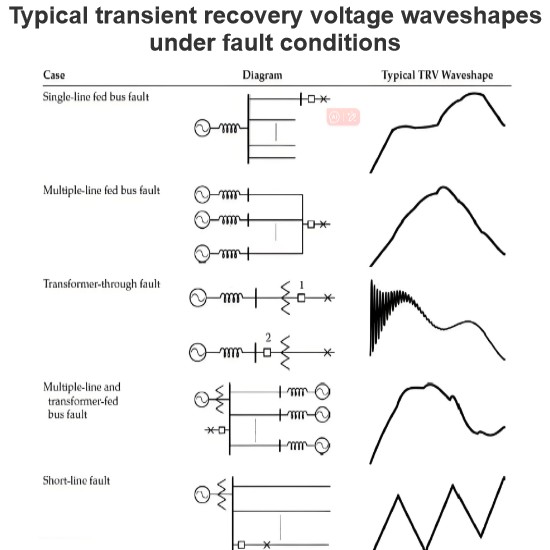
Typical transient recovery voltage waveshapes under fault conditions
Transient Recovery Voltages (TRVs) caused by fault current interruptions are typically categorized into three types of waveshapes: exponential, oscillatory, and sawtoothed. Additionally, significant TRV conditions can be classified under two main scenarios: Short Circuit Current Interruption: This is the simplest scenario involving the interruption of a symmetrical, rated-frequency short-circuit current. Since this current naturally reduces to zero at least once every half cycle, it represents t
02/07/2025
Consult
Tip
Consult
Tip
What is the difference between a GI wire and a copper wire for electrical connections?
Materials and Conductivity Copper Wire: Copper has excellent electrical conductivity with low resistivity, meaning it can transmit current more efficiently than other materials in the same size. Therefore, copper wire is typically the preferred choice for efficient power transmission applications such as household wiring, industrial power distribution, etc. GI Wire (Galvanized Steel Wire): The core of GI wire is steel, coated with a layer of zinc to prevent corrosion. While steel's conductivity
02/06/2025
Consult
Tip
Consult
Tip
How does temperature affect dielectric strength?
Temperature has a significant impact on dielectric strength, which is manifested as follows:1. Effects of Increased Temperature Material Softening: High temperatures cause insulating materials to soften, reducing their mechanical strength and insulation performance. Increased Conductivity: Rising temperatures enhance the mobility of charge carriers within the material, leading to increased conductivity and decreased insulation performance. Risk of Thermal Breakdown: At high temperatures, heat ac
02/06/2025
Consult
Tip
Consult
Tip
Gasket design for SF6 leakage
Leakage Causes and Gasket Design ConsiderationsLeaks in equipment often occur due to the deterioration of gasket materials over time and with use. Three critical factors influence gasket design and performance: Hardening of Gaskets:High ambient temperatures and the heat generated by electrical currents passing through circuit breakers during normal operation can reduce the elasticity of gaskets, causing them to harden over time. Chemical Attack:In substations, SF6 gas undergoes chemical changes
02/06/2025
Consult
Tip
Consult
Tip
How does core material permeability affect transformer efficiency?
The magnetic permeability of core materials has a significant impact on transformer efficiency, mainly manifesting in the following aspects:1. Magnetic Flux Density High Permeability: Core materials with high permeability can more effectively conduct magnetic flux, increasing magnetic flux density and enhancing the electromagnetic induction efficiency of the transformer. Low Permeability: Lower permeability results in decreased efficiency of magnetic flux conduction, leading to increased energy
02/05/2025
Consult
Tip
Consult
Tip
In an ungrounded system, what is the return path for the capacitive coupling between the high voltage line and the earth to maintain the flow?
In an ungrounded (or isolated grounding) power system, there indeed exists capacitive coupling between high-voltage lines and the earth, forming a capacitive current path. This phenomenon occurs because the electric field between the high-voltage conductors and their surrounding environment, including the ground, causes uneven charge distribution, resulting in what is known as "earth capacitance."Return Path Through Capacitive Coupling Earth Capacitance: Each high-voltage line has a certain amou
02/05/2025
Consult
Tip
Consult
Tip
What is a substation in electrical engineering?
Substations are critical facilities in power systems used for voltage transformation, power distribution, and controlling the flow of electricity. Their primary functions include:Voltage TransformationSubstations use transformers to convert high voltage electricity to lower voltages, or vice versa, to meet the needs of different users and equipment.Power DistributionSubstations transmit electricity from power plants to various consumption areas, ensuring a stable and reliable power supply.Power
02/05/2025
Consult
Tip
Consult
Tip
How do temperature changes affect transformer performance?
Impact of Temperature Changes on Transformer PerformanceThe influence of temperature changes on transformer performance is mainly reflected in the following aspects:Insulation Material Aging High Temperature: High temperatures accelerate the aging of internal insulation materials in transformers, reducing their insulating properties and increasing the risk of faults. Low Temperature: Low temperatures can make insulation materials brittle, leading to cracks, which also affects insulation effectiv
02/05/2025
Consult
Tip
Consult
Tip
Auxiliary contact in switchgears
Auxiliary contacts are essential components in circuit breakers and switchgear, providing critical functionality for control and indication. Here's a breakdown of their purpose and operation:Purpose of Auxiliary Contacts: Breaker Trip & Closing Control: Auxiliary contacts are used in control circuits to manage the supply to the trip coil and closing coil, ensuring proper operation of the circuit breaker. Breaker ON/OFF Indication: These contacts provide signals to indicate whether the b
02/05/2025
Consult
Tip
Consult
Tip
Trip free operating mechanism definition acc to IEEE C37.04
Trip-Free Operation of Medium Voltage Circuit BreakersDefinition and BehaviorThe trip-free operation of medium voltage circuit breakers ensures that, regardless of any closing command, the breaker will open if a tripping signal (either mechanical or electrical) is received. This characteristic guarantees safe and reliable operation under all conditions. The behavior of the circuit breaker under different scenarios is detailed below: Simultaneous Closing and Tripping Signals:If a closing operatio
01/25/2025
Consult
Tip
Consult
Tip
Send inquiry
+86
Click to upload file
Download
Get the IEE Business Application
Use the IEE-Business app to find equipment, obtain solutions, connect with experts, and participate in industry collaboration anytime, anywhere—fully supporting the development of your power projects and business.






