If we were to name the longest-serving equipment in the power system, the transformer would almost certainly top the list. Line-frequency transformers have been serving in the grid for over a century — mature, robust, and dependable. But their ceiling is equally clear: bulky size, a modest efficiency limit, fixed transformation ratios, no active grid control, and no way to deal with harmonics.
In front of the new power system — with high penetration of renewables, the shift toward DC, and flexible control — this century-old veteran is increasingly out of its depth. The Solid-State Transformer (SST) targets exactly these shortcomings. By replacing conventional line-frequency electromagnetic transformation with power-electronic conversion, it is becoming the key enabling technology for making medium-voltage distribution networks "flexible, DC-ready, and highly efficient".
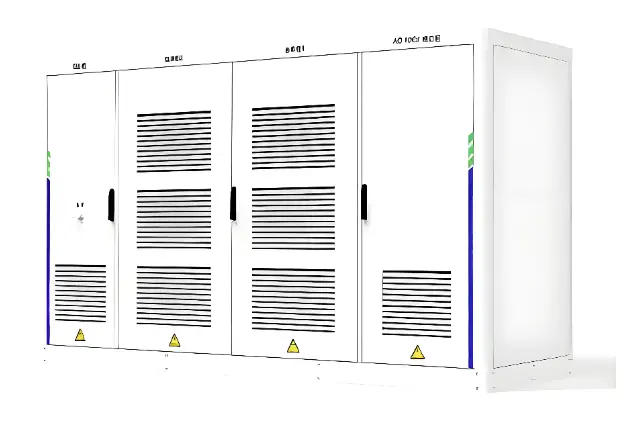
Solid-State Transformer (SST)
Five Inherent Bottlenecks of the Conventional Transformer
Let's first be clear about what the problem is. Conventional transformers share five built-in limitations:
| Pain Point |
Manifestation |
Physical Root Cause |
| Bulky size |
A 10 kV line-frequency transformer weighs several tonnes |
Low-frequency core/winding volume is inversely proportional to frequency |
| Efficiency ceiling |
Only 95%–97% at full load |
Core loss + copper loss cannot be eliminated |
| No control |
Passive transformation only |
No power-electronics-based controllable stage at all |
| No-load losses |
Continuous core loss, 24/7 |
Core is always energized by the grid |
| Harmonic sensitivity |
Cannot mitigate harmonics |
No filtering capability |
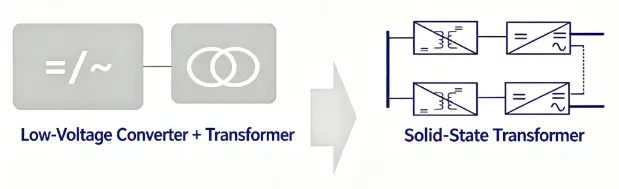
Why SST Can Overtake on the Curve?
SST takes a completely different technical path: it lifts the 50 Hz line frequency up to switching at 20 kHz and above, using power electronic devices plus high-frequency transformers to achieve transformation, isolation, and regulation.
| Stage |
Conventional Transformer |
SST (Solid-State Transformer) |
| Conversion method |
Electromagnetic induction (50 Hz) |
High-frequency power-electronic switching (20 kHz+) |
| Transformer |
Large line-frequency core |
Small high-frequency transformer, isolation up to 42 kV |
| Control capability |
None, fixed ratio |
Real-time DSP control: adjustable power, treatable harmonics |
There is a core physical logic here: transformer volume is inversely proportional to operating frequency. Raising the frequency to 20 kHz and above shrinks the core and winding volume by roughly 90% for the same power — this is the physical root of SST being able to cut equipment footprint by 65%. At the same time, soft-switching techniques in power electronics push efficiency past 98%, a level conventional methods cannot realistically reach.
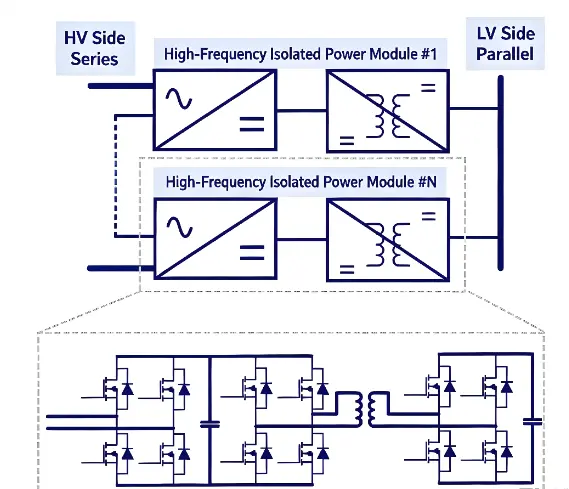
Solid‑state transformer high‑voltage series low‑voltage parallel module topology diagram
What This "Technology Base" Delivers?
We have built this SST technology base into a common platform serving six scenarios at once — AI/data-centre power, ultra-fast charging, energy storage, distribution network interconnection, rail transit, and microgrids. The capability leap maps to three key indicators:
-
Maximum efficiency 98.5% — SiC soft switching with full-range ZVS
-
Isolation rating 42 kV — 35 kV per module, 42 kV total isolation when series-connected
-
Power density 0.66 kW/dm³ — 130% higher than conventional solutions
Expanding further, its core value proposition is:
| Value Dimension |
Quantified Indicator |
Explanation |
| Efficiency |
98.5% |
SiC soft switching with full-range ZVS |
| Isolation |
35 kV per module / 42 kV total |
Modular design with high insulation |
| Power density |
0.66 kW/dm³ |
+130% vs conventional |
| Harmonics |
<1% |
No additional filtering equipment required |
| 10 kV production units |
1.0 / 1.25 / 1.5 MW |
Full product sequence covered |
| DC output |
200–1000 V stepless regulation |
Adapts to diverse loads |
| Redundancy |
Live N+X redundancy |
Dual power supply + dual-controller hot standby |
Technical Highlights: Three Signature Strengths
First, a hybrid three-level topology balancing performance and economics. On the high-voltage side, Si-IGBTs take most of the voltage stress (high voltage withstand, low cost); on the low-voltage high-frequency side, SiC-MOSFETs handle the high-frequency switching (fast switching, low losses). While maintaining performance, this approach cuts cost by more than 50% versus an all-SiC solution.
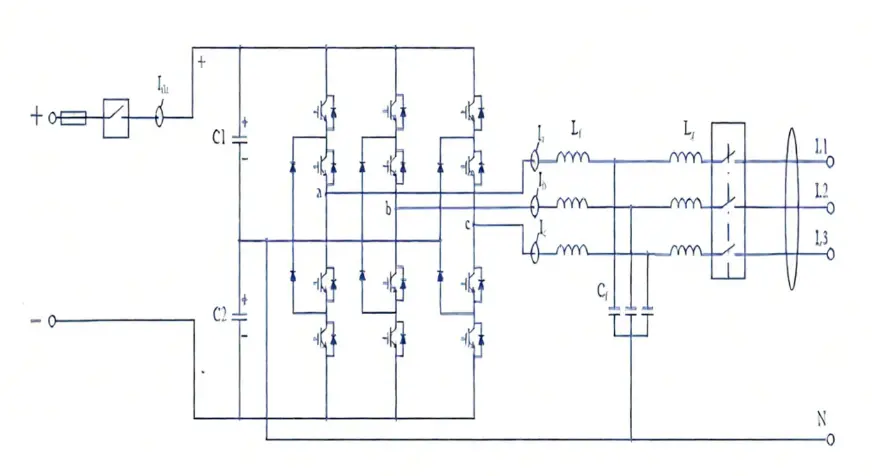
Second, high-frequency parallel soft switching with SiC. Multiple parallel devices achieve current balancing through current-sharing inductors (imbalance below 5%), combined with resonant ZVS (zero-voltage switching) to drive switching losses toward zero. Measured high-frequency full-load losses drop a further 12%, delivering a maximum efficiency of 98.5%.
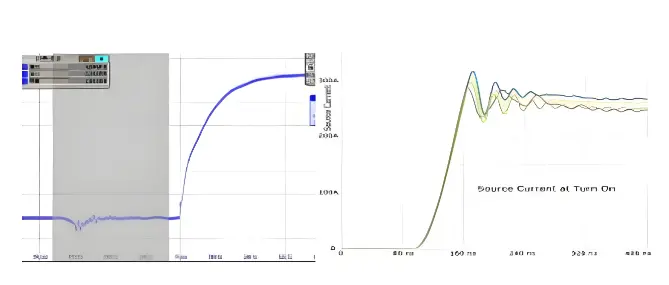
SiC MOSFET multi‑chip parallel turn‑on current test waveform
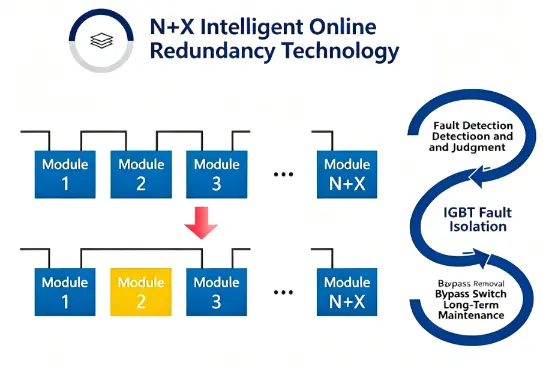
Third, high insulation plus intelligent redundancy. Each module is insulated to 35 kV, with 42 kV total isolation when series-connected; N+X redundancy plus dual-controller hot standby automatically bypasses a faulty IGBT, keeping system availability above 99.9% — a single point of failure does not affect operation.
Down to the Numbers: More Than Just Electricity Savings
On the financial side, the benefits of SST are all-round:
-
Equipment footprint −65%, sharply reducing civil-works investment
-
Copper usage −90%+, slashing material costs
-
Installation cycle compressed from 12 months to 3 months, 75% faster delivery
-
Maintenance shifts from periodic servicing to modular, maintenance-free operation, greatly reducing long-term costs
There is also proven field evidence: the CNPC Kunshan ultra-fast charging station operates at 95%+ efficiency with 40% less footprint; the GDS Chongqing direct-connect energy-storage project achieves 90% overall efficiency; and the Guangdong Power Grid six-area interconnection equipment runs at 98.7% efficiency.
Future-Ready: Build the Base First
Against the backdrop of "dual carbon" goals and the new power system, the value of the SST technology base is that it is not tied to any single application. Instead, it delivers one common platform for AI/data-centre power, ultra-fast charging stations, energy storage, distribution network interconnection, rail transit, and microgrids — medium-voltage direct connection, flexible regulation, and efficient isolation, all in one.
On delivery, we insist on factory-prefabricated, modular supply with plug-and-play on site — the Kunshan project is evidence that a one-day deployment is achievable. Once online, the platform comes with full-lifecycle remote O&M and OTA upgrades, letting the equipment "keep getting smarter the longer it runs".
Once the technology base is in place, the applications running on top of it move faster. If you are also thinking about how to take the medium-voltage side toward flexibility and DC-readiness, we'd love to talk through your specific scenario. Back to the question we started with — should this century-old veteran get a new core? The answer is clear: yes, and upgrading now costs less than being forced into it by your applications later.

 Login
Login