I. Solution Background
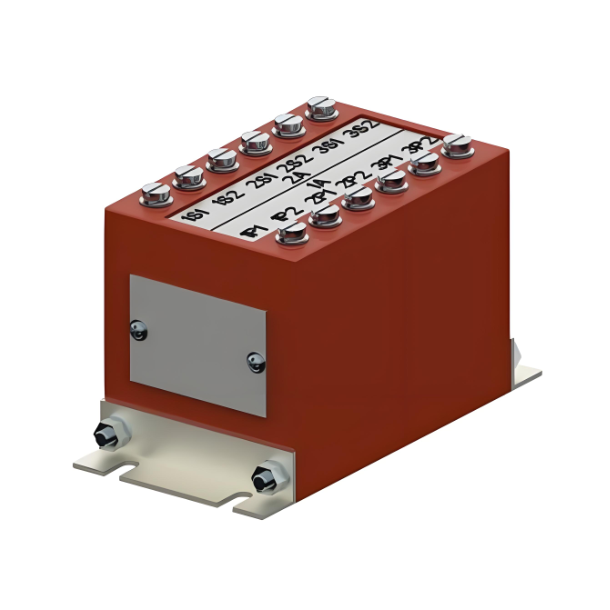
In high-precision applications such as smart grids, renewable energy metering, and industrial power monitoring, conventional low-voltage current transformers (LV CTs) often face challenges including insufficient accuracy, significant temperature drift, and poor long-term stability. To meet the 0.2S/0.5S-class high-precision metering requirements, this solution proposes a comprehensive improved design for electromagnetic LV CTs through core material innovation and structural optimization.
II. Core Technical Solutions
Upgraded High-Permeability Core Materials
Nanocrystalline/Amorphous Alloy Ultra-Thin Strips:
Cores are wound using 0.02–0.025mm thick nanocrystalline or amorphous alloy strips, achieving an initial permeability (μi) of over 1.5x10⁵ H/m. This significantly reduces excitation current and minimizes ratio/phase errors.
Magnetic Domain Optimization:
Directional magnetic field annealing eliminates core stress, enhances flux uniformity, and reduces hysteresis losses under high-frequency harmonics.
Magnetic Shielding and Anti-Interference Structures
Multi-Layer Composite Magnetic Shielding:
Dual Permalloy + copper mesh shielding layers are added around the core to suppress external AC magnetic field interference and mitigate DC bias effects.
Orthogonal Winding Process:
Segmented orthogonal winding technology for secondary windings reduces distributed capacitance and leakage inductance, improving frequency response (accuracy deviation < ±0.1% within 1–5kHz bandwidth).
Temperature Compensation and Signal Processing
Dynamic Temperature Compensation Circuit:
Integrated high-linearity NTC/PTC sensors real-time compensate for temperature drift in core permeability and winding resistance (temp. drift coefficient ≤ ±10 ppm/°C).
High-Stability Sampling Resistor:
Low-drift metal foil resistors (ΔR/R < ±5 ppm/°C) with four-terminal Kelvin connections ensure current-to-voltage conversion accuracy.
Encapsulation and Insulation Reinforcement
Vacuum Potting Process:
High-purity epoxy resin potting at 10⁻³ Pa eliminates bubbles and internal stress, enhancing mechanical strength and thermal stability.
Multi-Layer Insulation Architecture:
Polyimide film + silicone composite interlayer insulation achieves dielectric strength >15 kV/mm and partial discharge <5 pC (@1.5Ur).
III. Performance Advantages
Parameter |
Conventional CT |
This Solution |
Improvement |
Accuracy Class |
0.5–1.0 |
0.2S/0.5S |
Ratio/Phase errors ↓50% |
Temp. Drift Coeff. |
±100 ppm/°C |
±10 ppm/°C |
10x better stability |
Long-Term Stability |
±0.3%/year |
±0.05%/year |
Lifetime error controllable |
Phase Error (1%In) |
>30' |
<5' |
Phase precision ↑6x |
Operating Temp. |
-25°C~+70°C |
-40°C~+85°C |
Enhanced extreme-environment adaptability |
IV. Application Scenarios
This solution is particularly suited for:
• Power Metering: Smart meters, distribution network automation systems (compliant with IEC 61869-2 standard)
• Renewable Energy Monitoring: High-precision current sampling in PV inverters and energy storage systems
• Industrial Control: Fault current detection in VFDs and motor protection devices
• Lab Standards: Serving as 0.2S-class standard transformers for value transfer

 Login