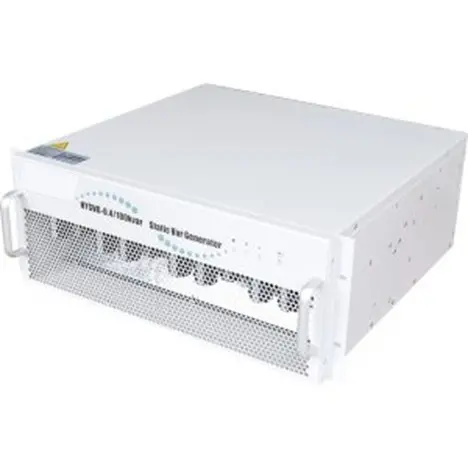
| Brand | Rw Energy |
| Series | RWSVG |
| Rated voltage | 380V |
| Frequency | 50Hz |
| Efficiency | ≥97% |
Rural distribution lines are long, loads are scattered, and end-of-line voltage is chronically low. With the rise of PV inverters, EV chargers, and other non-linear equipment, three-phase imbalance, harmonic pollution, and reverse reactive power flow are becoming widespread — causing transformer overheating, excessive line losses, and frequent end-user equipment trips.
This device is purpose-built to solve these issues, fully compliant with national low-voltage distribution network governance standards.
Advanced power electronics combined with real-time digital closed-loop control. The IGBT-based inverter module dynamically injects or absorbs reactive current and unbalanced three-phase currents. Intelligent high-speed algorithms continuously monitor phase voltage, current distortion, load imbalance ratio, and harmonic content, delivering millisecond-response, high-precision compensation.
| Feature | Description |
|---|---|
| Three-Phase Imbalance Correction | Real-time dynamic compensation with ultra-fast response |
| Neutral Current Compensation | Up to 3× rated phase current, prevents neutral-point potential drift |
| Reactive Power Compensation | Dynamic active/reactive regulation, accuracy ≥95%, PF up to 0.99, intelligent anti-over-compensation |
| Harmonic Suppression | 2nd to 13th order, suitable for EV chargers, PV inverters, and industrial loads |
| End-of-Line Voltage Boost | Especially effective on long rural low-voltage feeders |
| Parameter | Specification |
|---|---|
| Rated Voltage | 380 V (±20% allowable fluctuation) |
| Frequency | 50 Hz |
| Wiring | Three-phase three-wire |
| Compensation Capacity | 30 / 50 / 100 / 150 kvar |
| Efficiency | ≥97% |
| Power Consumption | ≤3% of rated power |
| Switching Frequency | 20 kHz |
| Response Time | 100 μs / 10 ms |
| Cooling | Forced-air cooling |
| Noise | < 65 dB |
| Protection Rating | IP55 with built-in Class II SPD |
| Operating Temperature | –10°C to +45°C |
| Storage Temperature | –20°C to +60°C |
| Humidity | < 95% RH (non-condensing) |
Three-level digital vector control algorithm
Precise voltage/current waveform distortion detection for active harmonic suppression
External CT input (Class 0.5 or above, ≥5 VA, secondary recommended: 5 A)
Dimensions: 978(H) × 465(W) × 485(D) mm (custom sizes available)
Material: Stainless steel or hot-dip galvanized steel
Side cable entry for easy on-site wiring
Front sun-shielded, waterproof, lockable maintenance door
Rear ventilation grilles matched to forced-air cooling
Designed for pole-mounted deployment in rural distribution networks
Local: WiFi handheld terminal for full parameter viewing and real-time status monitoring.
Remote (optional): GPRS cloud platform supporting data reporting, remote parameter configuration, multi-level fault alarms, and historical data review.
Multi-layer protection: over-temperature, over-voltage, under-voltage, over-current, short-circuit, module overload, and grid anomaly detection. Compliant with DL/T 860 and national low-voltage distribution network standards.
Adaptive compensation under variable load conditions
Anti-resonance design prevents system resonance risks
Automatic module isolation during grid anomalies; auto-restart when grid normalizes
Switches to protection mode under severe power quality deterioration
Three‑phase imbalance is typically caused by the uneven distribution of single‑phase loads, such as residential appliances, lighting, and increasingly, EV chargers. This imbalance leads to increased energy losses in transformers, neutral line heating, and voltage fluctuations at the end of the line.
Unlike traditional capacitor banks that provide fixed, step‑wise compensation, the RWSVG is an active power electronic device based on IGBT technology. It provides continuous, stepless compensation in both inductive and capacitive ranges. Most importantly, it can redistribute active power between phases to eliminate current imbalance, which passive capacitors cannot do.
Yes. By injecting reactive power dynamically, the RWSVG stabilizes the terminal voltage and raises the voltage level of low‑voltage feeders. This ensures that users at the end of long distribution lines receive stable power, preventing equipment malfunction due to undervoltage.








 Login