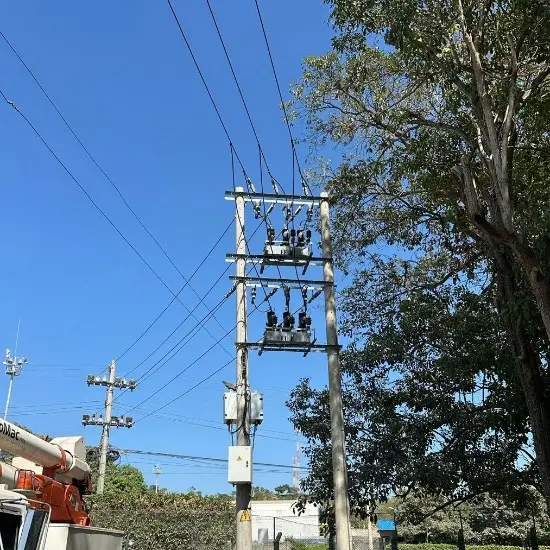
The reason a recloser can function as a circuit breaker is that, when examined from the perspectives of physical structure, core technology, and electrical functionality, a recloser is essentially a highly integrated, purpose-built circuit breaker. However, it is important to note that a recloser is not simply a circuit breaker plus a controller.
The core reasons why it can perfectly perform the role of a circuit breaker are as follows:
1. The Underlying Arc-Quenching Mechanism Is Identical
What fundamentally defines a circuit breaker is its ability to safely interrupt massive short-circuit fault currents—something ordinary load switches cannot achieve.
-
The "heart" of a modern 35 kV recloser is exactly the same as that of a conventional 35 kV circuit breaker—typically a vacuum interrupter or an SF₆ interrupter chamber.
-
When a short circuit occurs, the recloser extinguishes the arc through vacuum or gas media, thereby interrupting the fault current. The physical process is entirely identical to that of a standard circuit breaker.
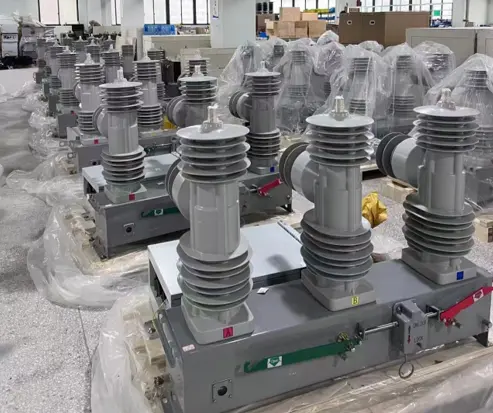
RCW Series Silicone Rubber Outdoor Vacuum Reclosers
2. Equivalent Interrupting and Insulation Capabilities
To qualify as a circuit breaker, a device must meet the requirements of national or international standards (such as IEC or GB) for rated short-circuit breaking current.
-
A 35 kV recloser also undergoes rigorous type testing and is capable of interrupting fault currents of 12.5 kA, 16 kA, or even 20 kA. It can withstand the lightning impulse withstand voltage (typically 185 kV) and power-frequency withstand voltage required for 35 kV systems. In terms of insulation and interrupting capacity, it fully meets the definition of a circuit breaker.
3. Fast-Acting Operating Mechanism
A circuit breaker is required to complete mechanical tripping within an extremely short time (typically tens of milliseconds) to isolate faults.
-
Reclosers are generally equipped with permanent magnetic actuators or spring-charged operating mechanisms. Permanent magnetic actuators, in particular, have very few moving parts and offer extremely fast response times, fully meeting the stringent requirements for rapid fault clearing.
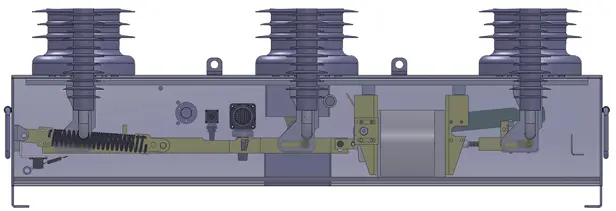
RCW Series Schematic Diagram of Permanent Magnetic Operating Mechanism
4. Logical "Backward Compatibility"
A circuit breaker is essentially a "mute" device that relies on an external protection relay to tell it when to trip—and once tripped, it remains open.
-
A recloser, on the other hand, is an integrated unit comprising an "intelligent control box + circuit breaker mechanism."
-
If you only need it to perform the function of a standard circuit breaker, you can simply disable the auto-reclosing function on the intelligent controller's panel. In this mode, when a fault occurs, it behaves exactly like a conventional circuit breaker: detects the short circuit → trips immediately → locks in the open position, awaiting manual intervention.
Rockwill Solution: Rockwill's RCW series recloser—like ABB's OVR series, Eaton's NOVA series, and Noja Power's OSM series—features high-precision current and voltage sensors (Rogowski coils, capacitive voltage dividers, etc.) directly embedded within the epoxy resin pole assembly, with the controller mounted locally on the unit itself. The end user simply needs to connect the power supply and communication cables, and then set the minimum tripping current, protection curves, and the number and intervals of reclosing operations via the controller panel. The device is then ready to operate independently, requiring no external protection relays or PLCs to perform its protection and control functions. Moreover, the RCW series recloser offers a mechanical service life far exceeding that of circuit breakers at the same voltage level.
Edited From:Garca

 Login