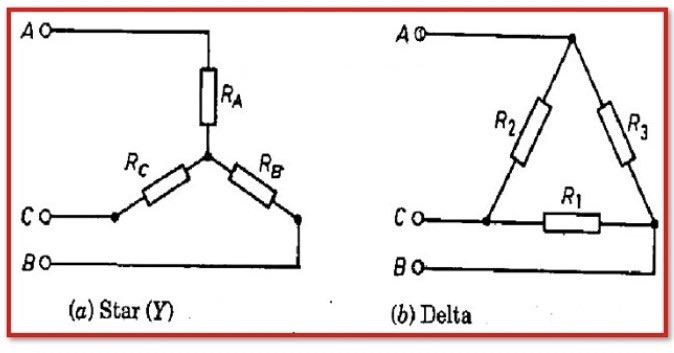
The Star-Delta transformation is a technique in electrical engineering that allows the impedance of a three-phase electrical circuit to be transformed from a “delta” configuration to a “star” (also known as “Y”) configuration, or vice versa. The delta configuration is a circuit in which the three phases are connected in a loop, with each phase connected to the other two phases. The star configuration is a circuit in which the three phases are connected to a common point, or “neutral” point.
The Star-Delta transformation allows the impedance of a three-phase circuit to be expressed in either the delta or the star configuration, depending on which is more convenient for a given analysis or design problem. The transformation is based on the following relationships:
The impedance of a phase in a delta configuration is equal to the impedance of the corresponding phase in a star configuration divided by 3.
The impedance of a phase in a star configuration is equal to the impedance of the corresponding phase in a delta configuration multiplied by 3.
The Star-Delta transformation is a useful tool for analyzing and designing three-phase electrical circuits, particularly when the circuit contains both delta-connected and star-connected elements. It allows engineers to use symmetry to simplify the analysis of the circuit, making it easier to understand its behavior and to design it effectively.
The Star-Delta transformation is only applicable to three-phase electrical circuits. It is not applicable to circuits with a different number of phases.
RA=R1R2/(R1+R2+R3) ——— Equation 1
RB=R2R3/(R1+R2+R3) ——— Equation 2
RC=R3R1/(R1+R2+R3) ——— Equation 3
Multiply and then add each set of two equations.
RARB+RBRC+RCRA=R1R22R3+R2R32R1+R3R12R2/(R1+R2+R3)2
RARB+RBRC+RCRA= R1R2R3 (R1+R2+R3)/(R1+R2+R3)2
RARB+RBRC+RCRA = (R1+R2+R3)/(R1+R2+R3) ———- Equation 4
Divide Equation 4 by Equation 2 and get
R1=RC+RA+(RC/RARB)
Divide Equation 4 by Equation 3 and get
R2=RA+RB+(RA/RBRC)
Divide Equation 4 by Equation 1 and get
R3=RB+RC+(RB/RCRA)
The resistances of the delta network can be found using the above relations. In this technique, a star network can be converted into a delta network.
Statement: Respect the original, good articles worth sharing, if there is infringement please contact delete.

 Login
Login