A Brief Discussion on the Testing and Analysis of Gas Micro-Water in SF6 Circuit Breakers
SF₆ circuit breakers possess excellent physical, chemical, insulation, and arc - extinguishing properties. They allow for a large number of consecutive interruptions, have low noise, and pose no risk of sparking. Additionally, they are small in size, light in weight, large in capacity, and require little or no maintenance. As a result, they are gradually replacing traditional oil - filled circuit breakers and compressed - air circuit breakers. Moreover, in medium - voltage power distribution, these circuit breakers have advantages such as non - reignition when interrupting capacitive current and no over - voltage generation when interrupting inductive current, which has led to their widespread application.
1 Properties of SF₆ Gas
1.1 Physical Properties
The molecular weight of SF₆ gas is 146.07, and its molecular diameter is 4.56×10⁻¹⁰ m. It exists in a gaseous state under normal temperature and pressure. At 20°C and one atmospheric pressure, its density is 6.16 g/L (approximately five times that of air). The critical temperature of SF₆ gas is 45.6°C, and it can be liquefied by compression. Usually, it is transported in steel cylinders in a liquid state. Pure SF₆ gas is colorless, odorless, tasteless, non - toxic, and non - flammable.
1.2 Electrical Properties
(1) SF₆ is an electronegative gas (capable of adsorbing free electrons), with excellent arc - extinguishing and insulating properties. In a uniform electric field under one standard atmospheric pressure, the voltage - withstand strength of SF₆ gas is approximately 2.5 times that of nitrogen.
(2) Pure SF₆ gas is an inert gas. It decomposes under the action of an arc. When the temperature exceeds 4000K, most of the decomposition products are single atoms of sulfur and fluorine. After the arc extinguishes, the vast majority of the decomposition products recombine into stable SF₆ molecules. Among them, a very small amount of decomposition products react chemically with free metal atoms, water, and oxygen during the recombination process, generating metal fluorides and fluorides of oxygen and sulfur.
2 Micro - water Testing of SF₆ Circuit Breaker Gas
2.1 Significance of Micro - water Testing
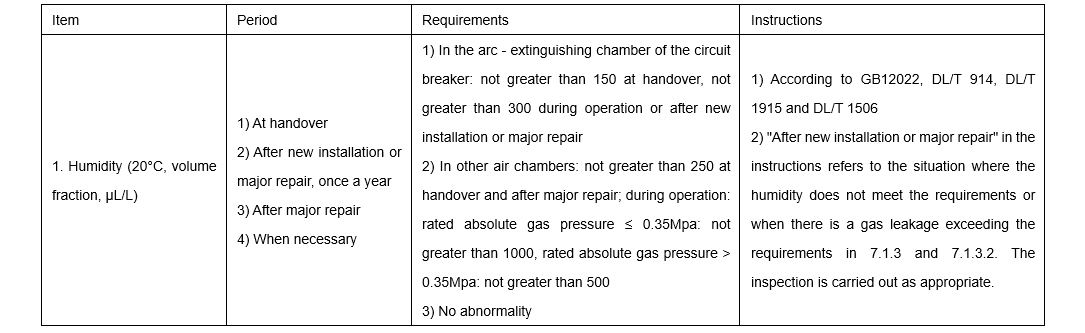
Detecting the micro - water content in the gas is a major test item for SF₆ circuit breakers. New SF₆ gas or gas in operation containing trace amounts of water will directly affect the gas's properties. When the water content reaches a certain level, hydrolysis reactions are likely to occur, generating acidic substances that can corrode equipment. Especially under high temperatures and the action of an arc, toxic low - fluorides are easily generated. The resulting fluorosulfur compounds react with water to form highly corrosive hydrofluoric acid, sulfuric acid, and other highly toxic chemical substances, endangering the lives of maintenance personnel and corroding the insulating materials or metals of the circuit breaker, causing insulation degradation. When the circuit breaker is installed outdoors and the temperature drops sharply, excessive water in the SF₆ gas may condense on the surface of the solid medium, leading to flashover. In severe cases, it can cause the circuit breaker to explode.
2.2 Testing Methods
(1) Gravimetric method: After passing through a desiccant, its weight change is accurately measured. However, this method has high operational requirements and consumes a large amount of gas in a constant - temperature, constant - humidity, and dust - free environment.
(2) Dew - point method: When the temperature of the test system is slightly lower than the saturation temperature of water vapor (dew point) in the sample gas, the test system can provide an electrical signal. After amplification and output, the water content is determined based on the dew - point value. Currently, this method is an important means for measuring trace water in SF₆, and dew - point meters are produced both at home and abroad.
3 Sources and Control of Humidity in SF₆ Circuit Breaker Gas
3.1 Sources of Humidity in the Gas
(1) For new gas, the main sources of humidity are: insufficiently strict detection by the gas - manufacturing plant; non - compliant storage environments during transportation; and excessive storage time.
(2) For electrical equipment filled with SF₆ gas, the main sources of humidity are: the humidity brought by the SF₆ gas itself; the small amount of residual humidity due to incomplete purification of the gas before charging; the humidity gradually released over time by insulating materials, welded parts, and components in the electrical equipment; and the humidity that intrudes from the outside through equipment leaks.
3.2 Control Measures for the Water Content of SF₆ Gas in SF₆ Circuit Breakers
Ensure strict quality inspection during new gas acceptance; control the treatment of insulating parts; control the quality of sealing parts; control the quality of adsorbents; control the operation during gas charging; strengthen gas leakage detection during operation; and strengthen the monitoring and measurement of gas micro - water during operation.
4 Toxicity of SF₆ Gas
When SF₆ gas is used in electrical equipment, whether under fault conditions or during normal arc interruption, it may decompose to produce fluorides of oxygen and sulfur, as well as metal fluoride powders. When the content of hydrolyzable fluorides in SF₆ gas reaches a certain concentration, the SF₆ gas becomes toxic, and it also affects the insulation strength and arc - extinguishing performance of SF₆ gas in electrical equipment.
Under the action of spark discharge and arc, SF₆ gas circuit breakers will generate highly toxic gases through dissociation and ionization. Since these gases are colorless and odorless, they are difficult to detect. Moreover, with a density of 6.16 g/L (about five times that of air), some toxic and harmful gases generated during monitoring accumulate near the ground in the switch room. This makes it easy for potential poisoning of workers to occur during circuit breaker disassembly, major repairs, or micro - water testing of the gas, posing a great threat to the physical and mental health of workers and the safe operation of equipment.
For example, if an SF₆ gas leakage monitoring and alarm system and a quantitative SF₆ gas leakage detector are not installed in the SF₆ switch room, it is impossible to know whether the SF₆ concentration is within the safe standard range. Experience shows that even in an environment with very trace amounts of decomposition products, workers may feel pungent or uncomfortable gases, which can cause obvious irritation to the nose, mouth, and eyes. Generally, after poisoning, symptoms such as tearing, sneezing, runny nose, a burning sensation in the nasal cavity and throat, hoarse voice, coughing, dizziness, nausea, chest tightness, and discomfort in the neck may occur. In severe cases, shock may even occur.
Therefore, online monitoring of SF₆ gas leakage has become a major topic in current technical research. For example, the exhaust fan can be organically controlled together with the SF₆ gas leakage alarm system, so that the exhaust fan can be automatically turned on when the SF₆ gas leakage concentration exceeds the standard, ensuring the safety of personnel and equipment.
The two most important monitoring items for SF₆ circuit breakers are water content and leakage detection. If their reliability is affected, it will also pollute the environment. Therefore, the monitoring of micro - water and leakage detection of SF₆ circuit breakers in operation have received much attention.
(3) Electrolysis method: It can measure the humidity in the gas intermittently or continuously. There are other methods for micro - water testing of SF₆ gas, such as the piezoelectric quartz oscillation method, adsorption calorimetry, and gas chromatography. However, due to the high cost of the instruments or technical limitations, they have not been widely promoted and applied.