
• Product
  • Suppliers
  • Manufacturers
  • Solutions
  • Free tools
  • Knowledges
  • Experts
  • Communities
Search


Severe Consequences of Disconnector Misoperation & Interlocking-Based Prevention Strategies

Rockwill
Field: Manufacturing
10Year<
China
 
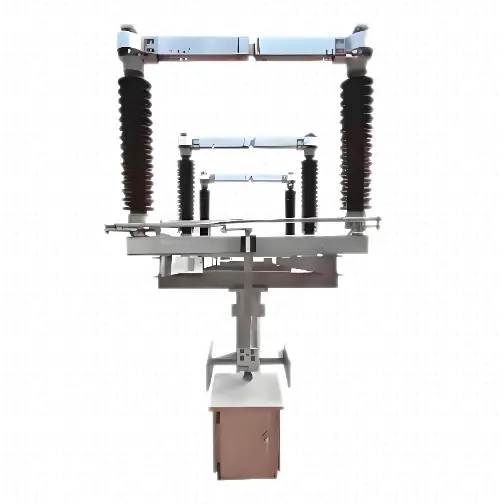
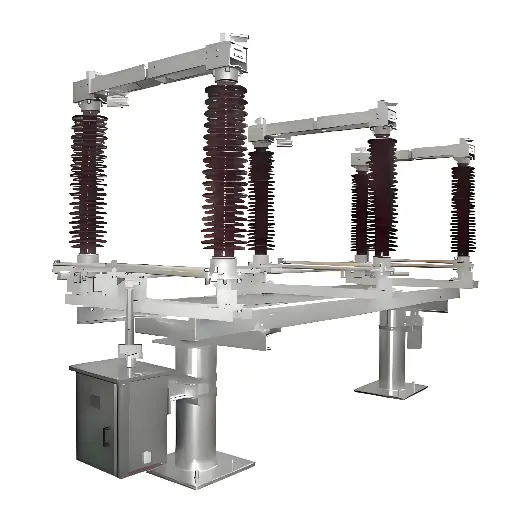
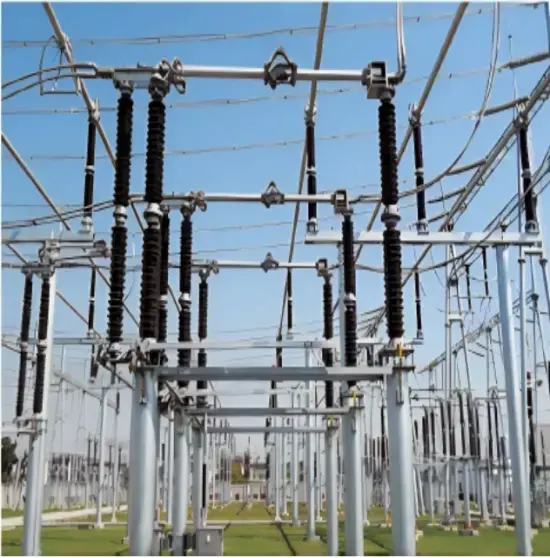
As a key component that keeps maintenance work on power equipment safe, the disconnector provides a clear physical break for electrical isolation. However, because it has no arc-extinguishing capability, it must never be operated under load — an erroneous under-load operation can readily lead to a catastrophic safety incident.
iee-business

I. Severe Consequences of Disconnector Misoperation

A disconnector (colloquially known as a "knife switch") has no dedicated arc-extinguishing device and must never be operated under load. Should a misoperation occur, the consequences are extremely serious:

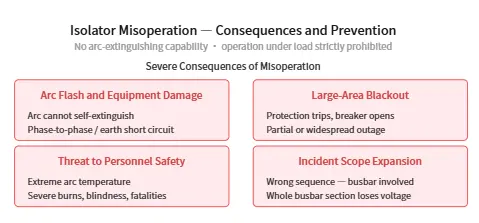
  • Arcing short circuit and equipment destruction: When a disconnector is opened or closed under load, a violent arc is struck between the contacts. Since the arc cannot self-extinguish, it rapidly elongates and develops into a phase-to-phase or phase-to-ground arcing short circuit, severely burning the contacts, insulation, and even the entire disconnector.

  • Large-scale power outage: The arcing short circuit normally trips the upstream protective relays, clearing the fault via the circuit breaker and causing a localized or even widespread power outage.

  • Serious threat to personnel safety: The intense arc generates extremely high temperatures and can easily cause severe arc-flash burns, blindness, or life-threatening injuries to operating personnel.

  • Artificial expansion of the incident: If the switching sequence is reversed during de-energization or re-energization (for example, opening the bus-side disconnector first when isolating for shutdown), a misoperation can drive the arcing short circuit directly onto the busbar, de-energizing the entire bus section and further widening the scope of the incident.

iee-business

II. Interlocking-Based Prevention Strategies

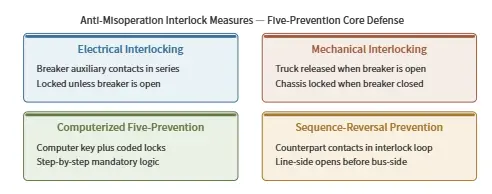
To fundamentally prevent such incidents, power systems strictly enforce the "Five-Precautions" requirements, of which "preventing the opening/closing of disconnectors under load" is the core defense. Interlocking is mainly implemented through the following technical means:

  • Electrical interlocking: The auxiliary contacts of the circuit breaker and the disconnectors are wired in series in the disconnector control circuit. The disconnector operating circuit can be energized only when the circuit breaker is in the open position — if the breaker has not been opened, the circuit remains forcibly interlocked and power-driven open/close operations are blocked.

  • Mechanical interlocking: Restraint is achieved through the transmission of mechanical components. In high-voltage switchgear, for example, the mechanical interlock releases the withdrawable truck (which performs the function of a disconnector) only when the circuit breaker is open, allowing the truck to be racked in or racked out. While the breaker is closed, the chassis leadscrew is locked to prevent the truck from being moved under load.

  • Microcomputer-based Five-Precaution interlocking (coded electrical locks): This is currently the mainstream smart anti-misoperation solution. The system works in tandem with a computer key and coded electrical locks, requiring the operator to follow the switching sequence generated by the system. The next step of the operating circuit is unlocked and energized only after the computer key has verified that the equipment code is correct and the preceding step (e.g., tripping the circuit breaker) has been completed — providing mandatory, logic-based interlocking across the entire sequence.

  • Improved control-circuit design (preventing sequence reversal): To prevent the operating sequence of the bus-side and line-side disconnectors from being reversed, the auxiliary contacts of the opposing disconnector are connected in series in the interlocking circuit. During de-energization, for example, the bus-side disconnector control circuit is unlocked only after the line-side disconnector has been opened first, thereby enforcing the correct switching order.

iee-business

III. On-Site Operation & Anti-Misoperation Management Requirements

Alongside technical interlocking, on-site operating rules and management procedures form an equally important line of defense against misoperation:

  • Strict verification before operation: Before any opening or closing operation, the equipment name, number, and the actual position of the circuit breaker must be carefully verified. Never rely on experience or mimic diagrams alone. The operator must confirm that the equipment is de-energized using open-position indicator lamps, position indicators, and voltage verification, so as to avoid misoperation caused by entering the wrong bay or inadequate checking.

  • No blind bypass or override of interlocking: The anti-misoperation interlocking devices must be maintained in good working order. If an interlock fails or cannot be released owing to an equipment fault, the cause must be identified and operation is permitted only after approval from the technical manager following the prescribed procedure (e.g., using a dedicated bypass key). Breaking locks, bypassing interlocks, or overriding them by force without authorization is strictly prohibited.

IV. Emergency Response Principles for Misoperation

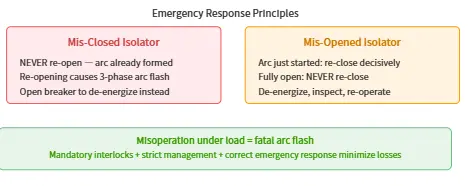
If the interlocking system fails or a misoperation occurs as a result of unauthorized unlocking, the following principles must be observed to minimize damage:

  • Disconnector accidentally closed: Even if the incorrect closing is noticed or an arc has already been struck, the disconnector must never be re-opened, because re-opening under load would create an even more severe three-phase arcing short circuit. Keep it in its current position, immediately clear the circuit load by tripping the circuit breaker, and deal with the aftermath only afterwards.

  • Disconnector accidentally opened: If the contacts have just parted and the arc has just been struck, re-close the disconnector decisively and promptly to extinguish the arc before the incident escalates. However, if the contacts have already fully separated and opened, re-closing is strictly prohibited — wait until the circuit breaker has de-energized the circuit, then inspect the equipment for damage and re-operate in accordance with standard procedures.

iee-business

Summary

Because a disconnector cannot extinguish arcs, operating it under load can trigger a fatal arcing short circuit, equipment destruction, and large-area blackouts — making it a top priority in power safety management. To eliminate this risk, mandatory technical barriers such as electrical interlocking, mechanical interlocking, and microcomputer-based Five-Precaution interlocking must be in place, supplemented by rigorous on-site verification and approval-managed unlocking procedures.

At the same time, field personnel must be thoroughly trained in emergency response principles — "never re-open a mistakenly closed disconnector" and "re-close promptly when an incorrect opening has just begun" — to keep losses to a minimum and safeguard both the power grid and personnel safety.

Edited From: Garca

Give a tip and encourage the author!
Topics:

Comments

Share your question or perspective
WhatsApp
Send inquiry
+86
Click to upload file
Download
Get the IEE Business Application
Use the IEE-Business app to find equipment, obtain solutions, connect with experts, and participate in industry collaboration anytime, anywhere—fully supporting the development of your power projects and business.
Login
or continue with
New here?
Register