The "four-step protection coordination mechanism" — typically a sequence of four operations combined with fast/slow time-current curves — is the core of distribution automation and overhead line fault self-healing.This four-step coordination (e.g., "1 fast + 3 slow" or "2 fast + 2 slow" trip patterns) applied in the RCW series vacuum reclosers offers the following significant advantages:
1. Perfect Implementation of Fuse Saving Strategy
In traditional distribution networks, branch lines are typically protected by fuses, while main lines are protected by reclosers.
-
Mechanism Coordination: When a fault occurs on a branch line, the first one or two protection levels of the RCW series vacuum recloser adopt a "fast curve" to trip ahead of the downstream fuse, then reclose. If it is a transient fault (e.g., momentary contact by tree branches), the recloser restores supply after reclosing, leaving the downstream fuse intact.
-
Advantage: This avoids unnecessary fuse blowouts due to transient faults, significantly reducing the labor costs and time required for utility crews to locate and replace blown fuse links.
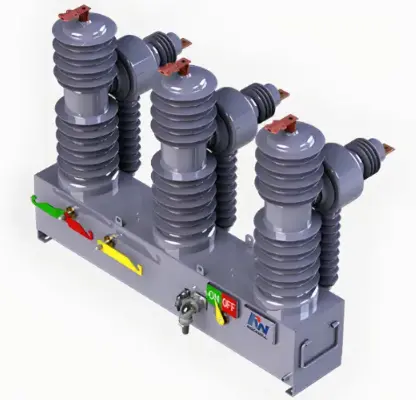
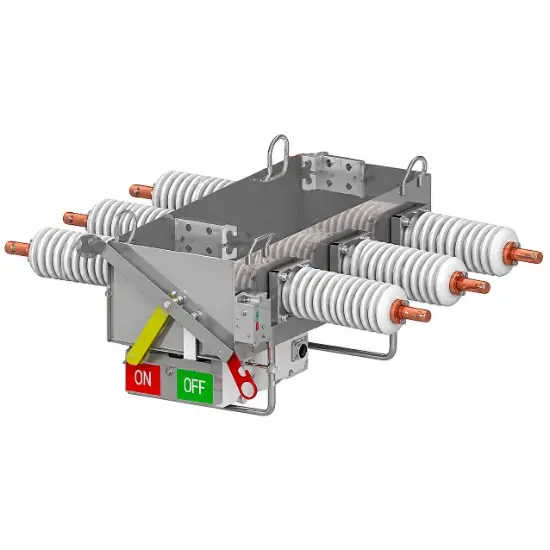
RCW Series Pole Mounted outdoor vacuum recloser
2. Precise Isolation of Permanent Faults with Minimized Outage Scope
If the fault persists after fast reclosing — indicating a permanent fault (e.g., broken conductor falling to the ground):
-
Mechanism Coordination: The RCW series vacuum recloser automatically switches to the 3rd and 4th "slow/delayed curve" levels. It intentionally delays tripping to give priority to downstream fuses or sectionalizers, allowing the downstream protection to clear the faulty branch first.
-
Advantage: This ensures that the main line and other healthy branch lines remain energized. If no downstream protection exists, the RCW series vacuum recloser will automatically lockout after completing the 4th operation, completely isolating the permanent fault.
3. Significant Improvement in Power Supply Reliability Indices (SAIDI/SAIFI)
Statistics show that 70%–80% of faults on overhead distribution lines are transient in nature (e.g., lightning strikes, animal/bird contact, temporary line sway due to high winds).
-
Advantage: By utilizing multiple reclosing attempts in the four-step protection sequence, the RCW series vacuum recloser can automatically eliminate approximately 80% of transient outage events. End users may experience only momentary flickers before supply is restored, greatly improving utility reliability metrics such as SAIDI and SAIFI.
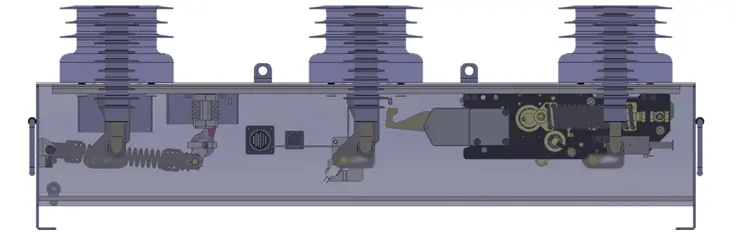
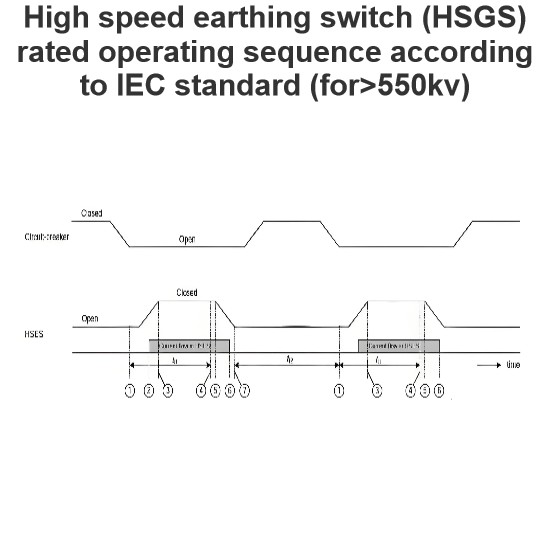
Schematic Diagram of RCW Series Spring mechanism
4. Highly Flexible Time Setting and Anti-Override Coordination
-
Mechanism Coordination: The RCW series vacuum recloser is equipped with a high-precision microprocessor-based controller (intelligent control cabinet) that supports complex IDMT curves, definite-time settings, and inrush current suppression functions.
-
Advantage: This enables coordinated operation not only with downstream fuses but also with upstream substation outlet circuit breakers and other downstream reclosers, forming a multi-level graded coordination scheme. In multi-tier series networks, the protection ensures that the switch closest to the fault point operates first, without any mal-operation or override.
5. Perfect Hardware Compatibility of RCW Series for Four-Step Protection
Frequent reclosing imposes extremely demanding requirements on the mechanical life and arc-quenching capability of the switchgear itself. The Rockwill RCW series excels in this regard:
-
Vacuum Arc-Quenching Capability: The vacuum interrupters (VIs) feature extremely fast dielectric recovery speed, enabling them to withstand the thermal and dielectric stresses of consecutive "open-close-open" (O-C-O) high-current short-circuit operations within the four-step sequence.
-
Maintenance-Free Mechanism: The highly reliable operating mechanism (e.g., permanent magnetic actuator or optimized long-life spring mechanism) perfectly supports frequent successive operations, ensuring no sticking or contact bouncing throughout the entire sequence, and guaranteeing maintenance-free operation over its entire service life.
Conclusion
The four-step protection coordination of the Rockwill RCW series embodies an intelligent "trial-and-isolate" logic — first attempting to restore supply after transient faults, then precisely isolating permanent ones. It can both tolerate transient disturbances on overhead lines and accurately pinpoint permanent faults, making it the most effective and mature solution for cost-effective distribution automation (DA) and smart grid implementation.
Edited From:Garca

 Login