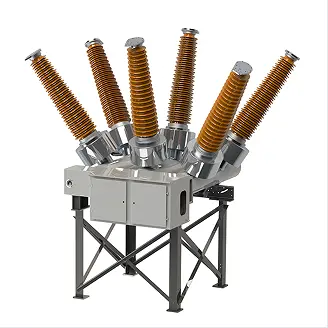
Medium-voltage circuit breakers—such as the common 12kV, 24kV, and 40.5kV vacuum circuit breakers—generally employ spring operating mechanisms. This is primarily because spring mechanisms achieve the optimal balance in medium-voltage applications across operating characteristics, reliability, economy, and dependence on auxiliary power.
Given the technical characteristics of medium-voltage switchgear, the specific reasons can be summarized in the following core aspects:
Extremely Low Requirements for Operating Power (Separation of Energy Storage and Actuation)
The spring mechanism operates on the principle of "slow motor charging, instantaneous spring release." The charging motor typically consumes only a few tens to a few hundred watts, with the charging process lasting several to over ten seconds. During closing or opening operations, only a very small current (a few amperes) is needed to trigger the tripping latch to complete the action.
-
Comparison with electromagnetic mechanisms: Early electromagnetic operating mechanisms required several tens to even over a hundred amperes of high DC current at the instant of closing, necessitating large-capacity DC power supplies and heavy-duty control cables in substations. The spring mechanism completely resolves this issue, being easily driven by either AC or DC power sources, significantly reducing the cost of auxiliary systems.
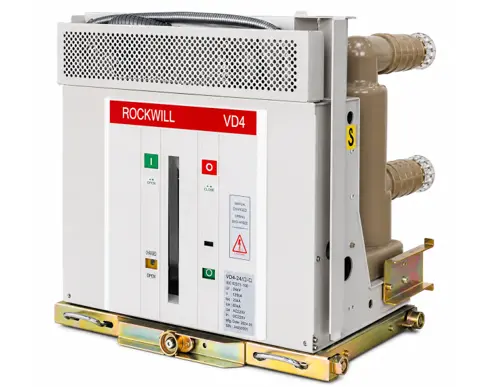
Rockwill VD4 Vacuum Circuit Breaker Physical Picture
Perfect "Loss-of-Voltage" Operating Capability (Emergency Reliability)
Under extreme conditions such as severe grid faults or total substation blackouts, reliable operation of the circuit breaker is critical.
-
As long as the spring is in a charged (stored-energy) state, no external power supply is required—mechanical pushbuttons can be used to complete opening or closing operations to isolate faults or restore power.
-
Even if the spring is not charged and no power supply is available, operators can use a manual charging handle to mechanically charge the spring, followed by manual closing or opening. This robust mechanical redundancy is an important safeguard for grid security.
Perfect Match with the Mechanical Characteristics of Vacuum Circuit Breakers
The vast majority of medium-voltage applications currently use vacuum circuit breakers (VCBs). The contact gap of the vacuum interrupter is very small (for 12kV circuit breakers, the gap is typically around 8–11mm), and the overtravel is also short. However, the requirements demand high initial velocity during closing and opening, as well as minimal closing bounce.
-
The spring releases with tremendous instantaneous force. Coupled with the mechanical design of cams, linkages, and four-bar mechanisms, it can precisely deliver the high initial contact pressure and high opening speed required by the vacuum interrupter, effectively preventing contact welding and ensuring rapid arc extinction at current zero-crossing.
No Fluid Media, Good Environmental Adaptability
-
Comparison with hydraulic/pneumatic mechanisms: In high-voltage or extra-high-voltage applications (110kV and above), where large operating energy is often required, hydraulic or pneumatic mechanisms are used. However, in the medium-voltage domain, the operating energy required by circuit breakers (a few tens to a few hundred joules) falls well within the physical energy-storage limits of springs. Spring mechanisms are purely mechanical transmissions, free from issues such as oil or gas leakage, increased oil viscosity at low temperatures, and are less sensitive to ambient temperature variations, resulting in low maintenance costs.
For long-life requirements, medium-voltage circuit breakers may opt for permanent-magnetic operating mechanisms. These mechanisms use permanent magnets to maintain the closed position, have very few moving parts, and can achieve mechanical lifetimes of tens of thousands to over a hundred thousand operations—far exceeding those of traditional spring mechanisms (typically around 10,000 to 20,000 operations).
In special applications requiring frequent operation or ultra-long maintenance-free periods (such as electrified railways or metallurgical arc furnaces), permanent-magnetic mechanisms become a better choice due to their low wear and adjustment-free advantages.
However, permanent-magnetic mechanisms require dedicated controllers and capacitor banks, and place extremely high demands on the reliability of electronic components. Therefore, in the general medium-voltage switchgear market, spring mechanisms still maintain their absolute dominant position by virtue of their simplicity, independence, and low cost.
Conclusion
Spring operating mechanisms trade time for power (slow charging, fast release), providing a very high degree of system independence and redundancy through purely mechanical means. Taking the Rockwill VD4 as an example, its modular spring operating mechanism, built upon purely mechanical advantages, further achieves long-term maintenance-free operation, significantly reducing lifecycle maintenance costs.
At the same time, its solid-insulation pole structure effectively isolates dust and moisture ingress, ensuring consistently stable insulation performance under harsh operating conditions.
These characteristics perfectly align with the core requirements of medium-voltage power grids: "large-volume deployment, low maintenance costs, and extremely high fault-clearing reliability."
Edited From:Garca

 Login