The side-outlet low-voltage bushing arrangement—where the low-voltage terminals are positioned on the side of the transformer tank rather than on the top—is a common design choice for S-series and H61 distribution transformers in China. Its primary advantages are as follows:
1. Ease of Installation and Wiring
-
Reduced bending radius requirements: With low-voltage busbars or cables exiting horizontally from the side, the need for tight vertical bends in confined spaces is eliminated, making installation significantly easier.
-
Well-suited for compact substation layouts: In prefabricated substations (compact secondary substations), where low-voltage compartments are space-constrained, the side-exit configuration enables direct interface with the low-voltage switchgear, avoiding unnecessary cable looping.
-
Ample working space for connections: Maintenance personnel can work comfortably from the side of the transformer, improving safety and accessibility—particularly beneficial in narrow equipment rooms or outdoor distribution cubicles.
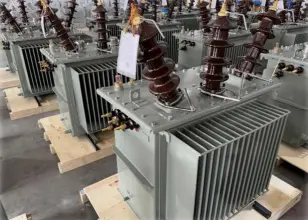
Rockwill H61 Series distribution transformers
2. Direct Interface with Low-Voltage Switchgear
-
Side-exit bushings allow for direct busbar connection to low-voltage switchgear panels (e.g., MNS, GCK types), eliminating the need for transitional busbars or cable trays. This reduces line losses and contact resistance.
-
The interface geometry is standardized, facilitating factory prefabrication and significantly shortening on-site installation time.
3. Enhanced Protection and Safety
-
With bushings positioned on the side, the space above the transformer is left clear for radiators (cooling fins), resulting in a cleaner top cover design and eliminating the risk of rainwater or foreign objects causing faults on top-exposed terminals.
-
Compared to top-exit designs, side-exit bushings are less prone to accidental contact or proximity by personnel, offering improved operator safety.
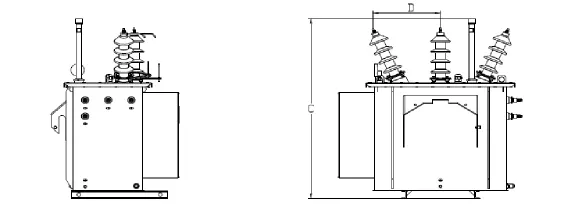
Rockwill H61 distribution transformers Outline drawing reference
4. Structural Benefits for Transport and Lifting
-
The absence of protruding bushings on the top cover reduces the overall height or makes the top profile more regular, facilitating compliance with transport height restrictions and minimizing the risk of impact damage during transit.
-
Lifting points on the top cover are clearly defined and unobstructed, allowing for standard lifting procedures without the need to maneuver around bushings.
5. Optimized Heat Dissipation and Layout
-
By separating the low-voltage connection area from the top-mounted cooling zone, the natural upward path of heat dissipation remains unobstructed, promoting more uniform cooling performance.
-
The side-exit area can be equipped with a dedicated protective enclosure, enabling functional partitioning between the connection zone and the cooling zone.
6. Comparative Summary
| Feature |
Top-Exit Bushing |
Side-Exit Bushing |
| Wiring/bending space |
Requires ample clearance |
Generous, easier to work with |
| Interface to LV switchgear |
Requires transition conductors |
Direct busbar connection possible |
| Transport height |
Slightly taller |
Lower, more compact profile |
| Top-side protection |
Exposed bushings, higher weatherproofing demands |
Fully enclosed top cover, better protection |
| Typical application |
Standalone installations with flexible cable exit directions |
Compact substations and prefabricated package solutions |
5.Conclusion
The adoption of side-outlet low-voltage bushings in H61 distribution transformers is primarily driven by the need to accommodate compact, packaged applications such as compact secondary substations and prefabricated enclosures. This design offers clear advantages in installation efficiency, interface standardization, operational safety, and transportation convenience. It has become a prevailing trend in urban distribution network engineering applications.
ROCKWILL Distribution Transformers – H61 Series
Featuring side-exit single-pole mounting as a key differentiator, the H61 series combines fully sealed, maintenance-free construction, robust performance in harsh environments, IEC standard compliance, and flexible customization options. It represents a highly efficient, reliable, cost-effective, and competitively positioned solution tailored for distribution networks in developing regions.
Edited From:Echo

 Login
Login