

• Product
  • Suppliers
  • Manufacturers
  • Solutions
  • Free tools
  • Knowledges
  • Experts
  • Communities
Search


Generator Circuit-Breaker Operation: Closing and Opening Essentials

Rockwill
Field: Manufacturing
10Year<
China
 
The generator circuit-breaker (GCB) sits at the heart of safe power plant operation. Knowing exactly when and how to close and open it protects both the machine and the network. This guide covers the key principles and a typical operating sequence for a standard diesel-generator set.
iee-business

1. When to Close the Breaker

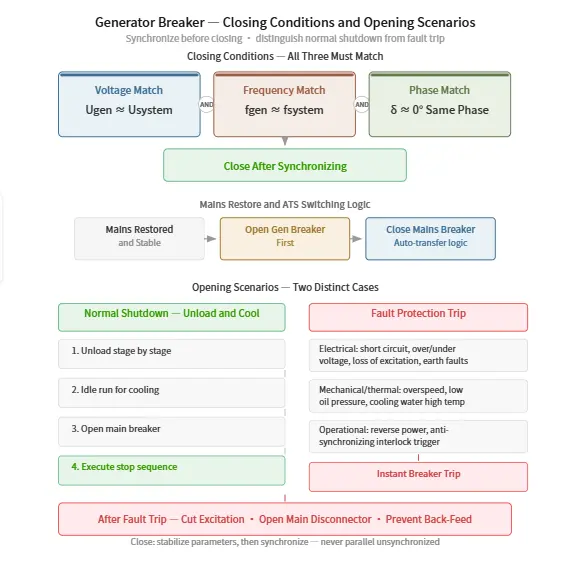
Closing must only happen once the generator and the system are properly synchronised. The conditions to check are:

  • Generator voltage is close to the system voltage
  • Generator frequency is close to the system frequency
  • Generator voltage phase coincides with the system voltage phase

On mains restoration (ATS transfer). In a dual-supply installation, once the mains supply returns and its parameters are stable, the automatic transfer switch (ATS) will first open the generator breaker and then close the mains breaker (or carry out the transfer according to the configured auto-transfer logic).

2. When to Open the Breaker

Opening falls into two categories: scheduled shutdown (unloading and disconnection) and emergency tripping.

Normal shutdown (unloading and disconnection). Before stopping, the connected load must be reduced in stages. Let the generator run unloaded for a while so the set cools down properly, then open the main breaker, and finally run the shutdown sequence.

Protective tripping. The breaker trips immediately to protect the equipment when a serious abnormal condition occurs. Common trip conditions include:

  • Electrical faults: short-circuit (instantaneous or short-time-overcurrent), over- or under-voltage, loss of excitation, stator or rotor earth faults, etc.
  • Mechanical/thermal faults: prime-mover overspeed, low lubrication-oil pressure, high cooling-water temperature, etc.
  • Operational abnormalities: reverse power (the generator motoring), or an interlock triggered to prevent out-of-synchronism paralleling.

iee-business

3. Typical Operating Procedure

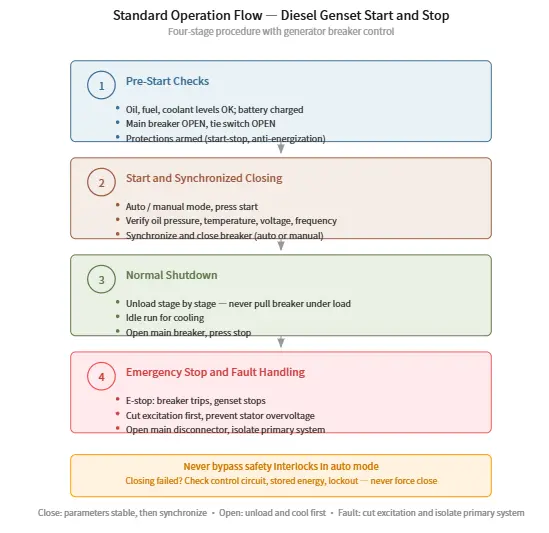
For a standard diesel-generator set, the normal start/stop and switching sequence looks like this:

Pre-start checks

  • Check oil, fuel and coolant levels, and confirm the battery voltage is adequate.
  • Confirm the generator main breaker is in the open (tripped) position and the changeover switch is open.
  • Confirm the relevant protections (e.g. start/stop protection and accidental-energisation protection) are correctly enabled, to prevent unwanted closing.

Starting and closing

  • Turn the control panel to “Auto” or “Manual” mode and press the start button.
  • After the generator starts, confirm oil pressure, water temperature, voltage and frequency have reached their normal rated ranges.
  • With all parameters normal and no alarms, complete synchronisation via the synchroniser (automatic or manual) and close the breaker to start supplying load.

Normal shutdown and opening

  • Before stopping, reduce the load step by step (or transfer the load). Never pull the breaker open directly under load.
  • Let the generator run unloaded for a while to cool down.
  • Open the main breaker, then press the stop button to bring the generator to rest.

Emergency stop and fault handling

  • In an emergency that threatens safety, press the emergency stop button immediately — the breaker will trip in an interlocked manner and the generator will shut down.
  • After a fault trip, the first priority is to confirm that excitation and the main supply are cut off to prevent stator overvoltage, and to open the main disconnector to isolate the primary system and prevent backfeed from the grid.

Safety note: Never bypass or jumper out safety interlock signals in automatic mode. If the breaker fails to close, investigate the control circuit, the spring-charged mechanism state, and any protection blocking signals — do not force the breaker closed.

iee-business

4. Summary

Closing and opening the generator circuit-breaker are core operations for safe and reliable power system operation. Closing must strictly follow the principle of “stabilise the parameters first, then synchronise properly”, so that voltage, frequency and phase all match before paralleling with the system — never parallel out of synchronism. Opening, in turn, must clearly distinguish between two scenarios: normal unloading and cooling on the one hand, and emergency fault isolation on the other.

In daily operation, always allow the unloaded cooling period before shutdown, and after a fault trip strictly enforce the safety principle of “de-energise the excitation and isolate the primary system”. Proper operating discipline not only prevents equipment damage and serious incidents, but also maximises the service life of the generating set and safeguards the continuity and security of supply.

Edited From: Garca

Give a tip and encourage the author!

Comments

Share your question or perspective
WhatsApp
Send inquiry
+86
Click to upload file
Download
Get the IEE Business Application
Use the IEE-Business app to find equipment, obtain solutions, connect with experts, and participate in industry collaboration anytime, anywhere—fully supporting the development of your power projects and business.
Login
or continue with
New here?
Register