

Search


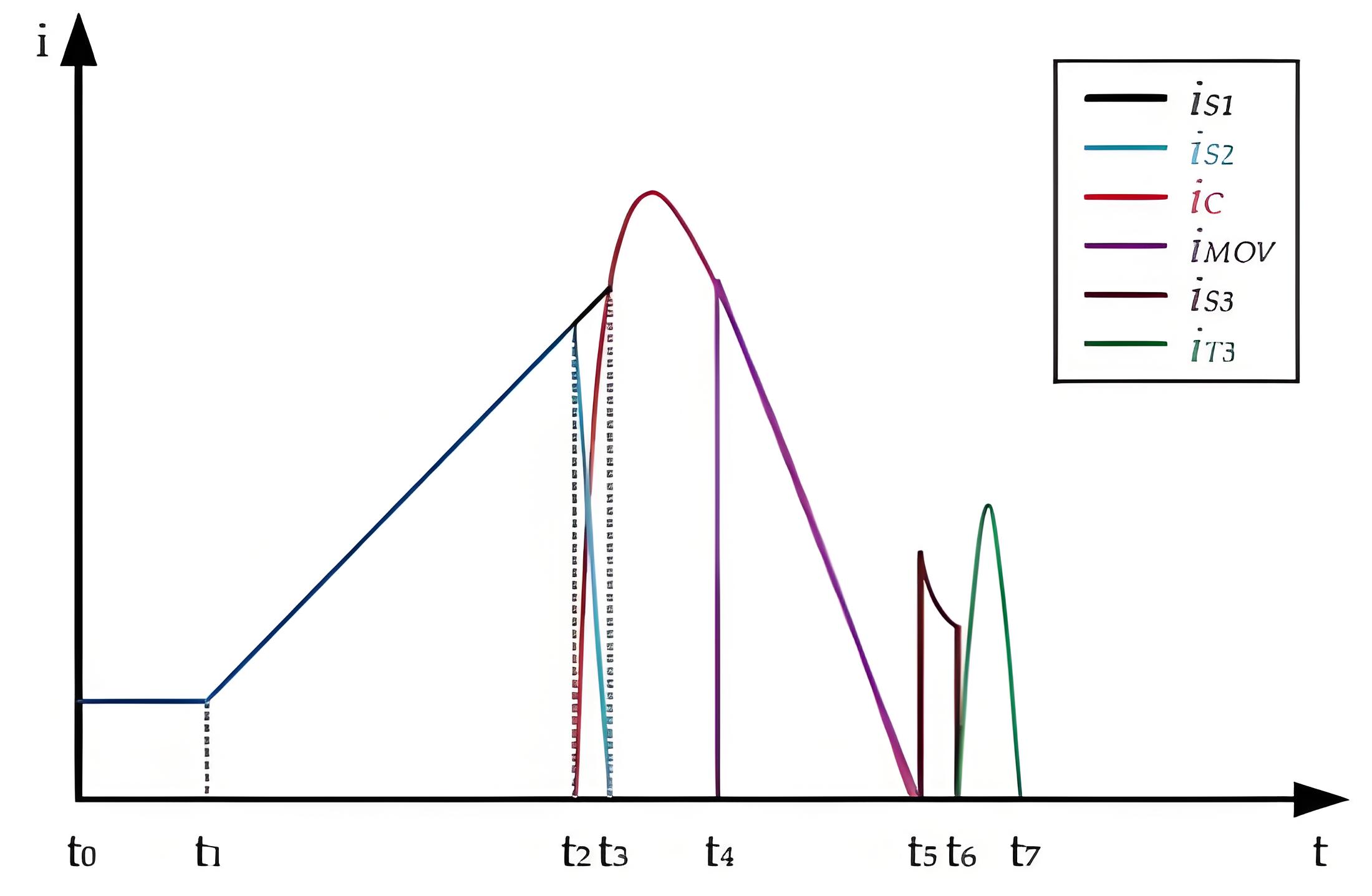
Current waveforms of the high voltage hybrid DC circuit breaker

Explore the eight operation intervals and key components of high-voltage hybrid DC circuit breakers. Understand current interruption, fault response, and capacitor discharge processes critical for optimizing DC grid protection.

Edwiin
Field: Power switch
10Year<
China
Add us on Google

Current waveforms of the high voltage hybrid DC circuit breaker

The operation of a hybrid circuit breaker is divided into eight intervals, corresponding to four operational modes. These intervals and modes are as follows:

  • Normal Mode (t0~t2):During this interval, power is transmitted seamlessly between the two sides of the circuit breaker.

  • Breaking Mode (t2~t5):This mode is used to interrupt fault currents. The circuit breaker rapidly disconnects the faulty section to prevent further damage.

  • Discharge Mode (t5~t6):In this interval, the voltage across the capacitor is reduced to its rated value. This ensures that the capacitor is safely discharged and ready for the next operation.

  • Reverse Mode (t6~t7):This mode is used to change the polarity of the capacitor. The polarity reversal prepares the capacitor for subsequent operations and ensures proper functionality.

Key Components and Their Functions

  • IS1: Residual DC current breaker. This component is responsible for breaking any residual DC current that may remain after the main current has been interrupted.

  • IS2, S3: Fast mechanical switches. These switches are designed to rapidly open and close the circuit, ensuring quick response times during fault conditions.

  • IC: Auxiliary branch capacitor current. This current flows through the auxiliary branch capacitor, which helps in energy storage and release during the operation of the circuit breaker.

  • I MOV: Metal oxide varistor (MOV) current. The MOV is used to protect the circuit from overvoltage conditions by clamping the voltage to a safe level.

  • IT3: Thyristor current for reversing the polarity of the capacitor. This current flows through the thyristor to reverse the polarity of the capacitor during the reverse mode.

Give a tip and encourage the author!
Topics:

Comments

Share your question or perspective
WhatsApp
Send inquiry
+86
Click to upload file
Download
Get the IEE Business Application
Use the IEE-Business app to find equipment, obtain solutions, connect with experts, and participate in industry collaboration anytime, anywhere—fully supporting the development of your power projects and business.
Login
or continue with
New here?
Register








