In the manufacturing of power transformers, the Drying Process is the critical threshold that determines the electrical life and reliability of the equipment. Since transformer insulation is a complex "Oil-Paper" system, the cellulose materials (cables paper, pressboard) are highly hygroscopic.
Excessive moisture leads to a drastic reduction in dielectric strength and accelerates thermal aging. As an expert in high-voltage engineering, I will provide a technical breakdown of the industry-standard Vapor Phase Drying (VPD) process in English.
1. The Core Objective: Targeting Moisture Content
The ultimate goal is to reduce the moisture content of the insulation to levels defined by international standards (IEC/IEEE):
- ≤ 110kV: Moisture content <1.0%<1.0%
- 220kV - 500kV: Moisture content <0.5%<0.5%
- UHV (±800kV/1000kV): Reaching the physical limit, typically <0.3%
| Paper Moisture Content |
Relative Insulation Strength |
Consequence |
| 0.5% (dry) |
100% |
Normal |
| 2% |
~70% |
Clearly degraded |
| 4% |
~40% |
Severely degraded |
| 6%+ |
~20% |
Breakdown risk at any time |
Adding just 3% moisture cuts insulation strength by more than half. This is the fundamental reason transformers must be dried during assembly.
2. The Mainstream Technology: Vapor Phase Drying (VPD)
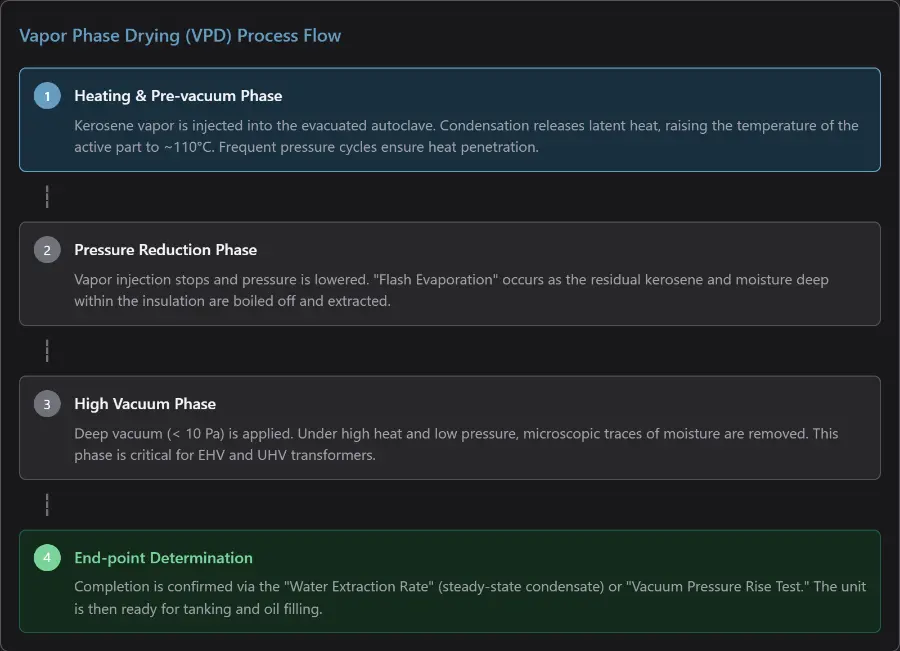
VPD technology utilizes Kerosene Vapor as the heat transfer medium. In a vacuum autoclave, kerosene vapor condenses on the cooler surfaces of the transformer active part, releasing a massive amount of latent heat of condensation. This ensures rapid and uniform heating of the thickest insulation structures.
The VPD process consists of four distinct stages:
3. Engineering Priorities and Constraints
From a technical supervision perspective, three parameters are paramount:
- Thermal Integrity (105°C - 115°C): Cellulose insulation is typically Class A (105°C). While drying requires heat, exceeding 125°C causes irreversible depolymerization (drop in DP value), making the paper brittle and reducing service life.
- Moisture Extraction Monitoring: We calculate the theoretical moisture load based on the weight of the pressboard. Drying is only considered complete when the actual extracted volume plateaus and matches ~95% of the calculated value.
- Vacuum Stability: A final vacuum level of less than 10 Pa (0.075 Torr) is mandatory for high-voltage units to ensure all deep-seated gas and moisture pockets are evacuated before the final oil impregnation.
4. Summary: Why VPD?
Compared to conventional Hot Air Vacuum Drying, VPD offers:
- Superior Heat Transfer: The molecular penetration of kerosene vapor is far more efficient than convection.
- Uniformity: It prevents "case hardening" where the surface dries but the core remains wet.
- Safety: The kerosene atmosphere prevents oxidation of the insulation at high temperatures.
This process is the "heart surgery" of transformer manufacturing. Only by strictly adhering to these vacuum and thermal parameters can we guarantee the decades of stable operation required by modern power grids.
Contact us:

 Login
Login