| Brand | ROCKWILL |
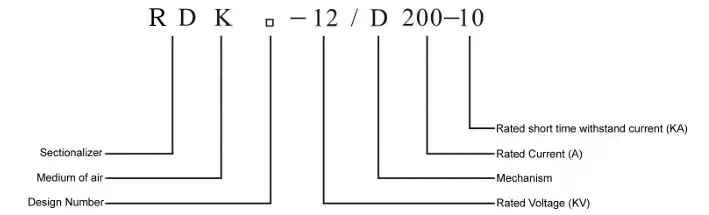
| Series | RDK |
| Rated voltage | 40.5 kV |
| Rated normal current | 200 A |
| Rated frequency | 50/60Hz |
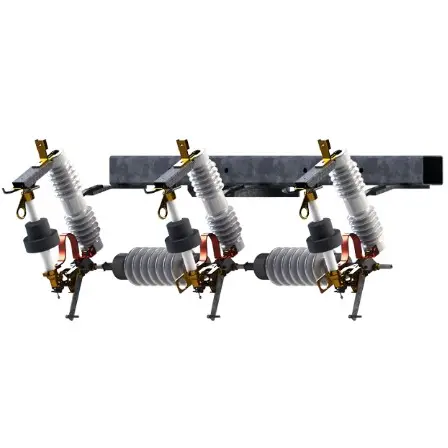
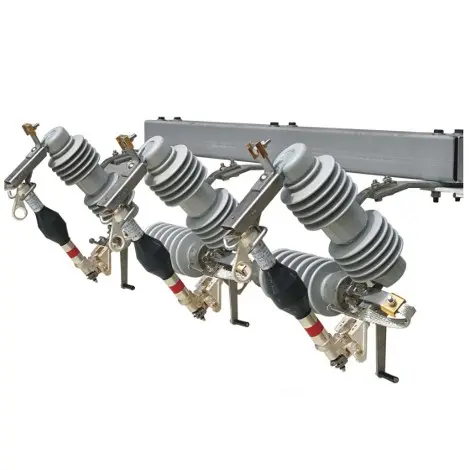
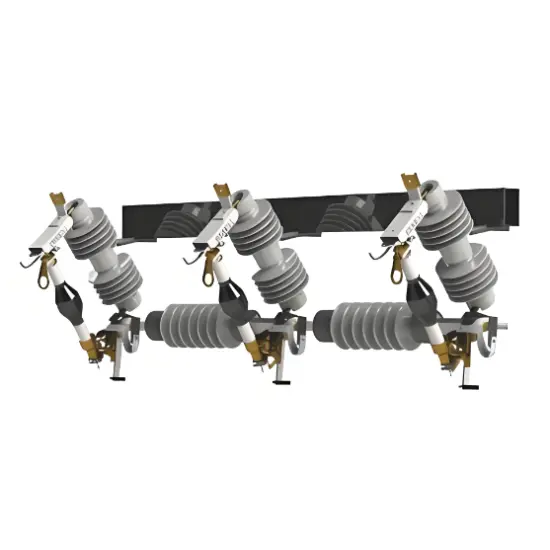
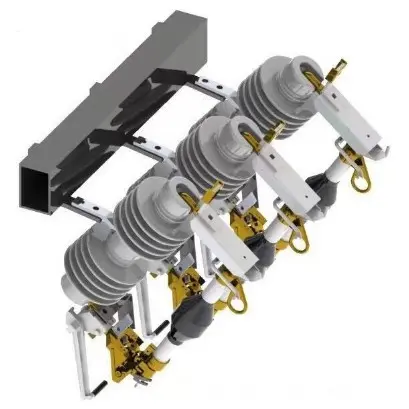
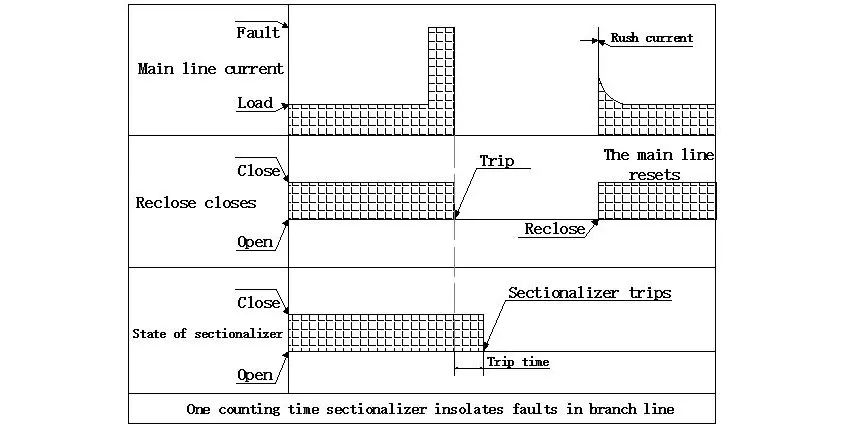
The RDK is entirely self-powered and maintenance-free. An integral current transformer detects main circuit current and feeds the signal to an electronic controller for digital processing. When a fault occurs, the upstream recloser opens and the RDK counts each loss-of-voltage event. Once the preset count (1 to 4) is reached, the sectionalizer trips within 180 ms, isolating the faulty section. The recloser then re-energises the healthy portion of the network. For temporary faults cleared before the count is reached, the RDK resets automatically to its original state.
| Rated voltage (Ur) | kV | 40.5 |
| Rated normal current (Ir) | A | 200 |
| Rated frequency | Hz | 50/60 |
| Overcurrent pick-up current range | A | 8 ... 400 |
| Rated short-time withstand current (r.m.s.) | kA | 10 |
| Rated short-circuit withstand duration (tk) | s | 1 |
| Rated peak withstand current | kA | 20 |
| Configurable fault counting sequence | — | 1, 2, 3, 4 |
| Maximum fault memory hold time | s | 20 |
| Maximum automatic reset delay time | s | 20 |
| Permissible deviation of pick-up current for memory reset time | % | ± 10 |
| Rated opening time | ms | ≤ 200 |
| Main circuit resistance | μΩ | ≤ 400 |
| Mechanical operating life | Operations | 500 |
| Terminal horizontal pull-out force | N | 250 |
| Manual opening torque | N·m | — |
| Manual opening force | N | ≤ 120 |
| Rated lightning impulse withstand voltage (phase-to-earth) | kV | 185 |
| Rated lightning impulse withstand voltage (isolating gap) | kV | 220 |
| Rated power-frequency withstand voltage (phase-to-earth) — Dry test | kV | 95 |
| Rated power-frequency withstand voltage (phase-to-earth) — Wet test | kV | 80 |
| Rated power-frequency withstand voltage (isolating gap) — Dry test | kV | 110 |
| Rated power-frequency withstand voltage (isolating gap) — Wet test | kV | 95 |
| Rated power-frequency withstand voltage (auxiliary & control circuit) | kV | 2 |
| Pollution class | Class | III |
| Maximum ice coating thickness | mm | ≤ 1 |
| 4-stage adjustable pick-up current & configurable fault counting sequence | — | Yes |
Please inform the order before ordering. For example:
| Pick up current (A) | Count/counts | ||||
| I1 | I2 | I3 | I4 | I5 | 1.2.3.4 |
Note: Please view the label to know the section current(I1, I2, I3, I4, I5) .
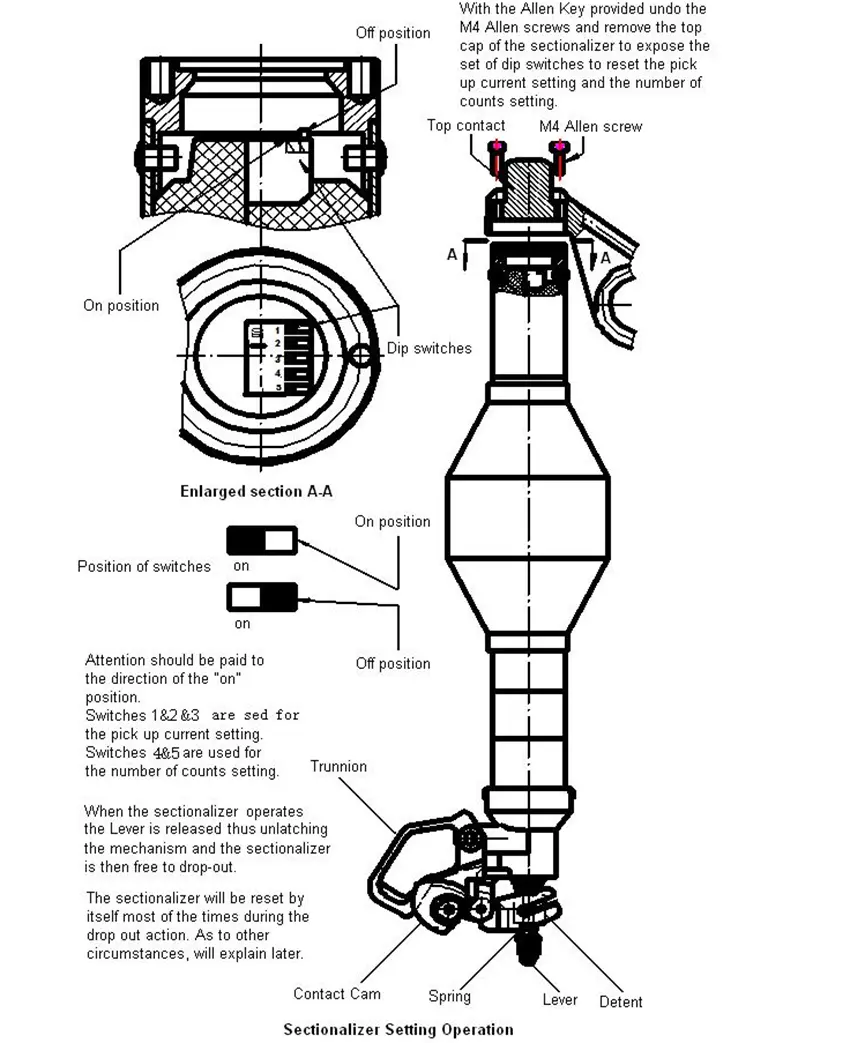
1.Current setting
The sectionalizer current setting must be selected at 20% below the minimum associated recloser or circuit breaker trip current.
2.Number of count setting
Generally the number of count settings should be 'one' less than the number of trips to lockout of the recloser or circuit breaker.
Normally, the sectionalizer is applied in conjunction with an upstream recloser or circuit breaker.For Example:
The recloser applied in the substation is set (1 fast and 3 slow) 4 shots to lockout and 6 units cutout sectionalizers (F1, F2, F3, F4, F5, F6) are applied in the four branch line to separate 7 section ( L1, L2, L3, L4, L5, L6, L7). The counts of F1 is set to 3 time, F2, F3, F5 are set to 2 times and F4, F6 are set to 1 time. As shown in the following figure:
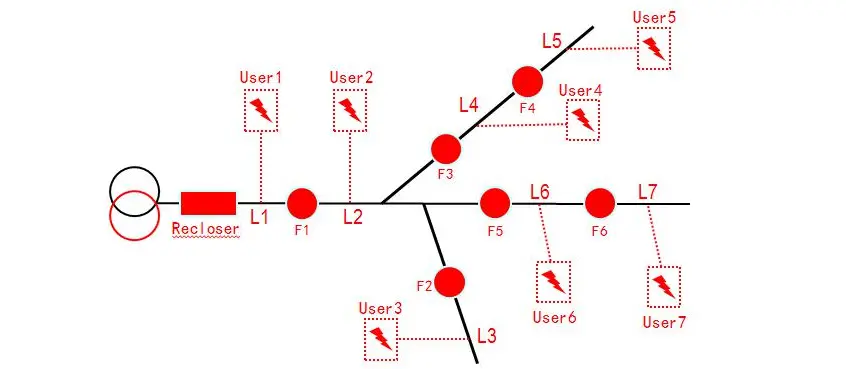
If there is a fault E1 in section L5, a fault current flow the recloser and sectionalizer F1, F3, F4, The recloser trip and all the line lost voltage, The sectionalizer F4 trip after it reach to the presetting "count" number 1 and isolate the fault section L5, the rescloser reclose and restore the healthy section L1, L2, L3, L4, L6, L7 to service.
If a fault E2 in section L6, a fault current flow the recloser and sectionalizer F1, F5, the recloser trip, if the fault is temporary, the recloser reclose to restore the line in service, then the sectionalizer F1, F5 remains closed and resets to its original state after a presetting time since it does not reach the presetting count number,. if the fault is permanent, the recloser fail to reclose successfully and trip again, all the line lost voltage and the sectionalizer F5 trip to isolate fault section L6 after it reaches the presetting count number 2, the sectionalizer F1 remain closes state since it does not reach the presetting count number. The recloser reclose again and restore the healthy section L1, L2, L3, L4, L5 to service.
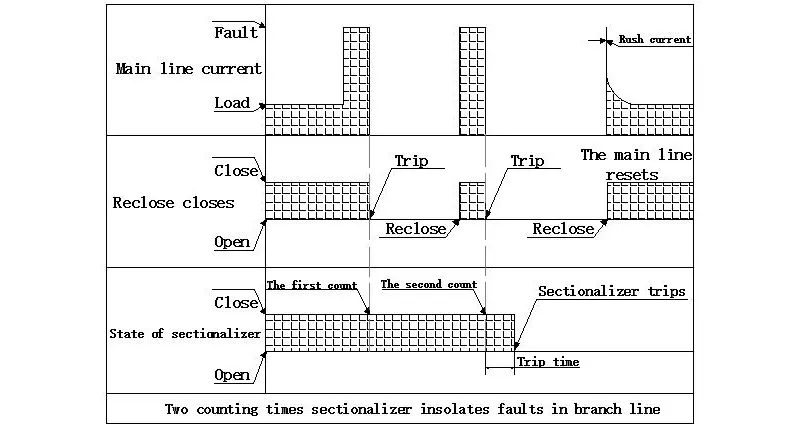
If a fault E3 in section L2, a fault current flow the recloser and sectionalizer F1, the recloser trip. If the fault is temporary the recloser reclose to restore the line in service, then the sectionalizer F1 remains closed and resets to its orginal state after a presetting time since it does not reach the presetting count number. If the fault is permanent , the recloser fail to reclose successfully and trip again all the line lost voltage and the sectionalizer F1 trip to isolate fault section L2 after it reach the presetting count number 3, The recloser reclose again and restore the healthy section L1 to service.
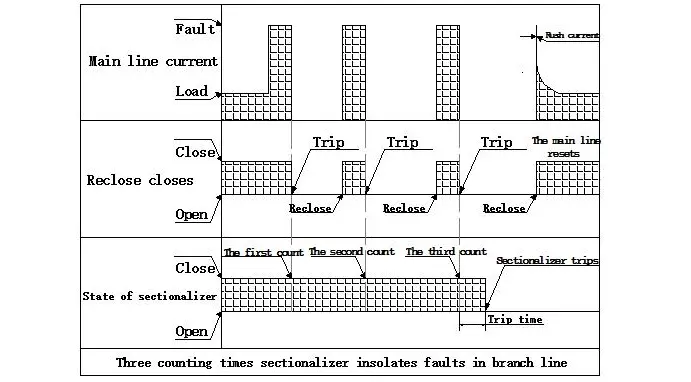
The count number of sectionalizer is set 1 time normally as it applied in the end of substation because almost fault occurring at the end of substation is permanent and is set 2 or 3 times applied on the overhead line because almost fault applied on the overhead line is temporary.
In this co-ordination, the sectionalizer can easily and optimized co-ordinate.
No external auxiliary power source is required. It takes energy from built‑in current‑transformer, completes fault‑current detection and counting logic by internal micro‑controller.
After permanent‑fault removal, operators can manually close it by insulated operating rod. No spare‑parts replacement is required. It will auto‑reset if fault is temporary without reaching count threshold.
Three conditions must be met simultaneously: fault current exceeds pickup setting; preset counting‑times (1‑4 times) are reached; line loses voltage and residual current below 300 mA.








 Login