Working Principle and Practical Applications of Analog Comparators
An analog comparator is a fundamental electronic component used to compare two input voltages and output a corresponding result. It has a wide range of applications in various electronic systems. Below is a detailed explanation of the working principle and practical applications of analog comparators.
Working Principle
Basic Structure:
An analog comparator typically consists of a differential amplifier with two input terminals: the positive input terminal (non-inverting input, +) and the negative input terminal (inverting input, -).
The output terminal usually provides a binary signal indicating the relationship between the two input voltages.
Operation:
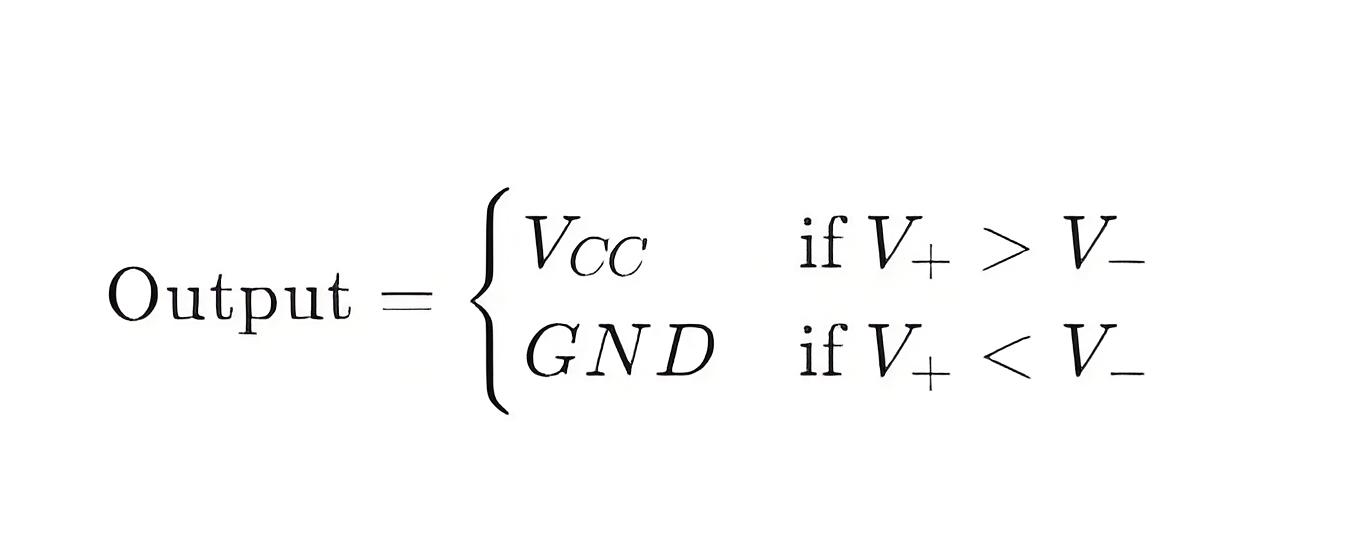
When the voltage at the positive input terminal (V+ ) is higher than the voltage at the negative input terminal (V−), the comparator's output is high (typically the supply voltage VCC).
When the voltage at the positive input terminal (V+ ) is lower than the voltage at the negative input terminal (V−), the comparator's output is low (typically ground GND).
Mathematically, this can be expressed as:
Hysteresis:
To prevent the comparator from switching its output rapidly when the input voltages are close to the threshold, hysteresis can be introduced. Hysteresis is achieved by adding resistors in a positive feedback loop, creating a small voltage range for output switching, thus enhancing system stability.
Practical Applications
Zero-Crossing Detection:Comparators can be used to detect the zero-crossing points of an AC signal. For example, in power management circuits, a comparator can monitor the zero-crossing points of an AC power supply to synchronize the operation of other circuits.
Voltage Monitoring:Comparators can be used to monitor whether a supply voltage exceeds or falls below a certain threshold. For example, in battery management systems, a comparator can detect if the battery voltage is too low, triggering an alarm or shutting down the system.
Signal Conditioning:Comparators can convert slowly varying analog signals into square wave signals. For example, in communication systems, a comparator can convert an analog signal into a digital signal for further processing.
Pulse Width Modulation (PWM):In PWM control circuits, comparators can compare a fixed reference voltage with a sawtooth waveform to generate a PWM signal with adjustable duty cycle. This signal is commonly used in motor control, LED dimming, and power converters.
Temperature Monitoring:Comparators can be used in temperature monitoring circuits. For example, the resistance of a thermistor changes with temperature, and a comparator can convert this change into a switch signal to control heaters or coolers.
Optical Detection:Comparators can be used in optical detection circuits. For example, the output current of a photodiode varies with light intensity, and a comparator can convert this variation into a switch signal for automatic lighting control or security systems.

 Login