What is Thermionic Emission?
Thermionic Emission Definition
Thermionic emission is the release of electrons from a heated material due to thermal energy overcoming the work function of the material.
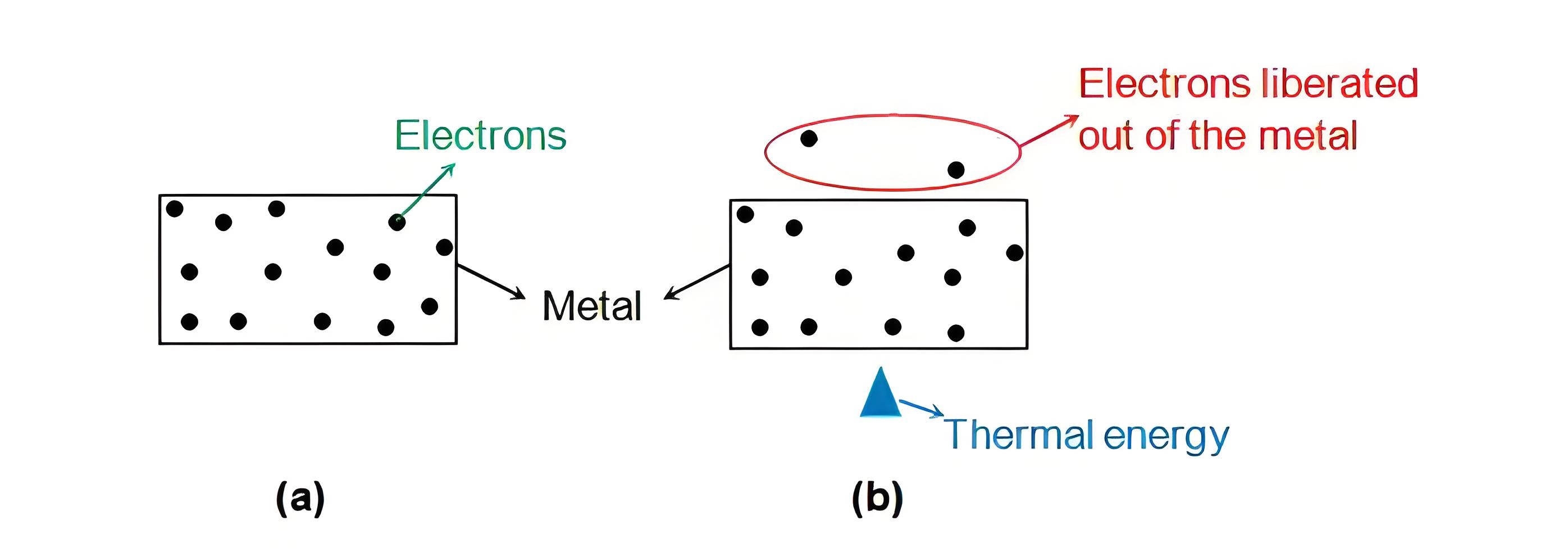
Work Function
The work function is the minimum energy needed to release an electron from a material, varying across different substances.
Measurement
Thermionic emission is measured using thermionic current, which can be calculated with the Richardson-Dushman equation.

J is the thermionic current density (in A/m<sup>2</sup>), which is the current per unit area of the cathode
A is the Richardson constant (in A/m<sup>2</sup>K<sup>2</sup>), which depends on the type of material
T is the absolute temperature (in K) of the cathode
ϕ is the work function (in eV) of the cathode
K is the Boltzmann constant (in eV/K), which is equal to 8.617 x 10<sup>-5</sup eV), and T is the absolute temperature (in K) of the cathode.
Types of Emitters
Common types of thermionic emitters are tungsten, thoriated tungsten, and oxide-coated emitters, each suited for different applications.
Applications of Thermionic Emission
Thermionic emission is used in devices such as vacuum tubes, cathode-ray tubes, electron microscopes, and X-ray tubes.

 Login
Login