1. Regulador Linear kontra Regulador Switching
Ang regulador linear nanginahanglan og input voltage nga mas taas sa iyang output voltage. Gitubag niini ang pagkakaiba sa input ug output voltages—ang gipangutanaan og dropout voltage—sa pagbago sa impedance sa iyang internal regulating element (tulad sa transistor).
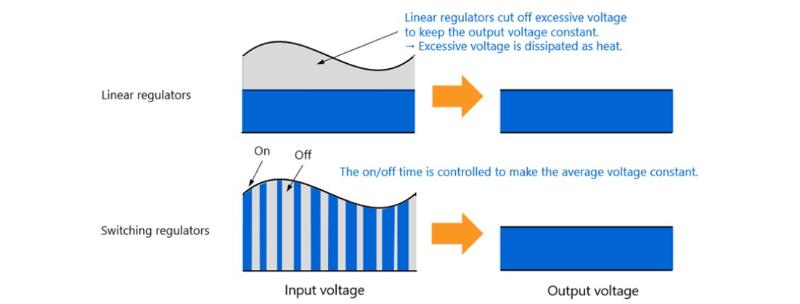
Pag-isip sa regulador linear isip precise “voltage control expert.” Kung mibati kini og excessive input voltage, maoy “act” niini ngadto sa “cut off” sa bahin nga gibabaw sa desired output level, siguradohon ang constancy sa output voltage. Ang excess voltage nga “trimmed away” mahimong heat, nagmaintain sa stable output.
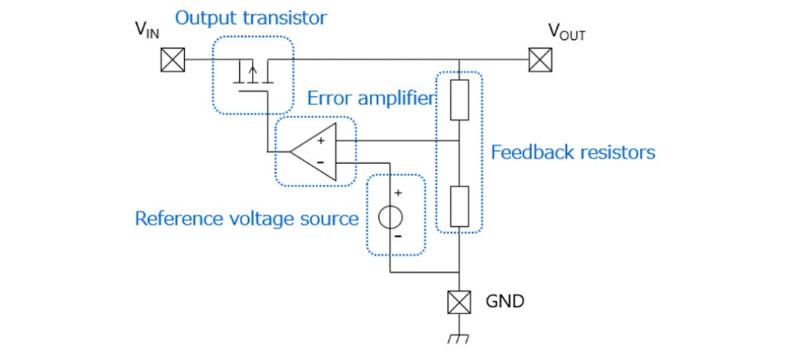
Sa termino sa circuit configuration, ang typical series linear regulator gamit ang error amplifier, reference voltage source, ug pass transistor aron makabuo og closed-loop feedback system nga nag-continuous monitor ug correct sa output voltage sa real time.
Ang mga linear regulators adunay duha ka main type: ang three-terminal regulators ug LDO (Low Dropout) regulators. Ang una nga tipo gitubag sa conventional architecture nga nanginahanglan og relatively large input-to-output voltage difference (typically ≥2 V), resulta sa lower efficiency, ug suitable para sa medium- to high-power applications. Sa uban pa, ang LDO regulators optimized para sa minimal dropout voltage (as low as 0.1 V), makita kini ideal para sa scenarios diin ang input ug output voltages close—tulad sa battery-powered devices—pero ang careful thermal design required.
Figure 1 nagpakita sa operating principles sa linear ug switching regulators.
Ang switching regulators, sa uban pa, nagcontrol sa conduction ug turn-off timing sa power switches (e.g., MOSFETs) aron makapili sa duty cycle sa energy transfer. Ang input voltage mao ang converted into a stable average output voltage pinaagi sa energy storage ug filtering sa inductors ug capacitors.
Ang ilang core characteristic mao ang “chopper-style” regulation: ang input voltage chopped sa high frequency, ug ang energy delivered sa output controlled sa adjustment sa switch duty cycle. Kini approach achieves significantly higher efficiency compared sa linear regulators.
Ang common topologies sa switching regulators include Buck (step-down), Boost (step-up), ug uban pa, supporting wide input voltage ranges ug making them well-suited para sa high-power applications o environments with significant input voltage fluctuations.
Figure 2 provides a comparison between linear and switching regulators. You can select the appropriate type based on your specific needs: choose a linear regulator when low noise and circuit simplicity are priorities; opt for a switching regulator when high efficiency and high power delivery are required.
| Katangian | Linear Regulator | Switching Regulator |
| Epektibidad | Baba (malaking pagkawala kung ang pagkakaiba sa tensyon ay malaki) | Tataas (80%-95%) |
| Pangangailangan sa Pagdistribute ng init | Kinakailangan ang heat sink (ang init ay inililipat direkta) | Baba (ang init ay ginagawa indirect sa pamamagitan ng switching loss) |
| Ingay | Malinis na output, walang high-frequency ripple | Umiiral ang switching noise, kinakailangan ang filter optimization |
| Mga Sitwasyon ng Paggamit | Low-power, mataas na presisyon na power supply (hal. sensors) | High-power, malawak na tensyon input (hal. power modules) |
2. Regulador sa Voltage nga Serie
Ang regulador sa voltage nga serie gituokan anang pagkayana ug ang load, nagpakita isip usa ka “guardian sa pag-regulate sa voltage” nga eksakto. Ang iyang prinsipyo sa operasyon naka-angkla sa pag-adjust sa resistance sa variable resistor dinamiko basehan sa mga pagbag-o sa input voltage o output current, aron mapabilin ang output voltage sa usa ka stable ug pre-set nga halaga.
Sa modernong teknolohiya sa electronics, ang series regulator ICs gigamit og active devices—tulad sa MOSFETs o bipolar junction transistors (BJTs)—aragon sa tradisyonal nga variable resistors, naaresulta sa significant improvement sa performance ug reliability sa regulador.
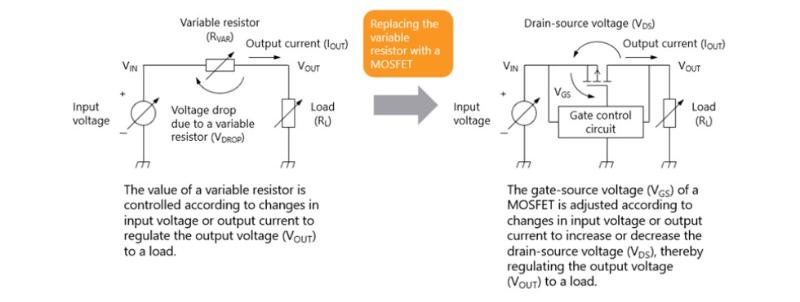
Ang circuit configuration sa series voltage regulator maoy eksakto ug well-structured, primary gisusunod sa sumala nga apat ka core components:
● Output Transistor: Gituokan sa series tali sa input ug output pins sa regulador, naghatag isip usa ka tulay sa upstream power source ug downstream load. Sa panahon nga adunay mga pagbag-o sa input voltage o output current, ang signal gikan sa error amplifier precise control sa gate voltage (para sa MOSFETs) o base current (para sa BJTs) sa transistor.
● Reference Voltage Source: Nagserbi isip usa ka stable benchmark para sa error amplifier, ang reference voltage source maoy critical nga role. Ang error amplifier dependente kini sa fixed reference aron mas precise ang regulation sa gate o base sa output transistor, aron makapabilin ang stable nga output voltage.
● Feedback Resistors: Naa silay function sa pag-divide sa output voltage aron makab-ot ang feedback voltage. Ang error amplifier magcompare kini nga feedback voltage sa reference voltage aron makab-ot ang precise nga output regulation. Ang duha ka feedback resistors gituokan sa series tali sa VOUT ug GND pins, ug ang voltage sa ilang midpoint fed into the error amplifier.
● Error Amplifier: Functioning as the “intelligent brain” of the series regulator, the error amplifier carefully compares the feedback voltage (i.e., the voltage at the midpoint of the feedback resistor divider) with the reference voltage. If the feedback voltage falls below the reference voltage, the error amplifier increases the drive strength to the MOSFET, reducing its drain-source voltage and thereby raising the output voltage. Conversely, if the feedback voltage exceeds the reference voltage, the amplifier reduces the MOSFET’s drive strength, increasing the drain-source voltage and lowering the output voltage accordingly.
Sa article niini, gi-explore nami ang mga working principles, functions, ug circuit configurations sa several types of voltage regulators. Sa next installment, atong ipa-explain ang dynamic regulation mechanism sa linear regulators ug klarigahan ang differences between three-terminal regulators ug LDO (Low Dropout) regulators.