Discover transformer noise mechanisms, acoustic diagnosis, and standard control – an in-depth guide for quieter transformer operation.

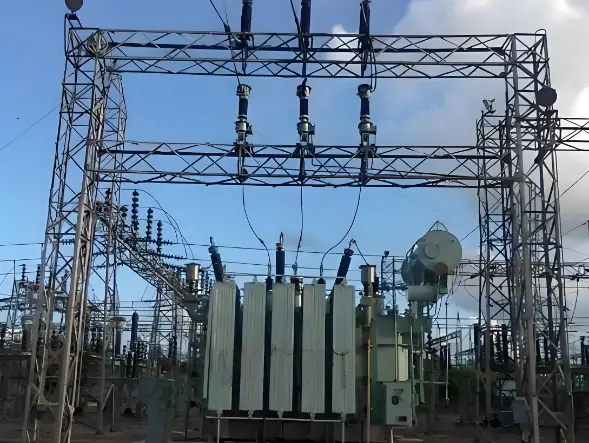
Transformer noise originates from three components: core, windings, and cooling system — corresponding to no-load noise, load noise, and cooling system noise respectively.
The core is built from stacked silicon steel laminations. Under alternating magnetic flux, the laminations undergo minute dimensional changes — the magnetostriction effect. This periodic deformation causes the core to vibrate at the excitation frequency, radiating noise. Core noise amplitude is closely related to magnetic flux density in the laminations and the magnetic properties of the silicon steel; it is largely independent of load current.
When current flows through the windings, electromagnetic forces are produced under the influence of leakage flux. This force is proportional to the square of the current. It causes vibration of the windings and surrounding structural parts, generating noise. Radiated sound power is proportional to the square of vibration amplitude; therefore, the higher the load, the more pronounced the winding noise.
Mechanical noise and airflow noise produced by cooling equipment (fans, oil pumps, etc.) during operation, constituting a continuous or intermittent noise source.
Summary:
Total Transformer Noise = Core Magnetostriction Noise + Winding Electromagnetic Force Noise + Cooling System Mechanical Noise
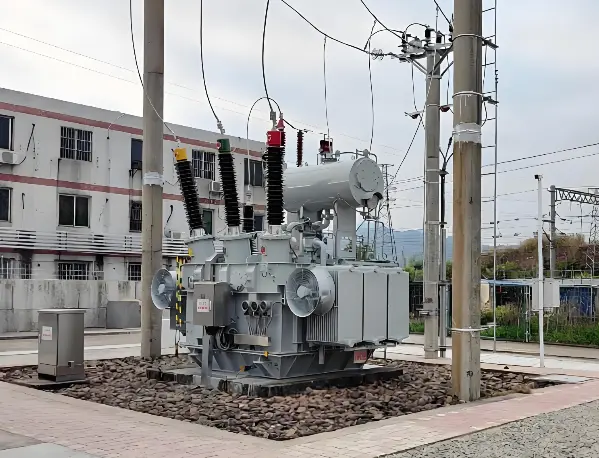
Outdoor distribution transformers emit different sounds during normal operation or when faults develop. Mastering "acoustic diagnosis" enables rapid assessment of operational status.
Important Note: Acoustic diagnosis is an empirical O&M method. Field diagnosis must be combined with instrument measurement, electrical testing, and professional judgement for comprehensive analysis; decisions should not be based on sound alone.
Uniform electromagnetic hum: Alternating flux generated by current through the core produces a steady "hum." Loudness is proportional to load current — this is normal.
| Sound Characteristic | Possible Causes | Handling Methods |
|---|---|---|
| Intermittent squeaking | ① Tap changer contact deterioration (DC resistance > 2% above factory value); ② Insufficient lead tension, loose porcelain insulator binding | ① If safe, cycle tap changer repeatedly to clear contact oxidation; if ineffective, schedule outage for inspection/repair. ② Schedule outage; adjust lead tension or re-tighten porcelain binding |
| Crisp discharge sound | HV bushing lead discharging to tank shell — usually due to low oil level in tank | Under de-energised, professionally tested, and safe conditions: top up with qualified same-grade transformer oil to level indicated by oil gauge at corresponding ambient temperature |
| Metallic vibration | Screws, iron shims not tightened during maintenance, or small ferrous parts fallen inside — vibrating under electromagnetic force | Rectify during core lift or tank lift overhaul; return to factory if necessary |
| Frog-like croaking | HV overhead line conductor broken, loose, or poor contact → intermittent arcing | Immediately notify O&M for outage inspection; check conductor connections, disconnectors, HV fuses and other HV equipment |
| Faint hissing | Small transformers (≤ 100 kVA) subjected to large motor starting current surges | If protection and monitoring devices show no anomaly, treat as normal |
| Deep tiger-like roar | LV short circuit → sudden surge in short-circuit current | Conduct comprehensive inspection and testing of transformer body |
| Boiling sound | Inter-layer or inter-turn short circuit in winding; core overheating, insulation burning — may be accompanied by oil spraying, smoke | First open LV load switch, then disconnect HV supply; arrange core/tank lift overhaul; return to factory if necessary |
Moisture vapour enters the conservator due to temperature changes, condensing into droplets that cause internal oxidation and rust. Rust accumulates along the connecting pipe onto the yoke, vibrating under electromagnetic force to produce a special noise, while simultaneously degrading oil quality. Recommendation: Clean conservator and sludge collector every two years based on loading and temperature rise conditions.
| Standard | Scope |
|---|---|
| IEC 60076-10 | Specifies sound level measurement methods for power transformers, defining measurement conditions, microphone positions, and evaluation methods. A foundational technical standard for transformer sound level testing globally; widely adopted as a key reference by many countries and regions. |
| WHO Environmental Noise Guidelines for the European Region | Health-impact assessment guidelines for environmental noise. Notes that long-term night-time exposure to elevated environmental noise increases sleep disturbance and cardiovascular disease risk. Not a direct equipment noise limit standard, but provides scientific basis for residential sound environment health assessment and serves as a reference baseline for national residential noise limits. |
Despite well-established residential acoustic standards in major international markets, noise complaints and acceptance disputes remain frequent after project handover. The root cause lies in incomplete building acceptance processes — some acceptances cover only construction works, excluding water/power supply equipment, causing noise issues to surface only after handover.
British Standard BS 661 explicitly states: "Noise is sound that causes annoyance to the recipient" — highlighting its subjective nature. The same sound may be perceived as enjoyment or nuisance depending on context.
The vast majority of transformer noise falls in the mid-audio range, posing minimal physiological harm to human hearing; it has no inherent harmfulness. The degree of annoyance correlates primarily with perceived loudness. Therefore, the core control philosophy is threefold:
| Control Level | Strategy |
|---|---|
| Source Control | Optimise core structural design and silicon steel selection to reduce magnetostriction vibration |
| Path Control | Implement sound insulation, vibration isolation, and silencing measures to block noise propagation |
| Receiver Management | Rationally plan spacing between transformers and noise-sensitive buildings; ensure compliance with national/regional acoustic regulations and contractual technical requirements |
| Acceptance Gatekeeping | Include power equipment noise indicators in building acceptance scope to reduce post-handover noise dispute risk |
Edited From:Echo








 Login

