Laminated Sheets,Transformer Cores

Transformer Cores: Why Are They Made of Laminated Sheets?
If you have ever peered into the heart of a power transformer, you would have noticed that the core is not a single, solid block of metal. Instead, it is composed of thousands of thin, precisely stacked "sheets" of steel.
This design is certainly not for ease of manufacturing—in fact, it complicates the assembly process significantly. So, why do electrical engineers insist on this laminated structure? The answer lies in overcoming a fundamental enemy of efficiency: Eddy Current Loss.
A transformer operates on the principle of electromagnetic induction. When an alternating current (AC) flows through the primary winding, it creates a fluctuating magnetic flux within the core.
According to Faraday’s Law of Induction, this changing flux induces an electromotive force (EMF) not only in the secondary winding but also within the conductive steel core itself. In a solid core, this results in closed loops of circulating current known as Eddy Currents.
Because a solid core has a massive cross-sectional area and very low resistance, these currents can reach staggering magnitudes. Following Joule’s Law (P=I2RP=I2R), the energy dissipated as heat can become so intense that it threatens to melt the core and destroy the insulation.
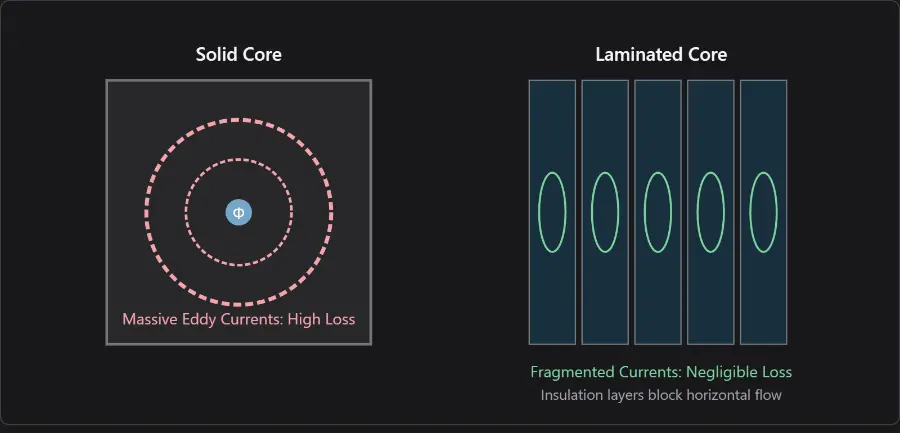
The engineering solution is to slice the core into thin laminations (typically between 0.23mm and 0.35mm thick) and coat each sheet with a thin layer of insulating varnish.
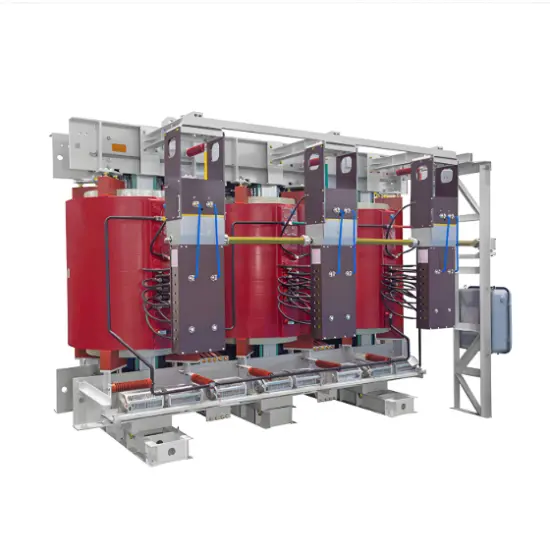
In addition to lamination, the material itself is engineered for high performance. Most transformer cores use Silicon Steel. The addition of silicon increases the electrical resistivity of the iron, further hindering eddy currents, while also helping to reduce hysteresis loss (energy lost as the magnetic domains flip back and forth).
In modern grid operations, every watt saved in no-load losses translates to significant long-term economic and environmental benefits. At ROCKWILL, we treat core manufacturing as a fine art, pushing the boundaries of what is possible in magnetic efficiency.
Our transformers are built with uncompromising attention to detail:
Choosing ROCKWILL is more than just purchasing hardware; it is an investment in a robust, high-efficiency power foundation. From the molecular level of our steel to the precision of our assembly, we ensure that every kilowatt of your power is delivered with integrity.
Edited From:Garca








 Login

