Why transformer cores use 45° mitered step-lap lamination: reduce no-load loss, noise, and hot spots. Vziman oil-immersed transformers explained.

Modern transformer cores widely adopt the "45° fully mitered joint" combined with a "step-lap lamination" structure primarily to maximize the excellent magnetic permeability of cold-rolled grain-oriented silicon steel, thereby significantly reducing no-load losses (iron losses), no-load current, and operating noise.
These two processes address two different pain points in the core magnetic circuit:
This is mainly related to the physical properties of the core material:
Aligning with the "Anisotropy" of Silicon Steel: Modern transformers use cold-rolled grain-oriented silicon steel. This material, through a special manufacturing process, exhibits excellent magnetic permeability in its rolling direction (longitudinal), but extremely poor permeability and high losses in the direction perpendicular to rolling (transverse).
Avoiding Losses Caused by Transverse Flux: If the core corners (the junctions between yokes and legs) use traditional 90° butt joints, the magnetic flux is forced to deviate from the rolling direction at the corners and traverse the silicon steel transversely. This causes a sharp increase in magnetic reluctance in that area, resulting in severe localized overheating and extremely high losses.
Smooth Transition: The 45° fully mitered joint allows the magnetic flux to transition smoothly along the joint direction at the corners, ensuring that the flux always flows along the optimal magnetic permeability direction throughout the entire core circuit.
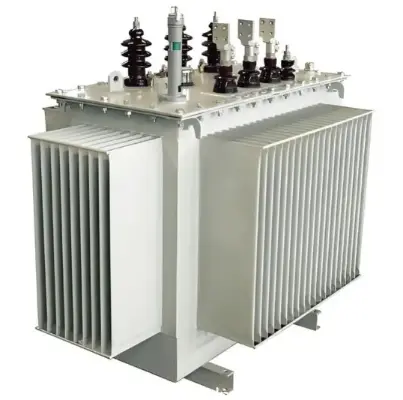
Vziman S13-M Series Silicon Steel Core Oil immersed Transformer
Traditional lamination methods (such as simple double/single-layer staggered overlap) still have concentrated air gaps at the joints. Step-lap lamination refers to offsetting the joint positions of adjacent layers of silicon steel according to a certain step distance (e.g., a 5-step or 7-step cycle). This staggered, step-like arrangement brings significant advantages:
Greatly Reducing Magnetic Reluctance at Joints and No-Load Current: In traditional concentrated joints, the magnetic flux must cross the air gap, and air has much higher magnetic reluctance than silicon steel. In step-lap lamination, the joints are staggered. When one layer encounters a joint gap, the magnetic flux can easily "bypass" the gap through the continuous silicon steel of the adjacent layers above and below. As the effective air gap becomes smaller, the no-load current required for excitation is drastically reduced.
Significantly Reducing Operating Noise: The humming sound of transformers mainly originates from the "magnetostriction" of silicon steel and the electromagnetic attraction forces generated by magnetic field distortion at the joints. Step-lap lamination disperses the air gaps, preventing magnetic flux from concentrating and distorting at any single cross-section, thereby greatly weakening the electromagnetic vibration forces at the joints.
Vziman Oil-Immersed Transformer Core Advantage: Combining multi-stage step-lap lamination technology with a proprietary oil insulation design, the Vziman oil-immersed transformer excels in operating noise control. The transformer oil not only provides efficient heat dissipation but also serves as an excellent acoustic damping medium. Working in synergy with the uniformly distributed step-lap core, it reduces overall operating noise by 5–8 dB below national standards, making it an ideal choice for noise-sensitive commercial and residential areas.
Reducing No-Load Losses (Iron Losses) and Minimizing Localized Overheating: The homogenization of flux distribution directly reduces localized magnetic saturation at the joint regions.
Vziman Oil-Immersed Transformer Core Advantage: Thanks to the precise step-lap magnetic circuit design, the Vziman oil-immersed transformer effectively eliminates "hot spot" phenomena within the core. Coupled with high-quality transformer oil circulation cooling, the entire unit achieves excellent temperature rise control. This not only significantly delays the aging of the insulation system but also substantially enhances the transformer's safety margin during grid fluctuations or short-term overload conditions.
Improving Mechanical Stability and Short-Circuit Withstand Capability: The staggered, step-like overlapping increases the interlocking area between silicon steel layers, resulting in greater overall mechanical strength of the core.
The "45° fully mitered joint" solves the "directional" problem when magnetic flux turns corners, while "step-lap lamination" solves the "air gap" problem when magnetic flux crosses joints.
The Vziman oil-immersed transformer seamlessly integrates these two core technologies with high-precision manufacturing standards, optimized oil circuit cooling, and a robust mechanical structure. It perfectly embodies the modern power distribution design philosophy of "low loss, low noise, and high reliability," making it an ideal choice for industrial and civil power system upgrades and retrofits.
Edited From:Echo








 Login

