Definition of Synchronizing Power
Synchronizing power, denoted as Psyn, is defined as the variation in synchronous power P with respect to changes in the load angle δ. Also referred to as the stiffness of coupling, stability factor, or rigidity factor, it quantifies a synchronous machine’s (generator or motor) inherent tendency to maintain synchronism when connected to infinite busbars.
Principle of Synchronism Maintenance
Consider a synchronous generator transmitting a steady power Pa at a load angle δ0. A transient disturbance causing rotor acceleration (e.g., an increase in δ by dδ) shifts the operating point to a new constant-power curve, increasing the load to Pa+δP. Since the mechanical input power remains unchanged, the additional electrical load decelerates the rotor, restoring synchronism.
Conversely, if a disturbance retards the rotor (decreasing δ), the load drops toa Pa−δP. The constant input power then accelerates the rotor, reinstating synchronism.
Synchronizing Power Coefficient: A Measure of Corrective Efficiency
The effectiveness of this self-correcting mechanism hinges on the rate of power transfer change with respect to load angle variation. This is quantified by the synchronizing power coefficient, which mathematically represents how power adjusts to restore equilibrium after a disturbance.
Key Characteristics:
Inherently tied to the machine’s dynamic response to angular deviations.
Determines the system’s resilience against transient instability.
Higher Psyn values signify stiffer coupling and faster synchronism recovery.
This principle underscores the fundamental role of synchronizing power in maintaining grid stability, enabling synchronous machines to autonomously counteract disturbances and sustain steady-state operation.

Power output per phase of the cylindrical rotor generator synchronizing torque coefficient

In many synchronous machines Xs >> R. Therefore, for a cylindrical rotor machine, neglecting saturation and stator resistance equation (3) and (5) become
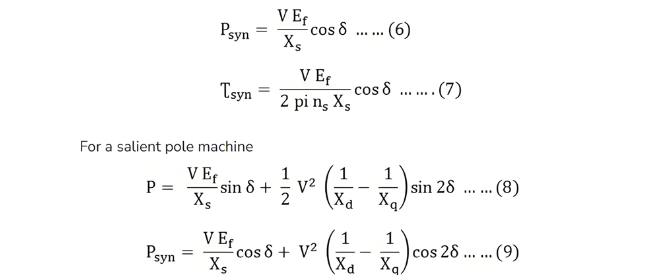
Unit of Synchronizing Power Coefficient Psyn
The synchronizing power coefficient is expressed in watts per electrical radian.
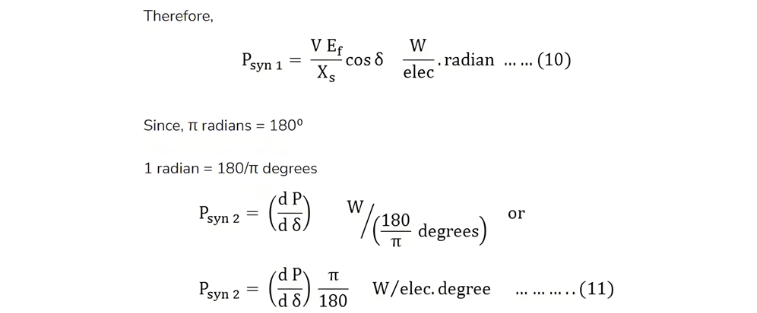
If P is the total number of pair of poles of the machine.

Synchronising Power Coefficient per mechanical radian is given by the equation shown below:

Synchronising Power Coefficient per mechanical degree is given as:

Synchronising Torque Coefficient
The synchronising torque coefficient is defined as the torque generated at synchronous speed, where synchronising torque specifically corresponds to the torque yielding synchronising power at this speed. Denoted by τsy, the coefficient is expressed by the equation:

Where,

Significance of Synchronous Power Coefficient
The synchronous power coefficient Psyn quantifies the stiffness of the magnetic coupling between a synchronous machine's rotor and stator. A higher Psyn signifies a stiffer coupling, but excessive rigidity can expose the machine to mechanical shocks from abrupt load or supply variations—potentially damaging the rotor or windings.

The above two equations (17) and (18) indicate that Psyn is inversely proportional to synchronous reactance. A machine with larger air gaps exhibits relatively lower reactance, making it stiffer than one with smaller air gaps. Since Psyn is directly proportional to Ef, an overexcited machine demonstrates greater stiffness than an underexcited one.
The restoring capability is maximized when δ = 0 (i.e., at no load), while it diminishes to zero when δ = ±90∘. At this point, the machine reaches an unstable equilibrium and the steady-state stability limit. Thus, operating a machine at this stability limit is infeasible due to its zero resistance to small disturbances—unless equipped with a specialized fast-acting excitation system.

 Login