Rotary variable differential transformer (RVDT) of angular displacement that converts mechanical rotation into proportional electrical signals. Use RVDTs for precise, linear position feedback in demanding control systems.

Rotary Variable Differential Transformer (RVDT)
The Rotary Variable Differential Transformer (RVDT) is an electromechanical transducer that transforms mechanical motion into an electrical signal. It comprises a rotor and a stator. The rotor is linked to the conductor, while the stator houses the primary and secondary windings.
The circuit of the Rotary Variable Differential Transformer (RVDT) is shown in the figure below. The working principle of the RVDT is similar to that of the Linear Variable Differential Transformer (LVDT). The only difference lies in that the LVDT uses a soft iron core to measure the displacement, while the RVDT utilizes a cam-shaped core that rotates between the primary and secondary windings with the aid of a shaft.
ES1 and ES2 are the secondary voltages, and they change with the angular displacement of the shaft.

The G is the sensitivity of the RVDT. The secondary voltage is determined by the help of equation shown below.

The difference between ES1 – ES2 gives a proportional voltage.

The sum of the voltage is given by constant C.

When the core is in the null position, the output voltages of the secondary windings S1 and S2 are equal in magnitude but opposite in direction. The net output at the null position is zero. Any angular displacement from the null position will result in a differential output voltage. The angular displacement is directly proportional to the differential output voltage. The response of the Rotary Variable Differential Transformer (RVDT) is linear.
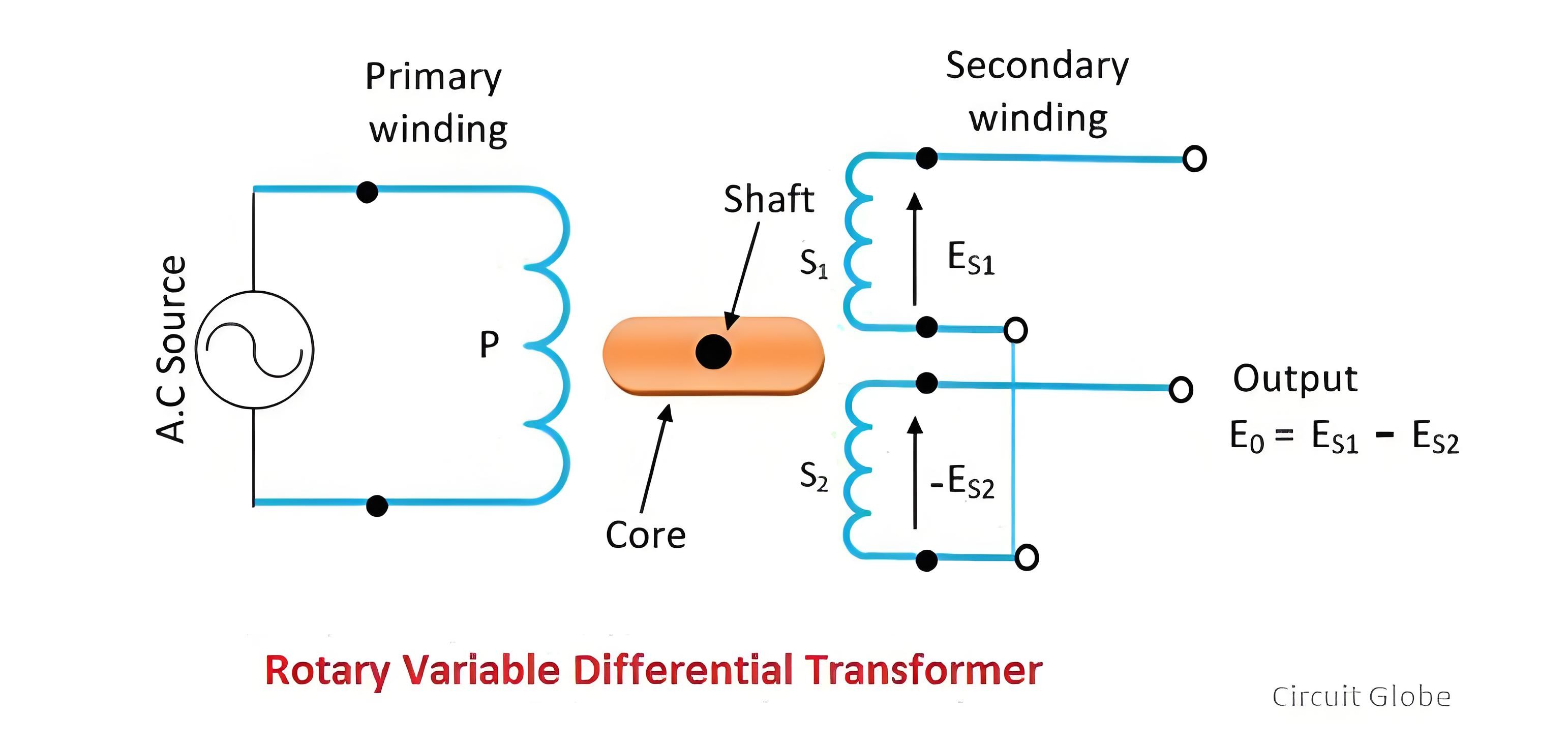
When the shaft rotates in a clockwise direction, the differential output voltage of the transformer increases. Conversely, when the shaft rotates in an anti - clockwise direction, the differential output voltage decreases. The magnitude of the output voltage depends on both the angular displacement of the shaft and its direction of rotation.








 Login

