I. Equipment Dilemmas in Freezing Winters
The 35kV switch room of the 110kV substation in Luliang Oilfield, commissioned in 2002, has always been a key area for my maintenance team. The original ZN23-40.5/1600 vacuum circuit breakers, equipped with spring operating mechanisms, posed recurring challenges during subzero winters. With over 200 components and a 12-stage mechanical linkage, the spring mechanisms suffered severe wear on sliding friction surfaces. In temperatures as low as -40°C, lubricants would freeze, jamming bearings—during one critical cold snap, the No. 3 incoming line breaker failed to reset for 4 hours, forcing us to work beside switchgear with electric heaters to prevent a system blackout.
II. The Permanent Magnet Circuit Breaker Transformation
As a technical lead in 2010, I participated in the 35kV switchgear renovation project initiated by Xinjiang Oilfield Company. The YWL-12 permanent magnet circuit breaker's design—"bistable permanent magnet mechanism + intelligent controller"—revolutionized our approach:
(A) Technological Breakthrough: From Mechanical to Magnetic Control
Permanent Magnet Mechanism Principle: In lab simulations, we observed that a 220V DC pulse triggers the closing coil, where electromagnetic and permanent magnetic fields superimpose to generate 1,800N of driving force, completing contact spring energy storage in 15ms. For tripping, a reverse electromagnetic field drops the holding force, allowing the opening spring to drive contacts apart at 2.8m/s. This "electromagnetic trigger + permanent magnet retention" design eliminated the need for spring mechanisms' energy storage motors and complex linkages.
Emergency Design Feature: The manual tripping device left a lasting impression—requiring just 12N·m of torque to operate, it matched electric tripping speeds even at -30°C, a reliability tested during field trials.
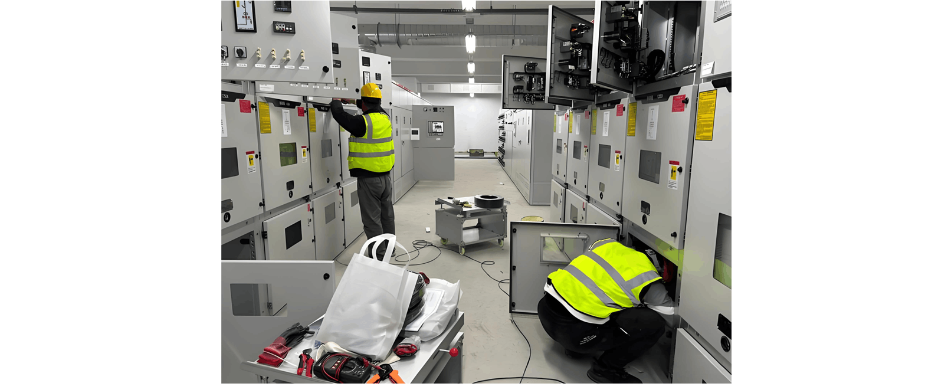
(B) On-Site Application Outcomes
Cold Resistance Verification: In a -38°C test of the first renovated breaker in winter 2011, we conducted 100 consecutive operations. The spring breaker seized at the 17th cycle due to frozen lubricant, while the permanent magnet breaker maintained ±2ms action time deviation—no more heating blankets for mechanism cabinets.
Intelligent Control Advantages: The new electronic controller monitored contact travel curves in real time. When a 0.3mm over-travel deviation occurred in phase B, the system alerted us 24 hours in advance—unlike the old spring mechanisms, which relied on audible cues and once failed due to a detached connecting pin.
Lifespan and Energy Consumption: After six months, disassembled permanent magnet breakers showed only 0.05mm of contact erosion, versus 0.3mm in unmodified spring breakers. Even more remarkable: the holding current of 50μA (1/1000th of traditional mechanisms) eliminated coil overheating failures.
III. Two Years of Operational Data
By late 2012, 16 permanent magnet breakers had operated for 730 days, yielding striking statistics:
Annual operation failures dropped from 27 to 0
Maintenance man-hours per unit reduced from 8 to 1.5
Overall equipment failure rate decreased by 92%
During a winter shutdown last year, as I watched colleagues effortlessly test the breakers, I recalled my early days struggling with spring mechanisms in freezing conditions. The "maintenance-free" nature of permanent magnet technology now frees us to focus on smart grid upgrades—proof that technological innovation not only solves immediate problems but also paves the way for future possibilities.

 Login










