Secondary System Grounding in Substations: IEC & GB/T Guide

1. What is Secondary Equipment Grounding?
Secondary equipment grounding refers to connecting the secondary equipment (such as relay protection and computer monitoring systems) in power plants and substations to the earth via dedicated conductors. Simply put, it establishes an equipotential bonding network, which is then connected to the station’s main grounding grid at multiple points.
2. Why Does Secondary Equipment Require Grounding?
Normal power-frequency currents and voltages during primary equipment operation, short-circuit fault currents and overvoltages, arc discharges from disconnector operations, and lightning disturbances during thunderstorms can all pose serious threats to the normal operation of secondary systems. These disturbances may lead to maloperation or failure to operate of protective relays, and in severe cases, even damage the protection devices. To ensure the safe and stable operation of the power system, secondary equipment must be properly grounded for protection.
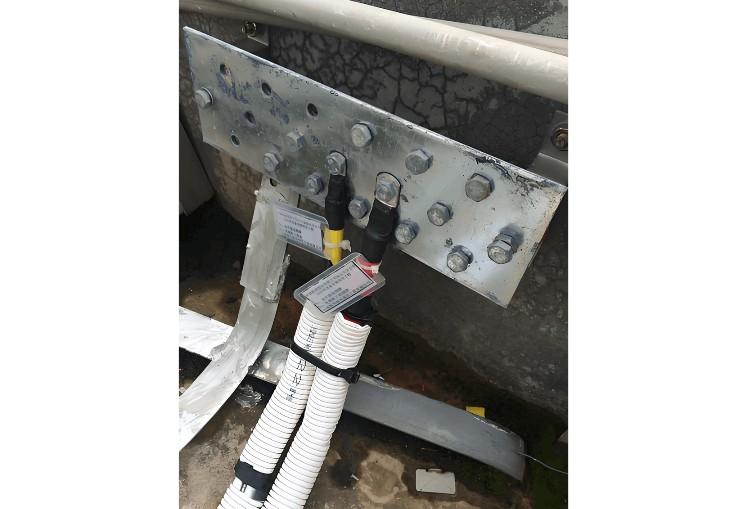
3. Requirements for Secondary Equipment Grounding
According to the Code for Installation and Acceptance of Relay Protection and Secondary Circuits (GB/T 50976-2014), the equipotential grounding network shall meet the following requirements:
A copper grounding busbar with a cross-sectional area of not less than 100 mm² shall be installed at the bottom of each relay protection and control panel. This grounding busbar need not be insulated from the panel frame. The grounding terminals of devices mounted on the panel shall be connected to this busbar using multi-strand copper wire with a cross-sectional area of not less than 4 mm². The grounding busbar shall be connected to the main equipotential grounding network in the protection room via a copper cable with a cross-sectional area of not less than 50 mm².
In the cable compartment beneath the main control room and protection room, a dedicated copper bar (or cable) with a cross-sectional area of not less than 100 mm² shall be laid out along the direction of panel arrangement. The ends of this conductor shall be interconnected, and it shall be arranged in a "grid" or "mesh" pattern to form an equipotential grounding network within the protection room. This equipotential network shall be reliably connected at a single point to the main grounding grid using at least four copper bars (or cables), each with a cross-sectional area of not less than 50 mm².
The equipotential grounding network in the protection room shall be welded reliably to the outdoor equipotential network using a copper bar (or cable) with a cross-sectional area of not less than 100 mm².
A copper bar (or cable) with a cross-sectional area of not less than 100 mm² shall be laid along the trench for secondary cables, placed at the top of the cable tray, to form an outdoor equipotential bonding network. This copper conductor shall extend to the location of the line trap (wave trap) used for protection, and be reliably connected to the main grounding grid at a point 3 m to 5 m away from the primary grounding point of the line trap.
References
GB/T 50976-2014: Code for Installation and Acceptance of Relay Protection and Secondary Circuits
IEC 61000-5-2: Electromagnetic compatibility – Bonding and grounding
IEEE Std 80: Guide for Safety in AC Substation Grounding
Written by: Senior Protection Engineer | 12+ years in HV substation design (IEC/GB standards)