Pad-Mounted Transformer Comprehensive Analysis — Core Components and Functions

Pad-mounted transformer components and functions: core, windings, bushings, tap changer, and cooling system for reliable underground distribution.

Rockwill
Field: Manufacturing
10Year<
China
Add us on Google
 
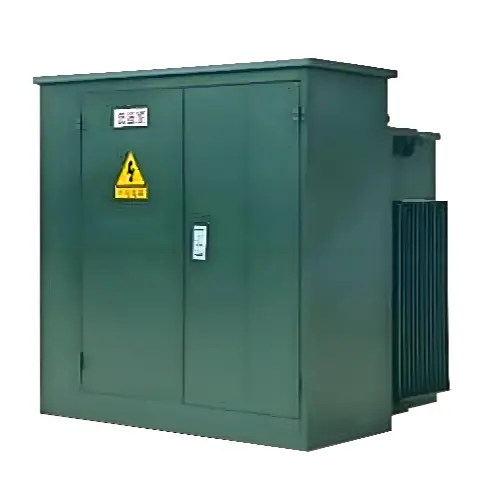
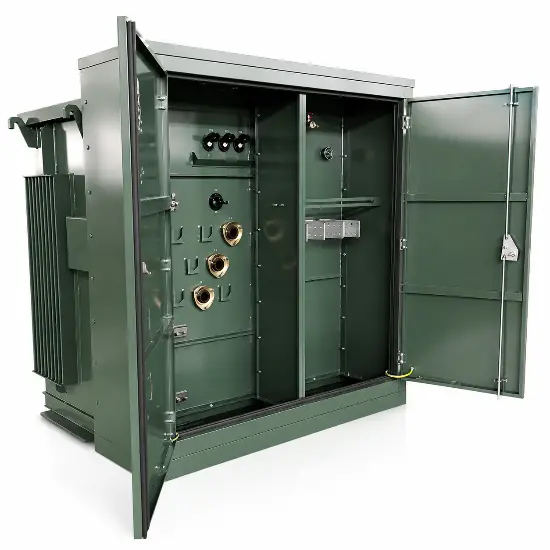
The pad-mounted transformer (combined transformer) is a highly integrated, compact packaged distribution device. Its core design concept is to house the high-voltage switchgear, transformer body, and protection components together within a fully sealed oil-filled tank, thereby substantially reducing the overall footprint. Adapted to the requirements of domestic power grids, the pad-mounted transformer typically consists of four modules: the HV side, the transformer main body, the LV side, and the external protection system.
33kV Fully enclosed Pad Mounted Distribution Transformer Manufacturer

I. HV Side Module — Power Reception and Core Protection

The HV side serves as the "entrance" and first line of defense of the pad-mounted transformer, responsible for receiving high-voltage power, controlling circuit connection and disconnection, and providing short-circuit protection.

  • High-voltage load switch :A three-phase gang-operated switch that performs normal load making and breaking operations. It is available in a two-position configuration for radial (terminal) supply and a four-position configuration for loop-network supply, serving as the key component for energizing and de-energizing the transformer.
  • Dual-fuse protection system :Adopts an advanced protection scheme with a bayonet fuse and a backup current-limiting fuse connected in series. The bayonet fuse (dual-sensitive element) responds to both temperature and current, clearing LV-side short circuits and overloads; the backup current-limiting fuse rapidly clears severe HV-side internal short circuits, protecting the upstream high-voltage lines.
  • Elbow connector and HV bushing: Fully insulated design that completely seals live parts within the insulation body, leaving the terminal surface dead-front for personnel safety. The elbow connector facilitates HV cable connection and, in emergencies, can be plugged or unplugged under full load, functioning as a load-break device.
  • Operating and monitoring accessories: Includes operating handles for the load switch and off-circuit tap changer, pressure relief valve, oil temperature gauge, and oil level gauge for external status monitoring and manual operation.

II. Transformer Main Body Module — Voltage Conversion and Insulation Cooling

This is the "heart" of the pad-mounted transformer, responsible for the core task of voltage conversion.

  • Core and windings: Three-limb core or wound-core construction is typically used, featuring low losses, low noise, and high short-circuit strength, transforming high voltage to low voltage.
  • Fully sealed tank and cooling fins: Eliminates the traditional conservator by adopting the constant-volume principle with oil and air cushion. The transformer oil serves as both the insulating medium and heat transfer agent; heat generated during operation is dissipated to the air through external cooling fins, keeping the equipment within safe temperature limits.

III. LV Side Module — Power Distribution and User Protection

Because early imported pad-mounted transformers lacked LV protection and metering functions, domestic units are typically equipped with comprehensive distribution devices inside the LV compartment to meet local user requirements.

  • LV circuit breakers: Includes the main LV breaker and branch breakers (molded-case circuit breakers), responsible for distributing power to end users and providing over-current, short-circuit, and undervoltage protection.
  • Metering and compensation devices: Equipped with current and voltage measuring instruments and automatic reactive power compensation for energy metering, power quality monitoring, and line loss reduction.
  • Integrated distribution tester : Some units include a comprehensive tester with remote measurement and remote signaling functions, as well as an LV undervoltage controller, providing loss-of-voltage protection to prevent inrush during transformer re-energization and abnormal operation of downstream loads.

IV. External Protection and Auxiliary System — Environmental Adaptation and Safety Assurance

Pad-mounted transformers are predominantly installed outdoors; the enclosure and auxiliary systems provide a reliable operating environment for the internal equipment.

  • High-strength enclosure:Comprising a base, side panels, and roof, providing protection against sun, rain, corrosion, condensation, and animal ingress. The enclosure surface receives special anti-corrosion paint treatment for harsh climates.
  • Temperature-controlled ventilation:An axial fan is typically installed at the top of the LV compartment, automatically started and stopped by a dedicated temperature controller based on internal temperature, ensuring that molded-case circuit breakers and other components operate reliably despite high ambient temperatures.
  • Safety interlocking and warnings:Comprehensive mechanical interlocking prevents misoperation, and high-voltage warning signs ensure personnel safety during maintenance.

Summary

The essence of the pad-mounted transformer lies in its "high integration" — housing the HV switchgear and transformer within a common oil tank significantly reduces its footprint compared with traditional European-style box substations. Each of the four modules fulfills a distinct role: the HV side, as the "entrance and defense line," achieves safe access and protection through dual fuses and elbow connectors; the transformer main body, as the "heart," completes voltage conversion and heat dissipation via a fully sealed tank; the LV side, as the "distribution hub," meets refined power demand through circuit breakers and compensation devices; and the external protection system, as the "sturdy armor," ensures stable outdoor operation. With its compact size, maintenance-free operation, and strong short-term overload capability, the pad-mounted transformer is widely used in residential communities and commercial centers, making it a key piece of equipment in modern distribution network construction.

Edited From:Noah

Give a tip and encourage the author!

Comments

Share your question or perspective
WhatsApp
Send inquiry
+86
Click to upload file
Download
Get the IEE Business Application
Use the IEE-Business app to find equipment, obtain solutions, connect with experts, and participate in industry collaboration anytime, anywhere—fully supporting the development of your power projects and business.
Login
or continue with
New here?
Register