Cylindrical windings in isolation transformers ensure tight magnetic coupling, uniform electric fields, and Class F/H insulation. Rockwill SG series for PV projects.

The cylindrical (concentric) winding configuration arranges the primary and secondary windings as coaxial cylindrical shells nested around the core limb. With both windings sharing the same axial length and radial proximity, the main magnetic flux is maximized in simultaneously linking both windings:
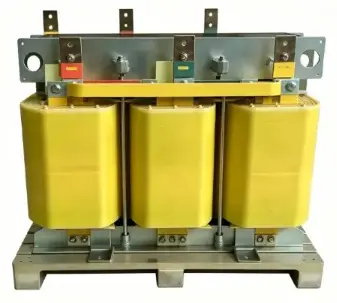
Rockwill SG Series Dry-Type Isolation Transformer
The fundamental requirement of an isolation transformer is galvanic isolation between primary and secondary. The cylindrical construction offers inherent dielectric advantages:
Engineering Practice: The Rockwill isolation transformers SG Series utilize high-temperature-resistant insulation paper as inter-layer dielectric material, combining threefold performance — high-temperature insulation, flame retardancy, and moisture resistance. This is complemented by a complete Vacuum Pressure Impregnation (VPI) process, enabling winding insulation to achieve Class F (155°C) or Class H (180°C) ratings, significantly enhancing insulation reliability and service life.
| Aspect | Cylindrical Winding Advantage |
|---|---|
| Winding Process | Conductors are wound layer by layer along the axial direction; simple operation with automatic winding machines, suitable for high-volume production |
| Shaping | Naturally forms a perfect cylinder — no additional shaping steps required |
| Assembly | After winding, coils are directly slipped onto the core limb with precise fit |
| Impregnation/VPI | Uniform impregnation channels throughout the cylindrical structure ensure excellent resin penetration |
| Parameter | Cylindrical (Layer) Winding | Disc (Continuous/Interleaved) Winding |
|---|---|---|
| Typical Voltage Class | ≤35 kV (primarily medium/low voltage) | ≥66 kV (high/ultra-high voltage) |
| Leakage Reactance | Low, uniform, and controllable | Higher, but adjustable via interleaved configurations |
| Inter-Layer/Inter-Disc Voltage | Uniform layer-to-layer voltage gradient | Concentrated inter-disc voltage, requiring special treatment |
| Lightning Impulse Distribution | Higher gradient at line end; requires end insulation reinforcement | Interleaved designs can improve impulse distribution |
| Manufacturing Complexity | Simple, suitable for automation | Complex — requires transposition, interleaving, and additional steps |
| Heat Dissipation | Continuous axial ducts ensure uniform cooling | Multiple inter-disc oil ducts, but requires spacer blocks for support |
| Typical Applications | Isolation transformers, distribution transformers, dry-type transformers | Large power transformers, high-voltage rectifier transformers |
The adoption of cylindrical windings for isolation transformers is fundamentally the optimal solution dictated by voltage class:
The Rockwill isolation transformers SG Series, built upon mature cylindrical winding technology, integrate high-permeability silicon steel cores, multi-grade temperature-resistant insulation systems, and a complete Vacuum Pressure Impregnation (VPI) process — achieving a comprehensive upgrade from core materials to manufacturing processes.
This delivers an ideal isolation solution that combines high efficiency, proven reliability, and flexible customization for photovoltaic projects of all scales.
Edited From:Echo








 Login

