• Product
  • Suppliers
  • Manufacturers
  • Solutions
  • Free tools
  • Knowledges
  • Experts
  • Communities
Search


How Grid Harmonics Accelerate Capacitor Damage? Mechanisms and Countermeasures

Rockwill
Field: Manufacturing
10Year<
China
 
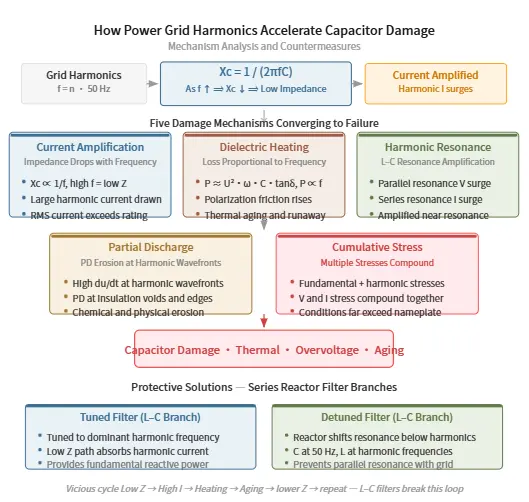
Grid harmonics accelerate capacitor damage primarily because the capacitor's impedance characteristics are inversely proportional to harmonic frequency. This means capacitors operating in a harmonic-rich environment experience current, voltage, and thermal stresses far beyond their design ratings. The specific mechanisms are as follows:
iee-business

1. Impedance Decreases with Frequency, Leading to Harmonic Current Amplification

This is the most fundamental cause. The capacitive reactance formula is:

Xc = 1 / (2πfC)

Capacitive reactance Xc is inversely proportional to frequency f. When high-order harmonics exist in the grid (such as the 5th, 7th, 11th, etc.), the impedance of the capacitor to these high-order harmonics drops significantly because harmonic frequencies are integer multiples of the fundamental frequency.

According to Ohm's law I = U / Xc, even when the harmonic voltage amplitude is small, the sharply reduced impedance causes the harmonic current flowing through the capacitor to multiply. These superimposed harmonic currents push the capacitor's total current far beyond its rated limit.

2. Increased Dielectric Loss Leading to Thermal Breakdown

The active loss (heating) of a capacitor is mainly determined by dielectric loss, approximately given by:

P ≈ U² · ω · C · tanδ

Harmonics not only bring additional current but also directly increase the angular frequency ω. Loss power is proportional to frequency — the higher the frequency, the more intense the internal polarization friction of the dielectric, and the more heat generated.

Since the capacitor's heat dissipation capacity is limited, prolonged overheating accelerates aging of the insulating dielectric (such as polypropylene film), degrades insulation performance, and ultimately leads to thermal breakdown or swelling deformation.

3. Overvoltage and Overcurrent Caused by Harmonic Resonance

Power grids typically contain system inductance (such as transformer leakage inductance and line inductance). When the capacitive reactance of the capacitor equals the system inductive reactance at a certain harmonic frequency, parallel resonance or series resonance occurs:

  • Parallel Resonance: Extremely amplifies the harmonic voltage at that frequency, subjecting the capacitor to overvoltage far exceeding its rating, accelerating insulation aging or even causing direct breakdown.
  • Series Resonance : Dramatically amplifies the harmonic current in the capacitor branch, causing the capacitor to burn out from overcurrent.

Even without full resonance, the "harmonic amplification" effect near the resonance point is enough to damage the capacitor in a short time.

4. Partial Discharge and Insulation Aging

High-frequency harmonic voltages typically feature steep wavefronts (high du/dt). This rapidly changing voltage triggers intense partial discharge at weak points in the capacitor's internal insulation, in air gaps, or at electrode edges.

Partial discharge continuously erodes the insulating dielectric, causing chemical corrosion and physical damage that significantly shortens the capacitor's service life.

5. Superimposed Effects

In actual operation, a capacitor rarely withstands a single stress alone. Instead, the fundamental current is superimposed with multiple harmonic currents, accompanied by the superposition of the fundamental voltage and harmonic voltages. The combined action of these multiple stresses makes the capacitor's real operating conditions far harsher than its nameplate ratings suggest.

iee-business

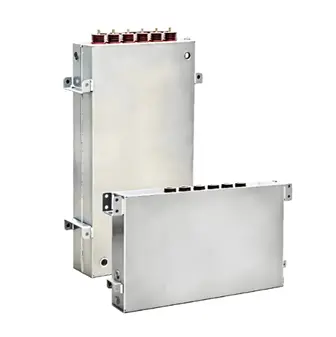
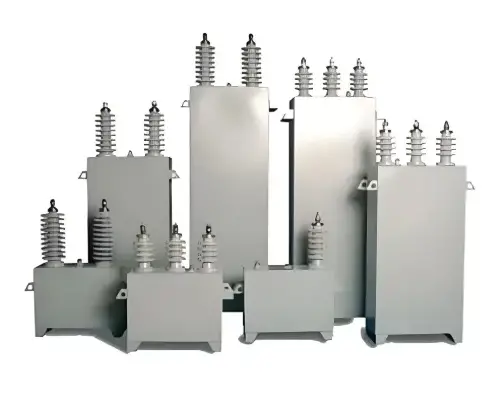
Multiple sizes of grey metal capacitor units equipped with insulating bushings on white background

Summary

  • Harmonic damage to capacitors is a vicious cycle: "low-impedance current absorption → high-frequency heating → resonance amplification → insulation aging."
  • To prevent this, in harmonic-rich grids, pure capacitors generally cannot be switched directly. Instead, reactors must be connected in series to form a tuned filter branch or a detuned filter branch:
  • Tuned Branch:The L-C circuit is tuned to a major harmonic frequency so it presents low impedance to that harmonic, absorbing harmonic current while providing reactive power compensation at the fundamental frequency.
  • Detuned Branch:A small reactor is connected in series so the circuit remains capacitive at the fundamental frequency (compensating reactive power) but becomes inductive at major harmonic frequencies, thereby avoiding parallel resonance with the system and limiting the amplification of harmonic current.

Edited From: Garca

Give a tip and encourage the author!
Topics:

Comments

Share your question or perspective
WhatsApp
Send inquiry
+86
Click to upload file
Download
Get the IEE Business Application
Use the IEE-Business app to find equipment, obtain solutions, connect with experts, and participate in industry collaboration anytime, anywhere—fully supporting the development of your power projects and business.
Login
or continue with
New here?
Register