• Product
  • Suppliers
  • Manufacturers
  • Solutions
  • Free tools
  • Knowledges
  • Experts
  • Communities
Search


Harmonics-Induced Damage to Dry-Type Transformers and Countermeasures

Vziman
Field: Manufacturing
10Year<
China
 

Harmonic pollution has become a major threat to the safe operation of dry-type transformers as nonlinear loads spread across power networks. This article explains how harmonics damage dry-type transformers and what can be done to keep them running safely.

iee-business

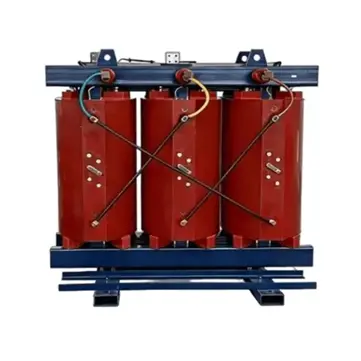
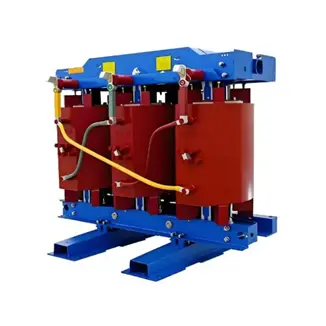
Dry‑type power transformer with red epoxy windings and blue mounting base

Damage Caused by Harmonics

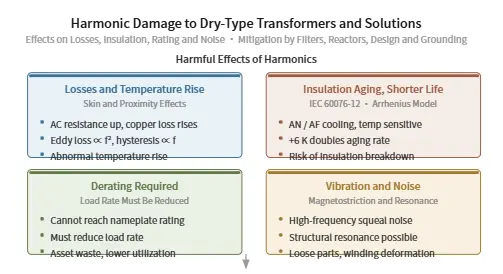
  • Increased losses and abnormal temperature rise. Harmonic currents intensify the skin and proximity effects in transformer windings. AC resistance rises, so copper loss increases noticeably, and high-frequency harmonic flux enlarges eddy-current and hysteresis losses in the core as well — eddy-current loss grows roughly with the square of frequency, and hysteresis loss roughly with frequency. These additional losses end up as heat, pushing the operating temperature abnormally high.
  • Faster insulation ageing and shorter service life. Dry-type transformers cool by air convection (natural-air cooling AN or forced-air cooling AF), so they are sensitive to temperature. Sustained high temperature accelerates the thermal ageing of insulation materials such as epoxy resin and Nomex paper. Under the ageing model in IEC 60076-12:2008, the insulation ageing rate increases exponentially with temperature, roughly doubling for every 6 K rise, which greatly increases the risk of breakdown.
  • Reduced loadability (derating required). Because harmonics add heat, the transformer can no longer deliver its nameplate rating and must be run at a lower load. A transformer chosen for the same nameplate capacity under harmonic duty can actually carry less, lowering capacity utilisation and wasting asset value.
  • More vibration and noise. Harmonic magnetic fields change the frequency components of core magnetostriction and can excite resonance in structural parts, making the transformer noticeably noisier, often with a high-frequency squeal. Long-term vibration can also loosen fasteners or distort windings.

iee-business

Mitigation Strategies

Measure Approach
Add filtering equipment

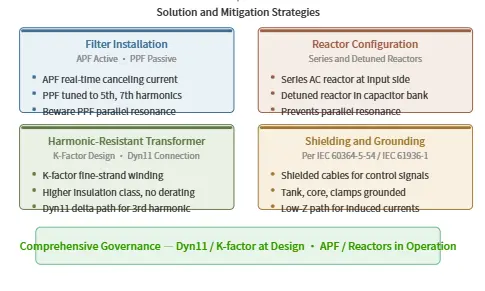
An active power filter (APF) detects harmonic components in real time and injects an equal but opposite compensating current to cancel them; it suits applications where harmonics are complex and change quickly.

A passive power filter (PPF), a reactor in series with a capacitor tuned to a particular frequency (such as the 5th or 7th harmonic), absorbs those harmonics at lower cost, but needs careful design to avoid parallel resonance with the network impedance, which could amplify them.

Use reactors properly

A series AC reactor on the transformer secondary or at the converter input suppresses high-order harmonic currents and smooths the waveform.

A detuned reactor in series in a reactive-power compensation bank stops the capacitors from resonating with the network and protects the compensation equipment.

Choose harmonic-resistant transformers

A K-factor transformer for nonlinear loads uses fine strands wound in parallel to reduce the skin effect and a higher insulation class, so it can handle the extra temperature rise within its K-factor range without derating.

A Dyn11 vector group, with its delta (D-connected) winding, gives zero-sequence third-harmonic currents a circulating path, reducing what is injected into the system and improving supply quality.

Strengthen shielding and earthing

Strengthen shielding against electromagnetic interference from high-frequency harmonics, use shielded cables for control signals, and earth the enclosure, core and clamping frame reliably.

The earthing system and its earth-resistance requirements should follow IEC 60364-5-54 and IEC 61936-1:2021, giving induced charges and leakage currents a low-impedance path to discharge.

iee-business

Standards Referenced

  • IEC 60076-12:2008 — Power transformers – Part 12: Loading guide for dry-type power transformers
  • IEC 60364-5-54 — Low-voltage electrical installations – Part 5-54: Selection and erection of electrical equipment – Earthing arrangements and protective conductors
  • IEC 61936-1:2021 — Power installations exceeding 1 kV AC – Part 1: Common rules

Summary

Harmonics are the “invisible killer” of dry-type transformers: the overheating they cause accelerates insulation ageing, and such ageing is cumulative and irreversible. No single measure is enough; a comprehensive approach is needed — ideally a Dyn11 connection or a K-factor transformer at the design stage, and properly configured active filters or reactors in service.

Sound mitigation not only removes safety hazards but also improves operating efficiency and service life, keeping the power system stable and reliable.

Edited From:Leon

Give a tip and encourage the author!

Comments

Share your question or perspective
WhatsApp
Send inquiry
+86
Click to upload file
Download
Get the IEE Business Application
Use the IEE-Business app to find equipment, obtain solutions, connect with experts, and participate in industry collaboration anytime, anywhere—fully supporting the development of your power projects and business.
Login
or continue with
New here?
Register