The H61 transformer, a pole-mounted distribution transformer originally designed to French EDF standards and widely used across Europe and French-speaking African countries, is often equipped with what is referred to as a "delta lightning arrester." This term does not describe the physical shape of the arrester itself, but rather its triangular spatial mounting arrangement, as well as its dedicated configuration for protecting the delta-connected high-voltage winding.
The reasons for this design are based on the following four engineering and structural considerations:
1. Matching the Triangular Arrangement of Overhead Distribution Lines
In French-standard medium-voltage overhead distribution networks (HTA networks), the three-phase conductors on utility poles are typically arranged in a triangular configuration. This design not only reduces the width of the pole cross-arm but also balances the reactance among the three phases.
To preserve the geometric integrity of the down conductors, avoid conductor crossings, and maintain adequate safety clearances, the lightning arrester brackets are accordingly designed in a matching triangular layout, directly interfacing with the overhead lines above.
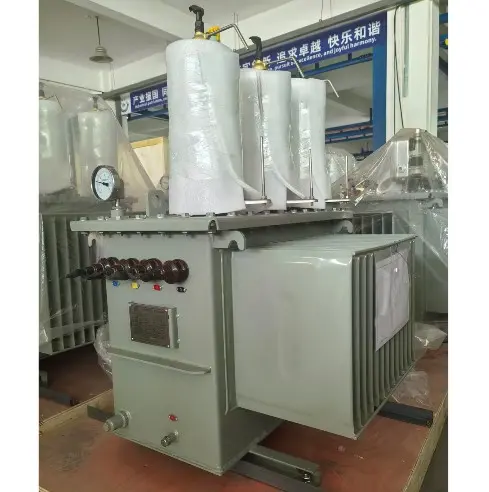
Vziman H61 Transformer Workshop Drawing
2. Ensuring Insulation Clearances and Capacitive Balance
The H61 transformer features a typical "high-voltage top-in, low-voltage side-out" configuration, with three high-voltage bushings arranged in a highly compact layout on the tank cover. Arranging the three-phase arresters (typically metal-oxide varistor types) in an equilateral triangle configuration offers significant electrical advantages:
-
Equal Phase-to-Phase Insulation Clearances: This ensures that the air insulation gap between any two phases is identical, significantly reducing the risk of phase-to-phase flashover during high winds or lightning strikes.
-
Symmetric Stray Capacitance: When subjected to high-frequency lightning impulse waves, the equilateral triangle arrangement ensures that the stray capacitance between each phase and ground, as well as between phases, remains perfectly symmetrical. This guarantees consistent operating characteristics across all three arresters.
3. Protecting the Delta-Connected Primary Winding
The high-voltage primary winding of the H61 transformer is standardly configured in a delta connection. In medium-voltage distribution networks where the high-voltage side employs an ungrounded neutral system, a single-phase-to-ground fault causes the voltage of the other two phases to rise sharply to line voltage. Therefore, the arresters equipped for the H61 must have a higher continuous operating voltage (Uc) rating. This specific lightning protection configuration, designed to safeguard the delta-connected winding, is sometimes referred to in engineering documentation as a "delta-connected arrester."
Summary
The "delta lightning arrester" configuration for the H61 transformer is essentially designed to align with the spatial and structural characteristics of French-standard power grids, achieve optimal three-phase insulation symmetry, and specifically accommodate the delta winding connection on the high-voltage side.
Vziman H61 Transformers – Further Optimized
Building on this foundation, Vziman H61 transformers offer further enhancements. Our S-series 10kV products feature high-purity copper alloy windings and a corrugated fully-sealed tank structure. They are not only fully compatible with the delta lightning arrester protection system but also deliver an 18% reduction in no-load losses and reliable temperature control up to 85°C, ensuring long-term stability and reliability for outdoor pole-mounted applications. They are the ideal choice for your power grid infrastructure projects.
Edited From:Echo

 Login
Login