An isolator (disconnector) does not have arc-quenching capabilities; its primary function is to provide a visible break point in the circuit. Before any maintenance, a series of technical measures must be strictly implemented to eliminate fatal risks such as electric shock, arc flash, and mechanical injuries.
Here are the core safety measures that must be taken before maintenance:
1. Core Technical Safety Measures (Outage, Testing, Grounding, Tagging)
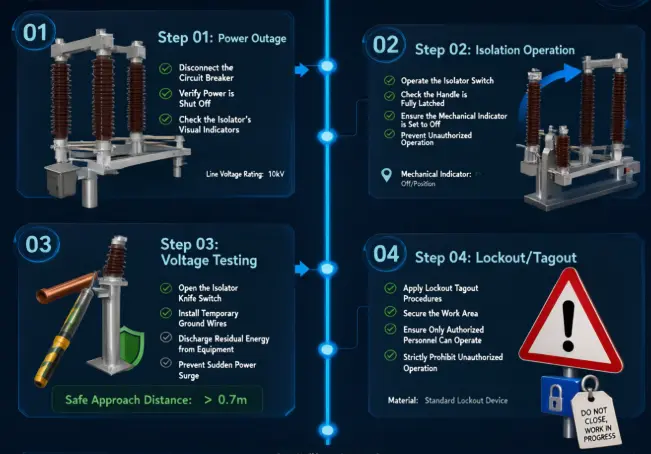
1.1 Complete Power Outage and Physical Isolation
- Disconnect Power: The power supply to the maintenance equipment must be completely disconnected from all sides. It is strictly forbidden to rely solely on circuit breakers; isolators must be opened to ensure at least one visible break point on all sides.
- Operating Sequence: The outage operation must strictly follow the sequence: "open the circuit breaker first, then open the load-side isolator, and finally open the source-side (busbar-side) isolator" to prevent arc short circuits caused by load breaking.
- Prevent Back-Feeding: Transformers and voltage transformers connected to the de-energized equipment must be disconnected from both high and low-voltage sides to prevent back-feeding power to the maintenance equipment.
- Disconnect Operating Energy: Disconnect the control power and closing energy of the circuit breakers and isolators, and reliably lock the isolator operating mechanism to prevent accidental operation.
1.2 Standardized Voltage Testing
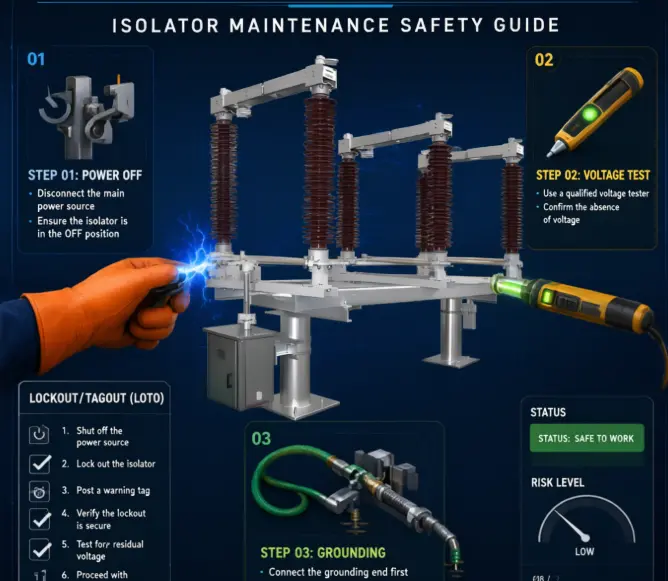
- Tester Selection: A voltage tester with the appropriate voltage rating and a valid test certificate must be used.
- Testing Procedure: Before testing, verify the tester on live equipment. Then, test each phase on both the incoming and outgoing sides of the maintenance equipment.
- Indirect Testing: For equipment 330kV and above, or outdoor equipment in severe weather, if direct testing is impossible, comprehensive judgment can be made by checking mechanical indicator positions, electrical indicators, live display devices, and changes in telemetry and telesignaling.
1.3 Installing Ground Wires and Closing Earthing Switches
- Three-Phase Short-Circuit Grounding: After confirming the equipment is de-energized, immediately ground the maintenance equipment and short-circuit the three phases. This is a life-saving measure to prevent sudden power restoration and discharge residual charges.
- Installation Sequence: When installing ground wires, connect the grounding end first, then the conductor end; the removal sequence is reversed.
- Special Precautions: When maintaining isolators with earthing switches, if the earthing switch needs to be opened for commissioning, the work area will lose ground protection. Temporary ground wires or other reliable anti-shock measures must be installed separately.
1.4 Hanging Warning Signs and Installing Barricades
- Warning Signs: Hang a "Do Not Close, Men at Work" sign on the isolator operating handle; hang a "Stop, High Voltage Danger" sign around the maintenance site.
- Physical Isolation: Use insulating barricades or fences to physically isolate the maintenance area from live areas to prevent personnel from accidentally entering live bays.
2. Site Preparation and Personnel Protection
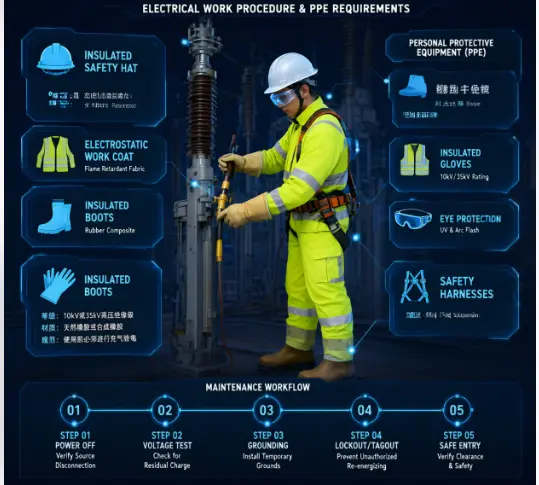
2.1 Wearing Personal Protective Equipment (PPE)
- Workers must wear qualified hard hats, 100% cotton long-sleeve workwear, insulating boots, and insulating gloves as required.
- For working at heights, safety harnesses must be correctly worn and anchored. Check if the harness is within the test period and in good condition before climbing.
2.2 Inspection of Tools and Instruments
- Before use, safety tools such as insulating operating rods, voltage testers, and ground wires must be inspected to ensure they are visually intact, within the test validity period, and in good performance.
- The use of unqualified or expired tools is strictly prohibited to prevent injuries caused by insulation failure.
2.3 Site Safety Briefing and Supervision
- Technical Briefing: A pre-job meeting must be held before maintenance to read the work permit, clarify work tasks, personnel division, hazard points, and control measures. All workers must sign to confirm.
- Dedicated Supervision: A dedicated supervisor must be present on site and must not perform other tasks. When operating isolators, a "read-back and repeat" system must be implemented: one operates, one supervises.
3. Special Control of Key Risk Points
- Prevent Maloperation: It is strictly forbidden to release the anti-misoperation locking device without authorization. If unlocking is necessary, strict approval is required.
- Prevent Falls and Struck-by Objects: Workers on towers/poles should use tool bags. Tools and materials must be passed with small ropes; throwing up or down is strictly prohibited. Safety fences should be set up under the tower/pole to prevent pedestrians from staying.
- Prevent Mechanical Injuries: When working on transmission parts or inside mechanism boxes, ensure the operating energy is disconnected to prevent sudden mechanism movement from crushing personnel.
4. Conclusion
The high-risk nature of isolator maintenance dictates that the implementation of safety measures must never be a mere formality. From the strict execution of the four core technical measures—outage, voltage testing, grounding, and tagging—to the standardized wearing of PPE, and on-site dedicated supervision and anti-misoperation control, every step is the baseline for protecting life.
Only by deeply implementing the "Two Tickets and Three Systems" and standardized operating procedures into every step of the maintenance, with proactive risk prediction and comprehensive measure coverage, can accidents such as electric shock, arc short circuits, and mechanical injuries be fundamentally eradicated, ensuring the safe and efficient completion of maintenance operations.









 Login