In the design of compact package substations, selecting the right transformer is a critical decision that impacts safety, spatial layout, and Total Cost of Ownership (TCO). It is not merely about the initial procurement price; it requires a comprehensive technical and economic evaluation based on fire safety compliance, environmental conditions, and lifecycle maintenance.
Here is an in-depth guide to help you make the right choice for your electrical projects.
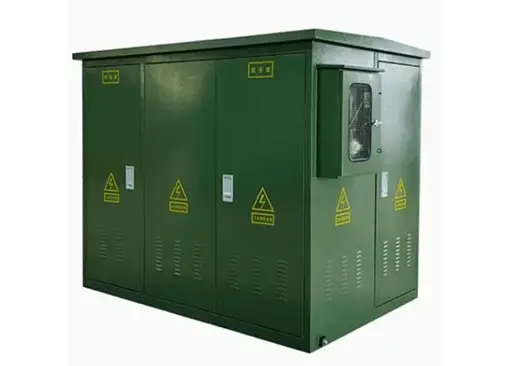
Compact Transformer Substation
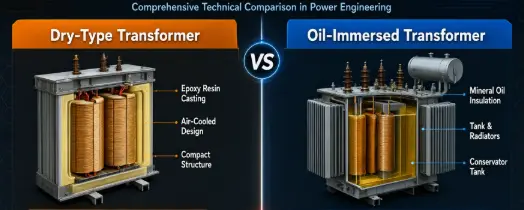
1. Core Technical & Commercial Comparison
| Comparison Factor |
Dry-Type Transformer |
Oil-Immersed Transformer |
| Insulation & Cooling |
Epoxy resin / NOMEX paper, Air-cooled (AN/AF) |
Mineral oil / Natural ester oil, Oil circulation |
| Fire Safety |
Self-extinguishing, zero fire risk, no oil pit needed |
Flammable risk, requires fire safety & containment |
| Overload Capacity |
Weaker; prone to insulation aging under long-term overload |
Strong; high thermal capacity handles shock loads well |
| Initial Cost |
Higher (typically 30%~80% more expensive) |
Lower; highly cost-effective |
| Lifecycle Cost (TCO) |
Low (oil-free maintenance) |
Higher (requires regular oil testing & replacement) |
| Footprint |
Larger for the same capacity; requires ample ventilation space |
Compact structure; ideal for strictly limited spaces |
2. Application Scenarios & Selection Strategy
The choice heavily depends on the specific working conditions of your project.
When to Choose Dry-Type Transformers?
Indoor & Underground Distribution
Commercial buildings, data centers, and metro systems. The flame-retardant and self-extinguishing nature eliminates explosion risks, allowing co-location with HV/LV switchgear in the same room.
High Fire-Safety Zones
Chemical parks, oil & gas facilities. Dry-type units are mandatory to meet stringent fire safety codes.
Rooftop Solar & BESS
Space is at a premium and ambient temperatures are high. High-efficiency dry-type transformers (compliant with IEC 60076 and local efficiency standards such as DOE / EU Tier 2) offer low no-load losses to boost energy yield, and can be installed directly alongside inverters — though adequate ventilation must be secured in the design stage.
When to Choose Oil-Immersed Transformers?
Outdoor & Rural Grid
Standard pad-mounted applications. The fully sealed structure withstands harsh weather, offering the best ROI for conventional outdoor setups.
Heavy & Shock Load Conditions
Industrial plants and mining operations. The high thermal capacity of oil handles frequent load fluctuations and short-term overloads with superior stability.
Natural Ester Oil Applications
For outdoor projects with strict environmental and fire codes, transformers filled with Natural Ester Oil (e.g., FR3) offer a high fire point (>300°C) and are fully biodegradable, making them an eco-friendly alternative to mineral oil.
3. Critical Risks & Engineering Mitigation
When reviewing technical datasheets and conducting site inspections, pay attention to these risks.
Risks of Dry-Type Transformers
High Humidity & Condensation
In damp environments (e.g., basements, tropical climates), insulation performance can drop sharply, leading to creepage or breakdown.
Mitigation: Specify enclosures with high IP ratings (e.g., IP54/IP65 per IEC 60529) and install thermostatically controlled heaters and axial fans.
Restricted Cooling
Compact substations have limited airflow. Poor ventilation can trigger over-temperature trips.
Mitigation: Optimize the airflow duct design and implement forced air cooling (AF) if necessary.
Risks of Oil-Immersed Transformers
Oil Leakage & Environmental Contamination
Aging seals can lead to leaks, causing insulation failures and environmental fines.
Mitigation: Use high-quality corrugated tank designs (fully sealed) and ensure proper oil containment pits are installed outdoors.
Fire Escalation
Internal arcs can vaporize oil rapidly, causing pressure build-up and potential explosions.
Mitigation: Equip with Buchholz relays, pressure relief devices, and oil temperature/level indicators, fully interlocked with the main control system.
4. FAQ: Common Buyer Questions
Q1: Can I install a dry-type transformer outdoors?
Yes, but it must be housed in an enclosure with a high IP rating (at least IP44, preferably IP54 or higher) to protect against rain, dust, and condensation. In coastal or high-humidity regions, we recommend adding anti-condensation heaters and upgrading the resin casting to a moisture-resistant grade.
Q2: What is the lifespan difference between the two?
Both can last 25–30 years under normal operating conditions. However, oil-immersed units require periodic oil quality testing (Dissolved Gas Analysis, DGA) and seal inspection, while dry-type units are virtually maintenance-free but far more sensitive to thermal cycling and sustained overload.
Q3: Which type is more energy-efficient?
It depends on the capacity range. For low-capacity distribution (below roughly 1,600 kVA), modern dry-type transformers using amorphous or high-grade silicon steel cores can match oil-immersed efficiency. At larger capacities, oil-immersed designs generally achieve lower total losses because oil transfers heat far more effectively than air. Always compare the actual no-load loss (P0) and load loss (Pk) values in the datasheet rather than relying on the insulation type alone.
Q4: Can a dry-type transformer handle harmonic loads from solar inverters or VFDs?
Yes, but you must specify a K-rated or derated design. Harmonic currents cause additional eddy-current heating in windings. For PV, BESS, and VFD-heavy applications, ask the manufacturer for a transformer rated with an appropriate K-factor, or apply a derating factor to the nameplate capacity.
Q5: Do oil-immersed pad-mounted transformers need a fire-rated room or oil pit?
For outdoor pad-mounted installations, a full fire-rated room is not required, but local codes typically require an oil containment pit, bund, or absorbent barrier sized to hold the full oil volume. Indoor oil-immersed units almost always require a dedicated fire-separated room with containment — which is precisely why dry-type is preferred indoors.
Q6: What capacity range is each type best suited for?
Dry-type transformers are commonly supplied from a few kVA up to about 2,500 kVA (larger ratings become bulky and expensive). Oil-immersed distribution transformers typically range from 30 kVA to 2,500 kVA for pad-mounted use, and can extend well beyond 10 MVA for package substations.
5. Make the Right Choice for Your Project
Selecting between dry-type and oil-immersed transformers comes down to balancing fire safety, environmental conditions, and TCO.
Not sure which configuration fits your grid requirements? Download our detailed selection handbook or contact our engineering team today for a customized quotation and technical support.









 Login