Transformer oil deficiency risks insulation failure, hot spots, and arc quenching loss. Vziman's sealed design prevents leaks, ensuring reliable long-term performance.

Transformer oil (insulating oil) plays two critically important roles in oil-immersed transformers: insulation and heat dissipation. A lack of oil can cause a significant drop in insulation performance, and may even lead to breakdown and burnout. This is driven by several physical and chemical mechanisms:
The live parts inside a transformer—such as windings and leads—are designed with insulation clearances based on the assumption that they are fully submerged in transformer oil.
The dielectric strength (breakdown voltage) of high-quality transformer oil is typically several times to more than ten times that of air.
Once the oil level drops, live components such as the upper portions of windings and tap-changer leads become exposed to air (or nitrogen in the conservator). Since the insulation strength of gases is far lower than that of transformer oil, these exposed areas are highly susceptible to air-gap breakdown or surface flashover under normal operating voltages or during lightning/switching overvoltages.
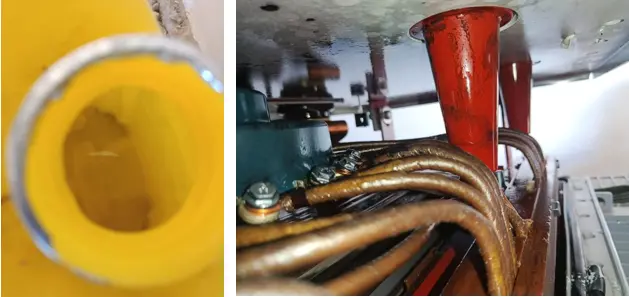
Schematic Diagram for Inspection of Transformer Active Part and Transformer Oil
The transformer interior forms a composite insulation system consisting of "oil + solid insulating paper/insulating boards."
The relative permittivity (dielectric constant) of transformer oil is approximately 2.2, that of insulating paper is about 4.0, and that of air is about 1.0.
In an AC electric field, the electric field stress distribution is inversely proportional to the dielectric constant. When the oil level drops or air gaps form, the gas with the smallest dielectric constant ends up bearing the highest electric field stress.
This ionizes the gas in the exposed regions, generating intense partial discharge (PD). The high-energy electrons, ultraviolet radiation, and chemical byproducts produced by PD continuously erode the surrounding solid insulation, eventually leading to a through-wall breakdown.
Oil deficiency is not just an insulation issue—it is also a serious thermodynamic problem.
Transformers rely on natural convection or forced circulation of oil to carry heat from the core and windings to the radiators for dissipation.
Oil deficiency can interrupt or significantly reduce the efficiency of oil circulation. Windings exposed above the oil surface lose their liquid cooling entirely, causing temperatures to rise sharply and creating severe localized hot spots.
Solid insulating paper (cellulose) is highly temperature-sensitive. Prolonged high temperatures accelerate thermal aging, embrittlement, and even carbonization. Carbonized insulation paper loses its insulating properties, becomes semiconductive, and can easily lead to turn-to-turn or layer-to-layer short circuits.
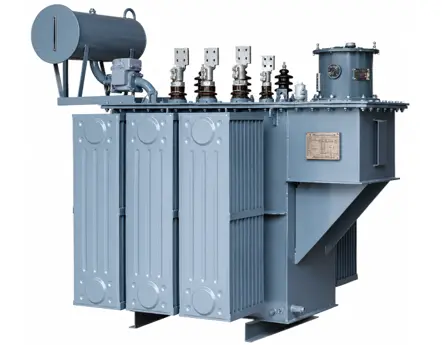
Vziman S Series Oil-Immersed Power Transformers
Transformer oil itself acts as a moisture barrier between the solid insulation and the external environment.
Insulating paper is highly hygroscopic. When windings are exposed to the air space above the oil level, they readily absorb moisture from the gas in that space.
Moisture is a critical weakness for insulation materials—it significantly reduces the insulation resistance of paper, increases leakage current, and further lowers the discharge inception voltage.
For transformers equipped with tap changers (especially on-load tap changers), arcing occurs during switching operations and relies on insulating oil for rapid arc extinction. If oil deficiency affects the tap-changer compartment, the arc cannot be effectively quenched. This not only burns the contacts but can also cause explosions in the surrounding oil–gas mixture, compromising the transformer's overall insulation structure.
Transformer oil deficiency directly deprives the equipment of its "high-dielectric medium" and "coolant," leading to concentrated electric field discharge and severe high-temperature thermal aging. For this reason, oil-immersed transformers are equipped with oil level gauges for monitoring and are fitted with Buchholz (gas) relays—when the oil level drops excessively, the float triggers a "light gas" alarm. If the oil loss continues to a critical level, a "heavy gas" trip will directly disconnect the transformer from the power supply to prevent complete insulation collapse.
We have discussed the insulation, thermal, and lifespan risks caused by transformer oil deficiency. The Vziman transformer effectively avoids these issues. Its fully sealed structure eliminates oil leakage, ensuring that insulation strength remains consistently reliable. Through optimized low-loss design and efficient heat dissipation, it reduces overheating risks at the source. Strict process control ensures low partial discharge levels, and together with high-quality materials, it provides enhanced long-term reliability for the equipment.
Edited From:Felix Spark








 Login

